
Lessons can be read in English and Japanese. Read whichever you prefer!
レッスンは英語と日本語で読めます。お好きな方をお読みください!
English Lesson

Hello, everyone!
How did your last lesson go?
Many of the Katakana studied in the last lesson had similar shapes. Have you looked at the shapes carefully and practised writing them in the stroke order?
Little by little, practise writing in the correct stroke order! The stroke order is important for good writing.
I’m doing Katakana lessons with you all at the moment, so I wrote a blog post about Katakana. It introduces the origins and usage of Katakana, which I didn’t explain in the lesson. I think you’ll find it useful, so have a read if you like!
And if you like, you can try our Hiragana word search!
That’s all for the news. Let’s study Katakana together again this time!
First, check the answers to the quiz and homework questions from the previous lesson.
If you do not need to see the answers to the quiz and homework questions, click on ‘Skip quiz and homework answers’ below.
→ Skip quiz and homework answers
What did you think of the last matching quiz? It might have been a bit difficult because of the similar Katakana. Check your answers below!
Katakana Quiz 4: Make pairs of Hiragana and Katakana.

The table above shows the answers. The shapes of the Katakana シ and ツ are very similar. Be careful not to confuse them when writing or reading!
The Katakana セ is easy to remember because it is similar to the Hiragana せ. But be careful not to mistake Katakana for Hiragana.
In the quiz font, the shape of the タ differs slightly from the writing order table in the lesson. The Katakana in the stroke order chart is in the textbook font, which is closer to Japanese handwritten characters. Although the differences are very small, look carefully at the Katakana in the stroke order chart and practise.
Katakana Quiz 5: Read the Katakana words below.
- スーツ [suutsu]
- ソテー [sotee]
- セーター [seetaa]
- カード [kaado]
- サッカー [sakkaa]
The red letters are the answers. Accents were not studied in the lesson, so look at the answers to learn them. The accents are in bold.
As you can see, the accent in Katakana words is usually at the beginning of the word.
Katakana Quiz 6: Write the Hiragana words below in Katakana.
- しーつ シーツ
- ぎたー ギター
- だいえっと ダイエット
- てすと テスト
- あじあ アジア
Did you get all of them right? シーツ, number 1, was quizzed to practise シ and ツ. It’s okay if you don’t write well at first. Try to write carefully.
Number 3, ダイエット, uses ‘ ゛’ and a small ツ. I think this was a little difficult. Well done to everyone who got it right!
Next, check your homework answers!
| 1 | おいしい | 2 | あそこ | 3 | たかい | 4 | つくえ | 5 | かさ |
| オイシイ | アソコ | タカイ | ツクエ | カサ | |||||
| 6 | おとこ | 7 | おかし | 8 | せかい | 9 | ちかく | 10 | けさ |
| オトコ | オカシ | セカイ | チカク | ケサ |
Did you write everything correctly?
In fact, Katakana is sometimes used instead of difficult Kanji. I wrote about this in my blog post on Katakana I mentioned above too. So you can all write in Katakana if you don’t know the Kanji.
These are the answers to the homework questions.
If you find it difficult to remember Katakana characters, practise reading them first. If you can see the Katakana characters and know how to pronounce them, you will be fine.
Some people are good at remembering, others are not so good at remembering. You should study at your own pace and take your time, without worrying about the pace of others.
In my opinion, the three most important things to remember when studying are the following.
- Never give up and keep going
- Practise repeatedly
- Study at your own pace and enjoy yourself
Study when you want to study. Take a break when you are tired. It’s obvious, but don’t forget it. Even if you can’t see the results now, if you keep trying you will definitely feel it one day!
Let’s start this Katakana lesson!
In this lesson you will study Katakana from ナ to ホ. If you have a textbook, please look at page 28 of the second edition textbook / page 24 of the third edition textbook. There is a Katakana table.
If you don’t have a textbook, you don’t need to look at anything. I will explain it to you, so let’s study together!
Katakana from ナ to ノ
Many of the Katakana characters from ナ to ノ are simple. Many of the shapes resemble symbols, so it’s a good idea to remember them by using the image of the symbols.
Below you will find Katakana stroke order charts and notes. Remember the forms of Hiragana with the same pronunciation, and learn them in pairs!

It resembles the shape of a cross, but the tip bends slightly to the left.

It is easy to learn because it is simple, isn’t it?
Similar to the ‘=’ symbol, but the Katakana ニ has a longer bottom line than the top line.
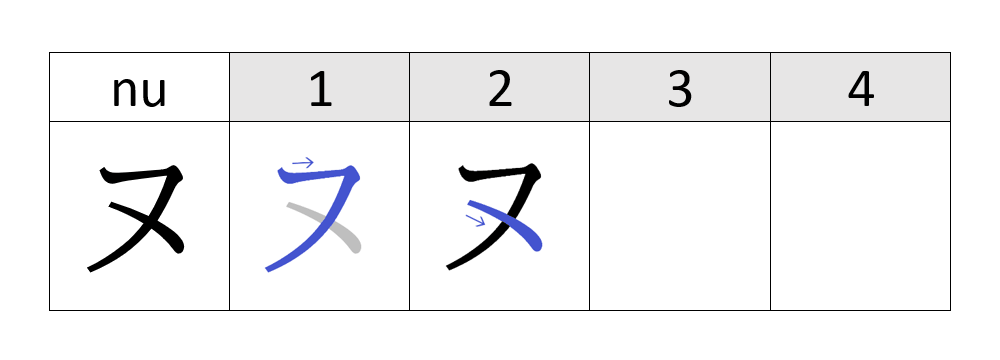


The form of ネ is a little unique, but I think all the other Katakana are easy.
Katakana from ハ to ホ
The Katakana ハ to ホ is also very easy.

The left line of the letter ハ is written like the Katakana ノ, while the right line is drawn straight from top left to bottom right and stopped. In the Kanji 八, the tips of both lines are bent outwards so that the bottom is open, whereas this is not the case with the Katakana ハ.
Look carefully at the shapes and practise!


It is good that ヘ has the same form as Hiragana. Although the other Katakana forms are completely different from Hiragana, they are easy enough to learn!
By the way, have you noticed that all 46 basic characters, both Hiragana and Katakana, can be written in up to four strokes?
Katakana Quiz: Katakana from ア to ホ
Now it’s quiz time, for fun!
The questions in this quiz are about the Katakana characters from ア to ホ.
The pattern of the quiz is the same as usual. Let’s review Hiragana and learn Katakana through matching quizzes!
Answers to the quiz will be explained, as usual, at the beginning of the next lesson.
Are you all ready?
When you’re ready, take the quiz below!
Katakana Quiz 7: Make pairs of Hiragana and Katakana.

Katakana Quiz 8: Read the Katakana words below.
- ノート
- ビジネス
- インターネット
- バナナ
- ページ
Katakana Quiz 9: Write the Hiragana words below in Katakana.
- あぱーと
- こーひー
- すぽーつ
- しぇふ
- ぱーてぃー
That’s it for the quiz! Thank you for your hard work as always!
If you have any questions, please leave a message using the contact form!
Homework
Finally, there is homework.
If you have a workbook, practise Katakana in the workbook. The homework for the second edition workbook is on page 126, and for the third edition workbook on page 130.
If you don’t have a workbook, first write the Katakana you studied in this lesson ten times each. You can also review Hiragana by writing Hiragana and Katakana in pairs, as in the quiz above.
Next, try writing the word below in Katakana!
| 1 | すーぱー | 2 | てにす | 3 | びーふ | 4 | ふぉーく | 5 | おーなー |
| 6 | ぱすぽーと | 7 | ねいてぃぶ | 8 | のいず | 9 | かぬー | 10 | ぺっと |
And if you’ve got workbook homework to do, by all means give it a go as extra practice! It’s all about lots of practice!
All the words in the quizzes and the homework are words that are commonly used in everyday life. My original homework is a bit difficult, but it’s good practice.
Recently, Katakana words have increased in the Japanese language. Try looking in the dictionary for words using Katakana that you have studied so far. There are lots of them!
Well, that’s the end of this lesson.
There are two more Katakana lessons. We are almost at the end of our study of characters other than Kanji.
Probably, Japanese language schools don’t do much Hiragana and Katakana practice in class. At my school, Hiragana and Katakana practice was homework.
Students who study a lot at home are fine. But some students are too busy to study or don’t know how.
So I decided to start with lessons in Hiragana and Katakana. And because it is hard to learn so many at once, I always limited the number of characters I teach in one lesson to 10.
Some of you who do well may find it boring because it is slow. It is good to be able to learn Hiragana and Katakana easily. So if the lessons are too easy, give yourself lots of practice. Needless to say, those who willingly study a lot improve their Japanese quickly.
There are only a few more Katakana lessons left. Let’s work together until the end!
Thank you for reading!
See you in the next lesson!
For more Katakana lessons, click here!

Click here to go to our Hiragana and Katakana practice pages!


日本語(にほんご)のレッスン

みなさん、こんにちは!
前回(ぜんかい)のレッスンは、どうでしたか。
前回(ぜんかい)勉強(べんきょう)したカタカナは、形(かたち)が似(に)ているものがたくさんありました。書(か)き順(じゅん)と形(かたち)に注意(ちゅうい)して、練習(れんしゅう)しましたか。
少(すこ)しずつでいいので、正(ただ)しい書(か)き順(じゅん)で書(か)けるように練習(れんしゅう)しましょう!カタカナを上手(じょうず)に書(か)くためには、正(ただ)しい書(か)き順(じゅん)で書(か)くことが大事(だいじ)です。
今(いま)みなさんとカタカナのレッスンをしているので、カタカナについてのブログの記事(きじ)を書(か)きました。レッスンでは説明(せつめい)していないことも、紹介(しょうかい)しています。よかったら、読(よ)んでみてください!
よかったら、ひらがなワードサーチも挑戦(ちょうせん)してみてください!
ニュースは以上(いじょう)です。今回(こんかい)もカタカナの勉強(べんきょう)を一緒(いっしょ)にがんばりましょう!
まずは、前回(ぜんかい)のレッスンのクイズと宿題(しゅくだい)の答(こた)えをチェックします。
クイズと宿題(しゅくだい)の答(こた)えを見(み)なくてもいい人(ひと)は、下(した)の「クイズと宿題(しゅくだい)の答(こた)えをスキップ」をクリックしてください。
前回(ぜんかい)のマッチングクイズはどうでしたか。似(に)ているカタカナがあったので、少(すこ)し難(むずか)しかったかもしれませんね。下(した)で、答(こた)えをチェックしましょう!
カタカナクイズ④:ひらがなとカタカナのペアを作(つく)りましょう。
上(うえ)の表(ひょう)が答(こた)えです。「シ」と「ツ」は形(かたち)がとてもよく似(に)ています。書(か)く時(とき)も読(よ)む時(とき)も、間違(まちが)えないように気(き)を付(つ)けましょう!
カタカナの「セ」は、ひらがなの「せ」に似(に)ているので、覚(おぼ)えやすいと思(おも)います。でも、カタカナとひらがなを間違(まちが)えないように注意(ちゅうい)してください。
クイズのフォントでは、「タ」の形(かたち)がレッスンの書(か)き順(じゅん)の表(ひょう)と少(すこ)し違(ちが)います。書(か)き順(じゅん)の表(ひょう)のカタカナが、教科書(きょうかしょ)のフォントです。日本人(にほんじん)は教科書(きょうかしょ)のフォントでひらがなとカタカナを練習(れんしゅう)します。
とても小(ちい)さい違(ちが)いですが、書(か)き順(じゅん)の表(ひょう)のカタカナをよく見(み)て、練習(れんしゅう)しましょう。
カタカナクイズ⑤:下(した)のカタカナの単語(たんご)を読(よ)んでください。
- スーツ [suutsu]
- ソテー [sotee]
- セーター [seetaa]
- カード [kaado]
- サッカー [sakkaa]
赤(あか)い文字(もじ)が答(こた)えです。アクセントはレッスンで勉強(べんきょう)しなかったので、答(こた)えを見(み)て覚(おぼ)えましょう。アクセントは太(ふと)い文字(もじ)のところです。
カタカナの単語(たんご)のアクセントは、たいてい単語(たんご)の最初(さいしょ)にあります。
カタカナクイズ⑥:下(した)のひらがなの単語(たんご)をカタカナで書(か)いてください。
- しーつ シーツ
- ぎたー ギター
- だいえっと ダイエット
- てすと テスト
- あじあ アジア
全部(ぜんぶ)正(ただ)しく書(か)けましたか。一番(いちばん)の「シーツ」は、「シ」と「ツ」の練習(れんしゅう)のためにクイズにしました。最初(さいしょ)は上手(じょうず)に書(か)けなくても大丈夫(だいじょうぶ)です。ていねいに書(か)きましょう。
三番(さんばん)の「ダイエット」は「゛」と小(ちい)さい「ツ」があります。少(すこ)し難(むず)しかったですね。正(ただ)しく書(か)けたみなさんは、すごいですよ!よくできました!
次(つぎ)に、宿題(しゅくだい)の答(こた)えをチェックしましょう!
| 1 | おいしい | 2 | あそこ | 3 | たかい | 4 | つくえ | 5 | かさ |
| オイシイ | アソコ | タカイ | ツクエ | カサ | |||||
| 6 | おとこ | 7 | おかし | 8 | せかい | 9 | ちかく | 10 | けさ |
| オトコ | オカシ | セカイ | チカク | ケサ |
全部(ぜんぶ)正(ただ)しく書(か)けましたか。
カタカナの記事(きじ)でも少(すこ)し書(か)きましたが、カタカナは難(むずか)しい漢字(かんじ)のかわりに使(つか)うことがあります。なので、みなさんも漢字(かんじ)がわからない時(とき)は、カタカナで書(か)いてもいいですよ。
これが、宿題(しゅくだい)の答(こた)えです。
カタカナを覚(おぼ)えるのが難(むずか)しい人(ひと)は、まず読(よ)む練習(れんしゅう)をしましょう。カタカナを見(み)て、発音(はつおん)がわかれば大丈夫(だいじょうぶ)です。
覚(おぼ)えるのが得意(とくい)な人(ひと)もいるし、覚(おぼ)えるのが苦手(にがて)な人(ひと)もいます。自分(じぶん)のペースでゆっくり勉強(べんきょう)するといいですよ。
勉強(べんきょう)する時(とき)に大事(だいじ)なことは、下(した)の三(みっ)つです。
- あきらめないで続(つづ)ける
- リピート練習(れんしゅう)をする
- 自分(じぶん)のペースで楽(たの)しく勉強(べんきょう)する
勉強(べんきょう)したい時(とき)に勉強(べんきょう)しましょう。疲(つか)れたらちょっと休(やす)みましょう。少(すこ)しずつでも、続(つづ)けていれば必(かなら)ずよくなりますよ!
それでは、今回(こんかい)のカタカナのレッスンを始(はじ)めましょう!
このレッスンでは、カタカナの「ナ」から「ホ」までを勉強(べんきょう)します。教科書(きょうかしょ)がある人(ひと)は、第二版(だいにはん)の教科書(きょうかしょ)の28ページ/第三版(だいさんぱん)の教科書(きょうかしょ)の24ページを見(み)てください。カタカナの表(ひょう)があります。
教科書(きょうかしょ)がない人(ひと)は、何(なに)も見(み)なくていいです。私(わたし)が説明(せつめい)するので、一緒(いっしょ)に勉強(べんきょう)しましょう!
カタカナ「ナ」から「ノ」
カタカナの「ナ」から「ノ」は、簡単(かんたん)な文字(もじ)が多(おお)いです。記号(きごう)に似(に)ている形(かたち)が多(おお)いので、記号(きごう)のイメージで覚(おぼ)えるといいですよ。
下(した)には、カタカナの書(か)き順(じゅん)と、注意(ちゅうい)するポイントを示(しめ)します。同(おな)じ発音(はつおん)のひらがなの形(かたち)を思(おも)い出(だ)しながら、ペアで覚(おぼ)えましょう!
「+」の記号(きごう)にも似(に)ていますね。
簡単(かんたん)なので覚(おぼ)えやすいですね。
「=」の記号(きごう)に似(に)ていますが、カタカナの「二」は下(した)の線(せん)が上(うえ)の線(せん)より長(なが)いです。
「ネ」が少(すこ)しユニークですが、他(ほか)のカタカナは全部(ぜんぶ)簡単(かんたん)だと思(おも)います。
カタカナ「ハ」から「ホ」
カタカナの「ハ」から「ホ」も簡単(かんたん)ですよ。
左(ひだり)の線(せん)は、「ノ」のように書(か)きます。でも、右(みぎ)の線(せん)は、下(した)で線(せん)を止(と)めます。なので、「八(はち)」のように下(した)が開(ひら)きません。
形(かたち)をよく見(み)て練習(れんしゅう)しましょう!
「へ」がひらがなと同(おな)じ形(かたち)なのは、いいですよね。その他(ほか)のカタカナはひらがなと全然(ぜんぜん)形(かたち)が違(ちが)いますが、簡単(かんたん)なのですぐに覚(おぼ)えられますよ!
ところで、ひらがなもカタカナも、基本(きほん)の46文字(もじ)は全部(ぜんぶ)書(か)き順(じゅん)が1から4までなんですよ。みなさんは、気(き)が付(つ)きましたか。
カタカナクイズ:カタカナ「ア」から「ホ」
それでは、クイズタイム!
今回(こんかい)のクイズは、カタカナの「ア」から「ホ」までです。
今回(こんかい)もクイズのパターンは同(おな)じです。マッチングクイズでひらがなを復習(ふくしゅう)しながら、カタカナも覚(おぼ)えましょう!
クイズの答(こた)えは、いつものように次(つぎ)のレッスンの最初(さいしょ)で説明(せつめい)します。
みなさん、準備(じゅんび)はいいですか。
準備(じゅんび)ができたら、下(した)のクイズに挑戦(ちょうせん)してみてください!
カタカナクイズ⑦:ひらがなとカタカナのペアを作(つく)りましょう。
カタカナクイズ⑧:下(した)のカタカナの単語(たんご)を読(よ)んでください。
- ノート
- ビジネス
- インターネット
- バナナ
- ページ
カタカナクイズ⑨:下(した)のひらがなの単語(たんご)をカタカナで書(か)いてください。
- あぱーと
- こーひー
- すぽーつ
- しぇふ
- ぱーてぃー
クイズは以上(いじょう)です!おつかれさまでした!
何(なに)か質問(しつもん)があったら、お問(と)い合(あ)わせフォームからメッセージをお願(ねが)いします!
宿題(しゅくだい)
最後(さいご)に、宿題(しゅくだい)です。
ワークブックがある人(ひと)は、ワークブックにあるカタカナの練習(れんしゅう)をしましょう。第二版(だいにはん)のワークブックは126ページ、第三版(だいさんぱん)のワークブックは130ページが宿題(しゅくだい)です。
ワークブックがない人(ひと)は、まずこのレッスンで勉強(べんきょう)したカタカナを10回(かい)ずつ書(か)いてください。上(うえ)のクイズのように、ひらがなとカタカナをペアで書(か)くと、ひらがなの復習(ふくしゅう)にもなりますよ。
次(つぎ)に、下(した)の単語(たんご)を、カタカナで書(か)いてみましょう!
| 1 | すーぱー | 2 | てにす | 3 | びーふ | 4 | ふぉーく | 5 | おーなー |
| 6 | ぱすぽーと | 7 | ねいてぃぶ | 8 | のいず | 9 | かぬー | 10 | ぺっと |
ワークブックの宿題(しゅくだい)がある人(ひと)も、よかったら挑戦(ちょうせん)してみてください!たくさん練習(れんしゅう)するのが大事(だいじ)ですよ!
クイズや宿題(しゅくだい)の単語(たんご)は、全部(ぜんぶ)よく使(つか)う単語(たんご)です。宿題(しゅくだい)は少(すこ)し難(むずか)しいですが、いい練習(れんしゅう)ですよ。
最近(さいきん)、日本語(にほんご)にはカタカナの単語(たんご)が増(ふ)えています。辞書(じしょ)で、これまでに勉強(べんきょう)したカタカナを使(つか)った単語(たんご)を探(さが)してみてください。たくさんありますよ!
それでは、今回(こんかい)のレッスンはこれで終(お)わりです。
カタカナのレッスンはあと2回(かい)です。もう少(すこ)しでひらがなとカタカナの文字(もじ)の勉強(べんきょう)も終(お)わりですね。
たぶん、日本語(にほんご)の学校(がっこう)では、クラスでひらがなとカタカナの練習(れんしゅう)をたくさんしないと思(おも)います。私(わたし)の学校(がっこう)では、ひらがなとカタカナの練習(れんしゅう)は宿題(しゅくだい)でした。
家(いえ)でたくさん勉強(べんきょう)する学生(がくせい)は、大丈夫(だいじょうぶ)です。でも、忙(いそが)しくて勉強(べんきょう)できない学生(がくせい)もいるし、どうやって勉強(べんきょう)するかわからない学生(がくせい)もいると思(おも)います。
なので、私(わたし)はひらがなとカタカナのレッスンを最初(さいしょ)にしました。そして、たくさん覚(おぼ)えるのは大変(たいへん)なので、勉強(べんきょう)する文字(もじ)はいつも10個(こ)までにしました。
ゆっくりなのでつまらない人(ひと)もいると思(おも)います。ひらがなやカタカナを簡単(かんたん)に覚(おぼ)えられるのは、とてもいいことです。なので、もしレッスンが簡単(かんたん)すぎたら、自分(じぶん)でたくさん練習(れんしゅう)を増(ふ)やしましょう。たくさん勉強(べんきょう)すれば、日本語(にほんご)が早(はや)く上手(じょうず)になりますよ!
カタカナのレッスンもあと少(すこ)しです。最後(さいご)まで一緒(いっしょ)にがんばりましょう!
最後(さいご)までお読(よ)みくださり、ありがとうございます!
次(つぎ)のレッスンで 、お会(あ)いしましょう!
他(ほか)のカタカナのレッスンはこちらからどうぞ!
ひらがなとカタカナの練習(れんしゅう)のページはこちらです!

