
Lessons can be read in English and Japanese. Read whichever you prefer!
レッスンは英語と日本語で読めます。お好きな方をお読みください!
English Lesson

Hello, everyone!
Since last time, we have started studying Lesson 4 of GENKI 1.
We used a lot of new words, didn’t we? Have you learnt the words yet?
It is difficult to learn a lot of words at once, so it is best to learn them little by little.
Practise using them with the sentence patterns you have studied, and read and write a lot.
It is better to practise a few words each day than a lot in one day.
When writing words, pronounce them as you write them.
You will learn the word and its pronunciation as a set.
The new words we will study this time are words that indicate the location and direction of objects.
All of these words are used very often.
They are easy to learn, so please learn them and use them a lot.
Now, before we start the lesson, I would like to announce the answers to the previous lesson’s homework.
I have made a Word document and a PDF file, which you can download if you want to see the answers!
Answers to Lesson 34 homework
Next, I will announce the answers to the previous summary quiz.
If you don’t need to see the answers to the quiz, please skip it.
In the previous lesson, we studied the difference between the verbs ある and いる.
All you have to do is remember the simple rules explained in the lesson, so you won’t make any more mistakes between ある and いる.
Check your answers to the quiz and do a little revision!
Quiz 1: Choose the correct verb.
- 大学(だいがく)にイギリス人(じん)の留学生(りゅうがくせい)が(
あります/ います)。 - 私(わたし)の町(まち)にデパートが(
いません/ ありません)。 - うちに日本語(にほんご)の本(ほん)が(あります /
います)。 - うちに猫(ねこ)が(います /
あります)。でも、犬(いぬ)が(ありません/ いません)。 - クラスに時計(とけい)が(
いますか/ ありますか)。
The verb ある is used with objects and plants.
The verb いる is used with people, animals and insects.
Just remember the rules above!
Quiz 2: Answer the questions.
- あなたのうちにテレビがありますか。
Example: はい、あります。 - 月曜日(げつようび)に何(なに)がありますか。
Example: 日本語(にほんご)のクラスがあります。 - 本屋(ほんや)に何(なに)がありますか。
Example: 本(ほん)があります。 - デパートに誰(だれ)がいますか。
Example: 人(ひと)がいます。 - あなたの町(まち)に何(なに)がいますか。
Example: 犬(いぬ)がいます。
Questions using the interrogative 何(なに) should be answered by paying attention to the verb.
The answer to the question 何(なに)がありますか is (thing / plant) があります.
When asking about an event, you can say: (event) があります.
The question 何(なに)がいますか is about the presence of animals and insects.
So, answer: (animal / insect) がいます.
When asking about someone, the question word is 誰(だれ), not 何(なに)!
Let’s have a look at the Contents of this lesson in illustration!
Contents of this lesson

Emma and John are in John’s room.
John is explaining where things are in his room.
This time we will study expressions using location words written in blue in the examples.
Look carefully at the location of the object and the word and check the meaning of the word.
For the questions, we will use the question you have already studied: どこですか.
I have written only one example in red.
The sentence pattern is (noun) はどこですか.
Grammar is very simple.
First of all, let’s learn the most commonly used location words!
Explanations of the grammar we will study this time can be found in the following pages of the textbook.
| Second edition | Pages 108 and 109: 2 Describing Where Things are |
| Third edition | Pages 108 and 109: 2 Describing Where Things are |
Location words
First, let’s learn some location words!
Textbook vocabulary pages are on the following pages.
| Second edition | Page 106: Location Words |
| Third edition | Page 106: Location Words |
If you don’t have a textbook, take a look at the illustrations below.
Learn the words by moving your hands and body!
上(うえ)、下(した)、右(みぎ)、左(ひだり)

The desk in the middle is the reference point.
右(みぎ) and 左(ひだり) are usually right and left as seen from the viewpoint of yourself.
But be a little careful when talking to someone face to face.
When you say (someone) の右(みぎ)/左(ひだり), it is usually the right and left of the other person from your point of view.

However, (someone) の右(みぎ)/左(ひだり) is a little confusing.
It is easy to get confused because the literal meaning of this expression does not make it clear whether you are talking about the other person’s right/left or your own right/left.
So, if you want to clearly express that you are indicating the right/left of the other person, you can add the phrase (someone) から見(み)て (from (someone)’s point of view) and say (someone) から見(み)て右(みぎ)/左(ひだり) for clarity.
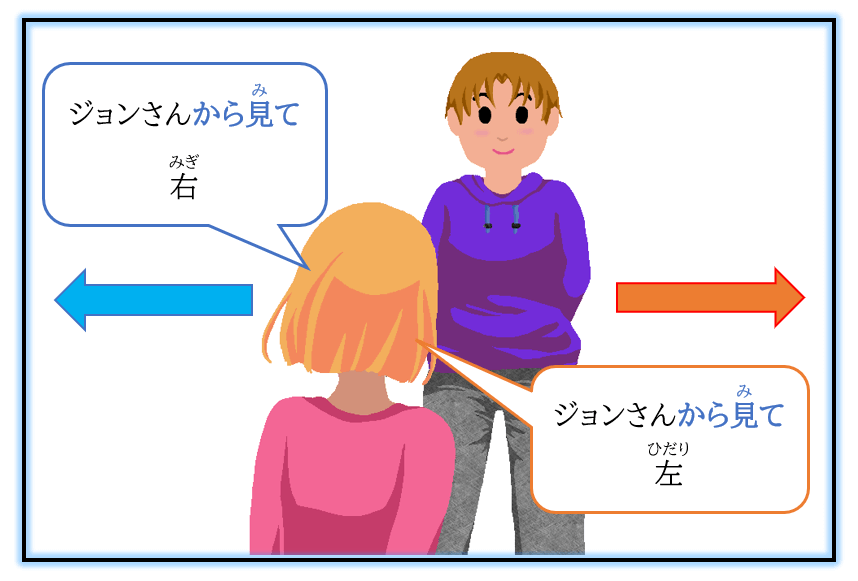
Basically, it is the same as ‘stage right/left’ in English.
Some students were confused, so I explained.
There is no problem if you always remember and use right and left as YOUR right and left.
If you are not sure, point and say そちら (that side/that way).
Now let’s check out 上(うえ), 下(した), 右(みぎ) and 左(ひだり)!
Practice
Answer the direction of the arrow.
Practise without looking in your textbook or notes!
Example: ↓
下(した)
- →, ←
- ↑, →, ↓
- ↓, ↑, →
- ←, →, ↑, ↓
- →, ↓, ←, ↑
It is easy to make a mistake between right and left, so be careful!
When you’re done, check your answers in the PDF below!
前(まえ)、後(うし)ろ、隣(となり)、間(あいだ)
There are more location words!
Look at the following illustration.
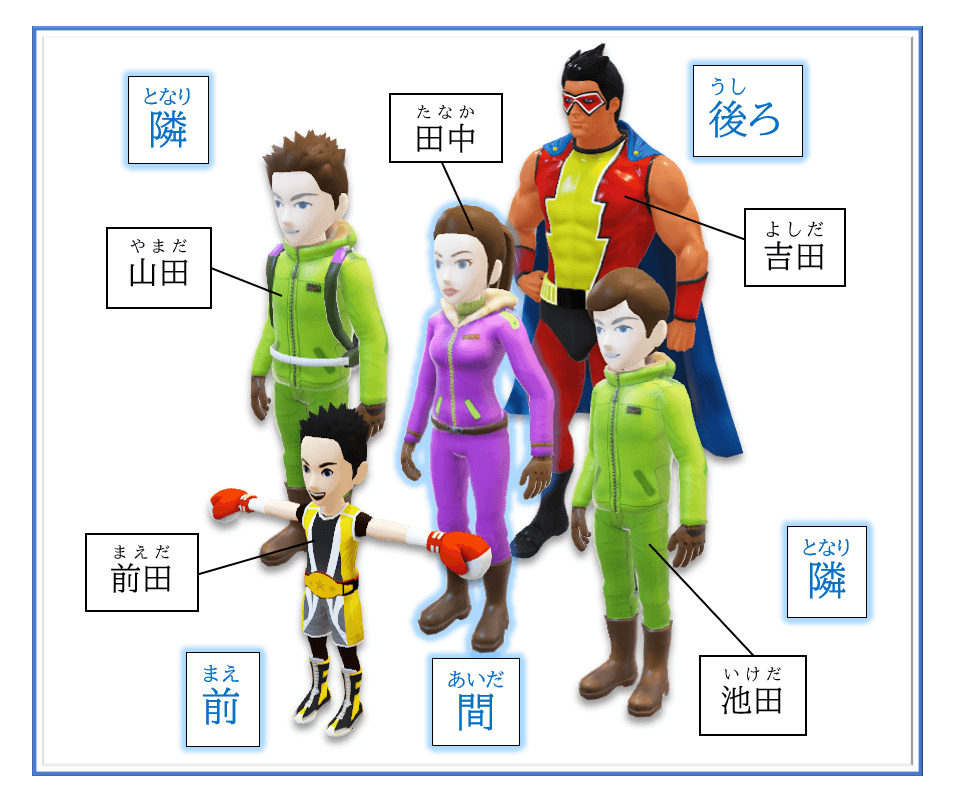
All names are common Japanese surnames.
The reference standard is 田中(たなか)さん in the middle.
隣(となり) is said to be 隣(となり) to both the right and the left sides.
The 隣(となり) to the right can be said to be 右隣(みぎどなり) and the 隣(となり) to the left 左隣(ひだりどなり).
隣(となり) is used when objects or people in the same category are standing side by side.
For example, it can be used when people or buildings are side by side, as in the illustration.
When you are not sure whether the categories are the same or not, or when you are talking about things, it is better to use 横(よこ) instead of 隣(となり).
If you have a textbook, you will find an explanation at the bottom of page 109 of the second and third editions of the textbook.
I wrote it down in case it’s explained in the textbook, but it’s not a big problem, so don’t worry too much if you get it wrong.
Now let’s take a moment to check each of the location words I’ve outlined above!
Practice
1. Write in Japanese.
Write without looking at your textbook or notes!
- front
- next
- between
- back
2. Look in the direction indicated by the location word.
(You can indicate by pointing.)
Example: 右(みぎ)
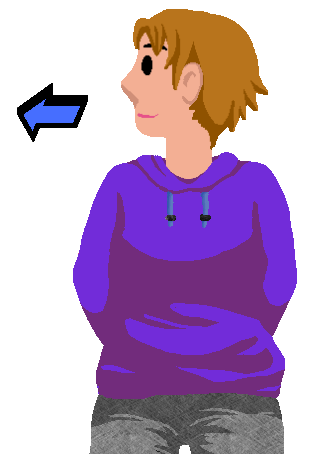
- 下(した)、隣(となり)
- 前(まえ)、後(うし)ろ
- 左(ひだり)、上(うえ)、前(まえ)
- 後ろ(うしろ)、左(ひだり)、下(した)、右(みぎ)
- 上(うえ)、前(まえ)、右(みぎ)、後(うし)ろ、下(した)、左(ひだり)
You can check the answers to exercise 1 in the PDF below!
Practice 2 is about using your body to remember the direction indicated by the location words.
Try pointing your finger or changing the direction of your body to practice!
中(なか)、近(ちか)く
Finally, just two more location words are introduced.
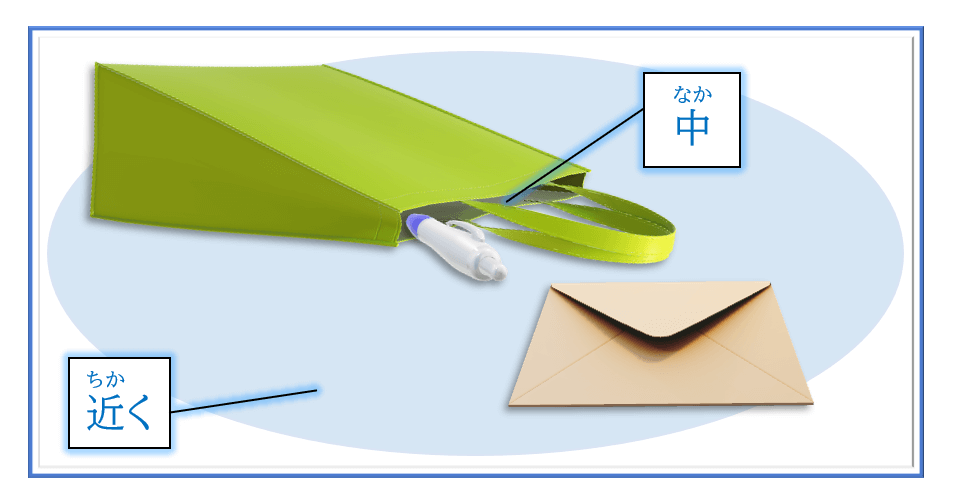
Instead of 近(ちか)く, you can say そば (by the side).
The difference between 隣(となり) and 近(ちか)く is whether people or things are lined up in a row or not.
Use 隣(となり) when they are side by side.
When they are not in a row, use 近(ちか)く.
中(なか) and 近(ちか)く are two of the easier ones and should be practised with sentence patterns later.
Sentence pattern: (subject / topic) は (noun) の (location word) です
Having introduced the location words, I will now explain the sentence patterns.
Before that, let’s review a sentence pattern using ここ/そこ/あそこ that we studied in Lesson 2 a little.
Review
Look at the illustration below and make sentences using the words ここ/そこ/あそこ.
You = Emma.

- 自転車(じてんしゃ)
- 日本語(にほんご)の本(ほん)
- 財布(さいふ)
Did you remember the sentence pattern?
Check the answers in the PDF below.
Sentence patterns using location words simply change the ここ/そこ/あそこ part of the sentence pattern (noun) はここ/そこ/あそこです that you have just reviewed into an expression using location words.
When you want to say the detailed location of an object using a location word, you can use the grammar of ‘(noun 1) の (noun 2)’, which you studied in Lesson 1, to say ‘(noun) の (location word)’.
If you combine the sentence pattern you have reviewed with a locative expression, you get: (subject / topic) は (noun) の (location word) です.
This is the sentence pattern using location words.
The negative form is (subject / topic) は (noun) の (location word) じゃないです.
You can also change じゃないです to じゃありません or ではありません.
In this sentence pattern, the position is indicated with reference to the word in the ‘(noun)’ part.
However, 間(あいだ) is the only word that cannot be used in this sentence pattern.
So let’s practise sentence patterns using 間(あいだ) later.
See illustrations and examples below.
| |
| Reference point: 机(つくえ) | Reference point: 田中(たなか)さん |
| 本(ほん)は机(つくえ)の上(うえ)です。 | 前田(まえだ)さんは田中(たなか)さんの前(まえ)です。 |
| 鞄(かばん)は机(つくえ)の右(みぎ)です。 | 山田(やまだ)さんは田中(たなか)さんの隣(となり)です。 |
| 犬(いぬ)は机(つくえ)の下(した)です。 | 池田(いけだ)さんは田中(たなか)さんの隣(となり)です。 |
| 椅子(いす)は机(つくえ)の左(ひだり)です。 | 吉田(よしだ)さんは田中(たなか)さんの後(うし)ろです。 |
|
| ペンは鞄(かばん)の中(なか)です。 |
| 手紙(てがみ)は鞄(かばん)の近(ちか)くです。 |
Did you get the sentence patterns?
Let’s get practising!
Practice
1. Look at the illustration below and make sentences.
Example: 新聞(しんぶん)
新聞(しんぶん)は机(つくえ)の上(うえ)です。

- ジーンズ
- 鞄(かばん)
- 財布(さいふ)
- 本(ほん)
- 時計(とけい)
- 傘(かさ)
- 靴(くつ)
2. Look at the illustration below and make sentences.
Example: エマさん
エマさんはゆきこさんの前(まえ)です。
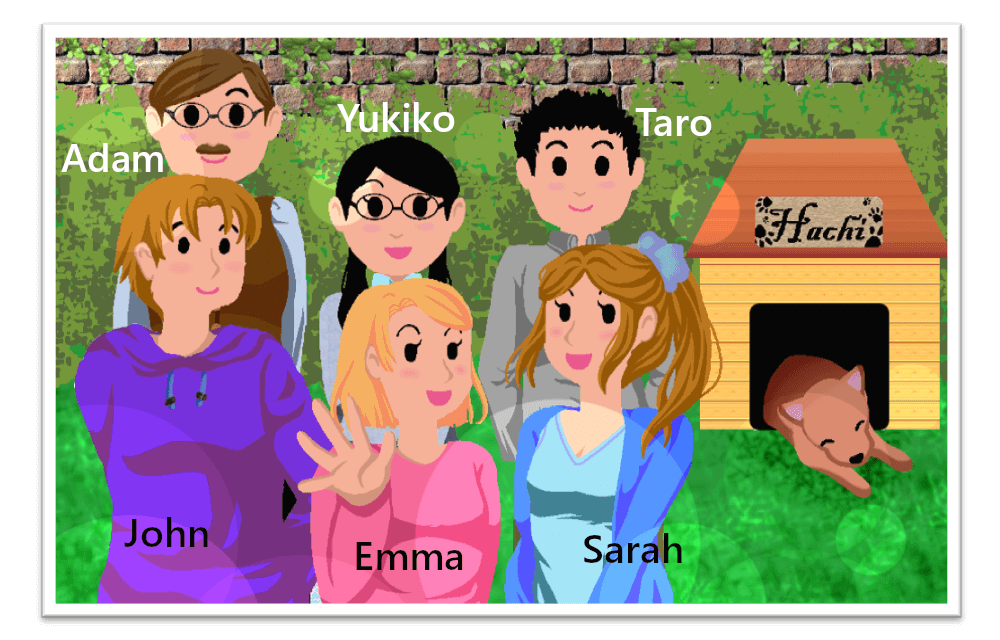
- アダムさん
- たろうさん
- ジョンさん
- サラさん
- ゆきこさん
- ハチ(犬(いぬ))
You can check the answers in the PDF below!
Sentence pattern: (subject / topic) は (noun A) と (noun B) の 間(あいだ)です
The next is a sentence pattern using 間(あいだ).
間(あいだ) indicates a thing or person in the middle between two things or two people.
So two nouns are used.
The same as the English expression ‘between A and B’, which in Japanese is A と B の間(あいだ).
The sentence pattern is: (subject / topic) は (noun A) と (noun B) の 間(あいだ)です.
間(あいだ) is usually used when something or someone is standing side by side in a row.
The word と in A と B の間(あいだ) means ‘and’, but the particle と has another meaning. Let’s study that later.
See the illustration and the example below.
|
| 田中(たなか)さんは山田(やまだ)さんと池田(いけだ)さんの間(あいだ)です。 |
Let’s have a little practice with some illustrations!
Practice
1. Look at the illustration below and make sentences using 間(あいだ).
- エマさん
- ゆきこさん
2. Look at the illustration below and make five sentences using 間(あいだ).

1.
2.
3.
4.
5.
Have you done it?
When you’re done, see the answers in the PDF below!
If you have a textbook, practice the textbook!
| Second edition | Page 117: II 図書館はどこですか A and B |
| Third edition | Page 117: II 図書館はどこですか A |
Question
Everyone, what is the question sentence pattern for (noun) はここ/そこ/あそこです?
You use the interrogative どこ to ask: (noun) はどこですか.
The same question is used in the positional sentences we are studying this time.
But this time use location words when answering.
Answers using location words other than 間(あいだ)are: (noun) の(location word) です.
In the exercises in the textbook, the phrase ‘(subject / topic) は’ is included, but you don’t have to say it.
The answer using 間(あいだ) is (noun A) と (noun B) の間(あいだ)です.
It’s easy and I’m sure everyone will be fine, but as usual I’ll summarise the questions and answers below.
質問(しつもん):(noun) はどこですか
Example: 写真(しゃしん)はどこですか。
| Location words other than 間(あいだ) | 間(あいだ) |
| (noun) の(location word) です | (noun A) と (noun B) の間(あいだ)です |
| 机(つくえ)の上(うえ)です。 | 本(ほん)と時計(とけい)の間(あいだ)です。 |
There is another question form that only requires か at the end of the affirmative statement.
This question is always answered with a はい or いいえ.
| 質問(しつもん) | 答(こた)え |
| (subject / topic) は (noun) の (location word) ですか Example 1: 本(ほん)は机(つくえ)の上(うえ)ですか。 Example 2: 本(ほん)は机(つくえ)の下(した)ですか。 | はい、そうです。 いいえ、(noun) の (location word) じゃないです。 Example 1: はい、そうです。 Example 2: いいえ、机(つくえ)の下(した)じゃないです。 |
| (subject / topic) は (noun A) と (noun B) の 間(あいだ)ですか Example 1: 本(ほん)は時計(とけい)と写真(しゃしん)の 間(あいだ)ですか。 Example 2: 本(ほん)は花(はな)と写真(しゃしん)の 間(あいだ)ですか。 | はい、そうです。 いいえ、(noun A) と (noun B) の 間(あいだ)じゃないです。 Example 1: はい、そうです。 Example 2: いいえ、花(はな)と写真(しゃしん)の 間(あいだ)じゃないです。 |
Then let’s practise!
Practice
1. Look at the illustration below and answer the questions.
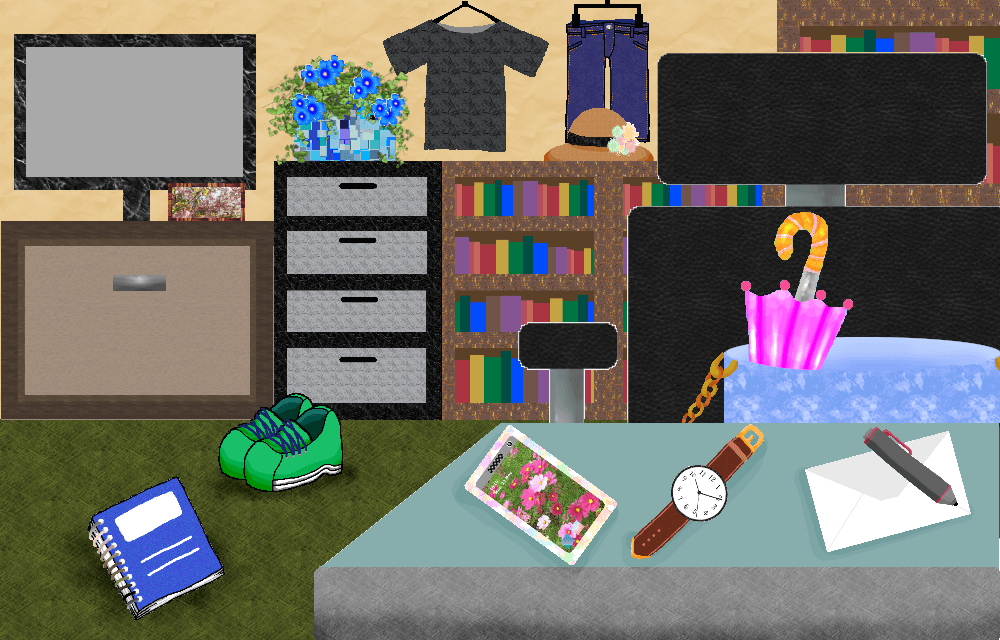
- 時計(とけい)はスマホと手紙(てがみ)の間(あいだ)ですか。
- 靴(くつ)はどこですか。
- 傘(かさ)はどこですか。
- ペンはどこですか。
- 帽子(ぼうし)はジーンズの右(みぎ)ですか。
- ノートはどこですか。
- スマホはどこですか。
- 手紙(てがみ)はどこですか。
- Tシャツはどこですか。
- 花(はな)はどこですか。
2. Answer the following questions about your room.
- 机(つくえ)はどこですか。
- 椅子(いす)はどこですか。
- 鉛筆(えんぴつ)はどこですか。
- 本(ほん)はどこですか。
- 鞄(かばん)はどこですか。
Check out the PDF below for the answers!
If you have a textbook, practice using it too!
Practice C in the second edition and B and C in the third edition are pair work.
You can practise the questions and answers yourself!
| Second edition | Page 118: C |
| Third edition | Page 117: B Page 118: C |
Remember this too!
In the textbook, only the sentence patterns explained above are practised, but you can also combine the ある and いる sentence patterns studied in the previous lesson with the location words.
See the illustration and examples below.

机(つくえ)の上(うえ)に手紙(てがみ)があります。
子供(こども)とお母(かあ)さんの間(あいだ)に犬(いぬ)がいます。
The sentence patterns for the verbs ある and いる are (place) に (thing / plant) があります and (place) に (person / animal / insect) がいます.
The ‘(place)’ part of these sentence patterns is changed to an expression using location words.
The verb ある is used with objects and plants, so it is also used in this sentence pattern to indicate the location of objects and plants.
On the other hand, the verb いる is used with people and animals, so it is used to indicate the position of a person or animal.
Questions use the verb ある and いる question sentence patterns.
Of course, adding a か at the end of a sentence makes it a question that can be answered with はい or いいえ.
Below is a summary of sentence patterns and examples.
Sentence pattern
| Sentence pattern with ある | Sentence pattern with いる |
| (noun) の (location word) に (thing / plant) があります | (noun) の (location word) に (person / animal / insect) がいます |
| Example: 机(つくえ)の上(うえ)に本(ほん)があります。 | Example: 机(つくえ)の下(した)に猫(ねこ)がいます。 |
Questions and Answers
| 質問(しつもん) | 答(こた)え |
| (noun) の (location word) に (thing / plant) がありますか | はい、あります いいえ、ありません |
| Example: 机(つくえ)の上(うえ)に本(ほん)がありますか。 | はい、あります。 |
| (noun) の (location word) に何(なに)がありますか | (thing / plant) があります |
| Example: 机(つくえ)の上(うえ)に何(なに)がありますか。 | 本(ほん)があります。 |
| (noun) の (location word) に (person / animal / insect) がいますか | はい、います いいえ、いません |
| Example: 机(つくえ)の下(した)に犬(いぬ)がいますか。 | いいえ、いません。 |
| (noun) の (location word) に何(なに)がいますか | (animal / insect) がいます |
| Example: 机(つくえ)の下(した)に何(なに)がいますか。 | 猫(ねこ)がいます。 |
| (noun) の (location word) に誰(だれ)がいますか | (person) がいます |
| Example: 家(いえ)の中(なか)に誰(だれ)がいますか。 | 私(わたし)がいます。 |
It is more difficult than the sentence patterns you studied in your textbook, but you will use it often.
So it’s good to learn them!
Let’s have a bit of practice!
Practice
1. Look at the illustration below and say where the objects, animals and people are as shown in the example.
Example: 魚(さかな)
机(つくえ)の上(うえ)に魚(さかな)がいます。
- 猫(ねこ)
- ペン
- 花(はな)
- 写真(しゃしん)
- 子供(こども)
2. Look at the illustration below and answer the questions.
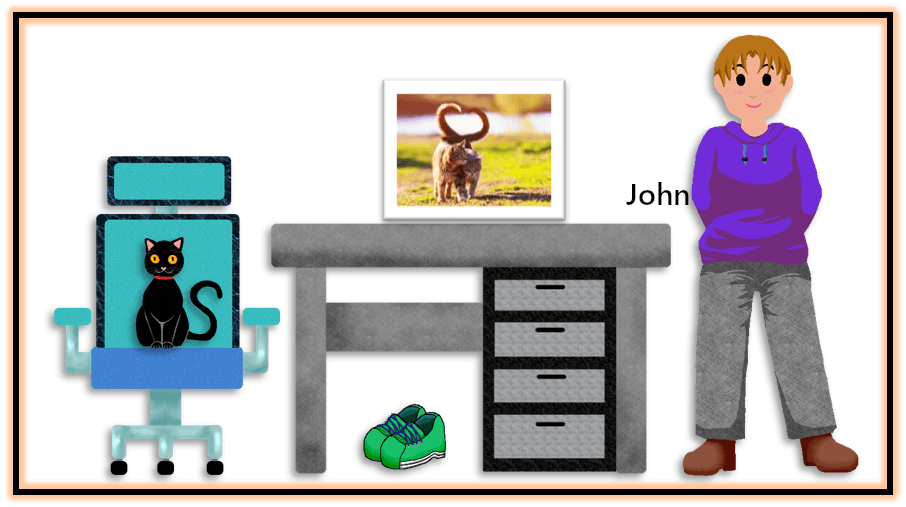
- 机(つくえ)の左(ひだり)に何(なに)がありますか。
- 机(つくえ)の下(した)に何(なに)がありますか。
- 椅子(いす)の上(うえ)に何(なに)がいますか。
- 机(つくえ)の上(うえ)に何(なに)がありますか。
- 机(つくえ)の右(みぎ)に誰(だれ)がいますか。
You can check the answers in the PDF below!
Summary quiz
We used a lot of location words this time.
The sentence patterns and questions were very easy.
At the end, summarise the lesson with a quiz!
Quiz 1: Look at the illustration below and answer the questions.
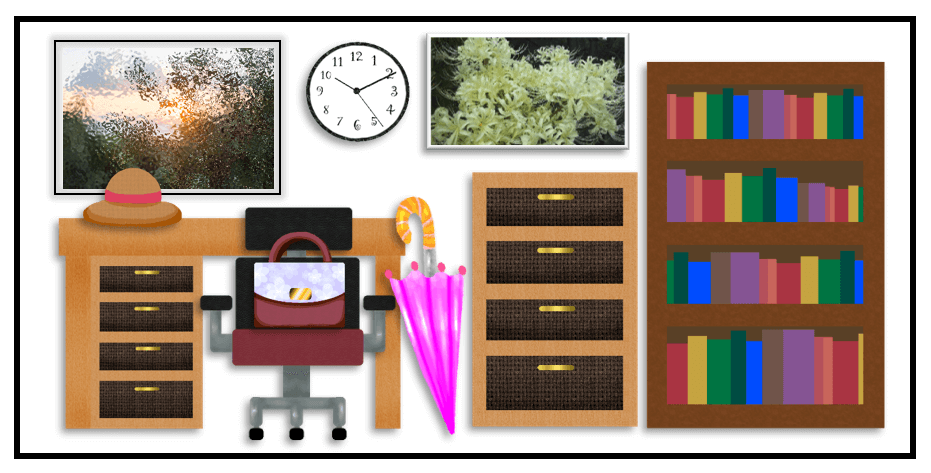
- 時計(とけい)はどこですか。
- 鞄(かばん)はどこですか。
- 写真(しゃしん)はどこですか。
- 傘(かさ)はどこですか。
- 帽子(ぼうし)はどこですか。
Quiz 2: Answer the following questions.
- あなたのスマホはどこですか。
- あなたのペンはどこですか。
- あなたの靴(くつ)はどこですか。
- あなたの財布(さいふ)はどこですか。
- あなたのTシャツはどこですか。
That’s it for the quiz!
Thank you to everyone who took the quiz! Answers will be announced in the next lesson.
If you have any questions, please leave a message using the contact form!
Homework
The workbook homework is on the following pages.
| Second edition | Page 37 |
| Third edition | Page 42 |
If you don’t have a workbook, do the homework below.
Download the Word or PDF version whichever you prefer!
Even if you have workbook homework to do, give it a go!
Check the answers in the workbook by looking at the answer book.
Answers to original homework assignments will be presented in the next lesson.
If you have any thoughts about the lessons or homework, please tell me!
Use location words to describe things in your own house or room.
If you have friends to practise with, try playing a game of pictionary!
First, one person describes the objects in his or her room using the sentence patterns they studied this time.
Other people listen to their stories and draw a picture of the inside of the person’s room.
When you’ve drawn them all, let’s see who got it right first!
This is great practice for both the speaker and the drawer.
Let’s have fun practising and learning the location words!
In the next lesson, we will study the past tense of X は Y です.
Let’s review a little about X は Y です and ‘nounじゃないです’, which you studied in Lessons 1 and 2.
Thank you for reading!
See you in the next lesson!
There’s a note about location words on the Bookshelf page!

For more lessons from Lesson 4, click here!

Click here to go to the Hiragana and Katakana, Kanji practice pages!


日本語(にほんご)のレッスン
みなさん、こんにちは!
前回(ぜんかい)から『げんき1』の第四課(だいよんか)の勉強(べんきょう)を始(はじ)めました。
新(あたら)しい単語(たんご)をたくさん使(つか)いましたね。
みなさんはもう単語(たんご)を覚(おぼ)えましたか。
単語(たんご)を一度(いちど)にたくさん覚(おぼ)えるのは難(むずか)しいので、少(すこ)しずつ覚(おぼ)えるといいです。
勉強(べんきょう)した文型(ぶんけい)と一緒(いっしょ)に使(つか)って練習(れんしゅう)したり、たくさん読(よ)んだり書(か)いたりしましょう。
単語(たんご)の練習(れんしゅう)は一日(いちにち)にたくさんするより毎日(まいにち)少(すこ)しずつした方(ほう)がいいです。
単語(たんご)を書(か)く時(とき)は、発音(はつおん)しながら書(か)きましょう。
単語(たんご)と発音(はつおん)をセットで覚(おぼ)えられますよ。
今回(こんかい)勉強(べんきょう)する新(あたら)しい単語(たんご)は、物(もの)の場所(ばしょ)や方向(ほうこう)を示(しめ)す単語(たんご)です。
全部(ぜんぶ)とてもよく使(つか)う単語(たんご)です。
簡単(かんたん)なので、覚(おぼ)えてたくさん使(つか)ってくださいね。
それでは、まずレッスンの前(まえ)に前回(ぜんかい)の宿題(しゅくだい)の答(こた)えを発表(はっぴょう)します。
WordとPDFを作(つく)ったので、答(こた)えを見(み)たい人(ひと)はダウンロードしてください!
レッスン34の宿題(しゅくだい)の答(こた)え
次(つぎ)に、前回(ぜんかい)のまとめのクイズの答(こた)えを発表(はっぴょう)します。
クイズの答(こた)えを見(み)なくてもいい人(ひと)は、スキップしてください。
前回(ぜんかい)は動詞(どうし)の「ある」と「いる」の違(ちが)いを勉強(べんきょう)しました。
レッスンで説明(せつめい)した簡単(かんたん)なルールを覚(おぼ)えるだけなので、みなさんはもう「ある」と「いる」を間違(まちが)えないですよね。
クイズの答(こた)えをチェックして、少(すこ)し復習(ふくしゅう)してみましょう!
クイズ1:正(ただ)しい動詞(どうし)を選(えら)んでください。
- 大学(だいがく)にイギリス人(じん)の留学生(りゅうがくせい)が(
あります/ います)。 - 私(わたし)の町(まち)にデパートが(
いません/ ありません)。 - うちに日本語(にほんご)の本(ほん)が(あります /
います)。 - うちに猫(ねこ)が(います /
あります)。でも、犬(いぬ)が(ありません/ いません)。 - クラスに時計(とけい)が(
いますか/ ありますか)。
動詞(どうし)の「ある」は、物(もの)や植物(しょくぶつ)と一緒(いっしょ)に使(つか)います。
動詞(どうし)の「いる」は、人(ひと)や動物(どうぶつ)、虫(むし)と一緒(いっしょ)に使(つか)います。
上(うえ)のルールを覚(おぼ)えておけば大丈夫(だいじょうぶ)です!
クイズ2:質問(しつもん)に答(こた)えましょう。
- あなたのうちにテレビがありますか。
例(れい):はい、あります。 - 月曜日(げつようび)に何(なに)がありますか。
例(れい):日本語(にほんご)のクラスがあります。 - 本屋(ほんや)に何(なに)がありますか。
例(れい):本(ほん)があります。 - デパートに誰(だれ)がいますか。
例(れい):人(ひと)がいます。 - あなたの町(まち)に何(なに)がいますか。
例(れい):犬(いぬ)がいます。
疑問詞(ぎもんし)の「何(なに)」を使(つか)った質問(しつもん)は、動詞(どうし)に注意(ちゅうい)して答(こた)えましょう。
「何(なに)がありますか」の答(こた)えは「(thing / plant) があります」ですね。
イベントについての質問(しつもん)の時(とき)は、「(event) があります」になります。
「何(なに)がいますか」の質問(しつもん)は、動物(どうぶつ)や虫(むし)の存在(そんざい)についての質問(しつもん)です。
なので、「(animal / insect) がいます」と答(こた)えましょう。
人(ひと)について聞(き)く時(とき)の疑問詞(ぎもんし)は「何(なに)」じゃなくて「誰(だれ)」ですよ!
それでは、今回(こんかい)のレッスンの内容(ないよう)をイラストで見(み)てみましょう!
今回(こんかい)のレッスン
エマさんとジョンさんは、ジョンさんの部屋(へや)にいます。
ジョンさんが部屋(へや)にある物(もの)の場所(ばしょ)について説明(せつめい)しています。
今回(こんかい)勉強(べんきょう)するのは、例(れい)の中(なか)に青(あお)で書(か)いた位置詞(いちし)を使(つか)った表現(ひょうげん)です。
物(もの)の場所(ばしょ)と単語(たんご)をよく見(み)て、単語(たんご)の意味(いみ)をチェックしましょう。
質問(しつもん)は、もうみなさんが勉強(べんきょう)した「どこですか」を使(つか)います。
例(れい)の一(ひと)つだけ赤(あか)で書(か)きました。
文型(ぶんけい)は「(noun) はどこですか」になります。
文法(ぶんぽう)はとても簡単(かんたん)です。
まずはよく使(つか)う位置詞(いちし)を覚(おぼ)えましょう!
今回(こんかい)勉強(べんきょう)する文法(ぶんぽう)の説明(せつめい)は、教科書(きょうかしょ)の以下(いか)のページにあります。
| 第二版(だいにはん) | 108ページと109ページ: 2 Describing Where Things are |
| 第三版(だいさんぱん) | 108ページと109ページ: 2 Describing Where Things are |
位置詞(いちし)
はじめに、位置詞(いちし)を覚(おぼ)えましょう!
教科書(きょうかしょ)の単語(たんご)のページは下(した)のページです。
| 第二版(だいにはん) | 106ページ: Location Words |
| 第三版(だいさんぱん) | 106ページ: Location Words |
教科書(きょうかしょ)がない人(ひと)は、下(した)のイラストを見(み)てください。
自分(じぶん)の手(て)と体(からだ)を動(うご)かしながら単語(たんご)を覚(おぼ)えましょう!
上(うえ)、下(した)、右(みぎ)、左(ひだり)
真(ま)ん中(なか)の机(つくえ)が基準(きじゅん)です。
右(みぎ)と左(ひだり)は、普通(ふつう)自分(じぶん)から見(み)た右(みぎ)と左(ひだり)です。
でも、誰(だれ)かと向(む)かい合(あ)って話(はな)す時(とき)は、ちょっと注意(ちゅうい)です。
「(someone) の右(みぎ)/左(ひだり)」と言(い)うと、普通(ふつう)は自分(じぶん)から見(み)た相手(あいて)の右(みぎ)と左(ひだり)になります。
でも、「(someone) の右(みぎ)/左(ひだり)」は、ちょっとわかりにくい表現(ひょうげん)です。
相手(あいて)の右(みぎ)/左(ひだり)なのか、自分(じぶん)の右(みぎ)/左(ひだり)なのかわかりにくいので、間違(まちが)えやすいです。
なので、相手(あいて)の右(みぎ)/左(ひだり)について言(い)いたい時(とき)は、「(someone) から見(み)て右(みぎ)/左(ひだり)」と言(い)うとわかりやすいです。
基本的(きほんてき)には英語(えいご)の ‘stage right/left’ と同(おな)じだと思(おも)います。
混乱(こんらん)する学生(がくせい)がいるので、説明(せつめい)しました。
右(みぎ)と左(ひだり)はいつも自分(じぶん)の右(みぎ)と左(ひだり)と覚(おぼ)えて使(つか)えば大丈夫(だいじょうぶ)です。
よくわからない時(とき)は、指(ゆび)をさしながら「そちら」と言(い)いましょう。
それでは、上(うえ)、下(した)、右(みぎ)、左(ひだり)をちょっとチェックしましょう!
練習(れんしゅう)
矢印(やじるし)の向(む)きを答(こた)えてください。
教科書(きょうかしょ)やノートを見(み)ないで練習(れんしゅう)してみましょう!
例(れい): ↓
下(した)
- →, ←
- ↑, →, ↓
- ↓, ↑, →
- ←, →, ↑, ↓
- →, ↓, ←, ↑
右(みぎ)と左(ひだり)を間違(まちが)いやすいので気(き)を付(つ)けましょう!
終(お)わったら、下(した)のPDFで答(こた)えをチェックしましょう!
前(まえ)、後(うし)ろ、隣(となり)、間(あいだ)
位置詞(いちし)はもっとありますよ!
次(つぎ)のイラストを見(み)てください。
名前(なまえ)は全部(ぜんぶ)よく使(つか)う名前(なまえ)です。
真(ま)ん中(なか)の田中(たなか)さんが基準(きじゅん)です。
隣(となり)は、右(みぎ)も左(ひだり)も隣(となり)と言(い)います。
右側(みぎがわ)の隣(となり)を「右隣(みぎどなり)」、左側(ひだりがわ)の隣(となり)を「左隣(ひだりどなり)」と言(い)ってもいいです。
「隣(となり)」は同(おな)じカテゴリーの物(もの)や人(ひと)が並(なら)んでいる時(とき)に使(つか)います。
たとえば、例(れい)のイラストのように人(ひと)が並(なら)んでいる時(とき)や、建物(たてもの)が並(なら)んでいる時(とき)に使(つか)います。
カテゴリーが同(おな)じかどうかわからない時(とき)や、物(もの)について言(い)う時(とき)は、「隣(となり)」じゃなくて「横(よこ)」を使(つか)うといいです。
教科書(きょうかしょ)がある人(ひと)は、第二版(だいにはん)と第三版(だいさんぱん)の教科書(きょうかしょ)の109ページの下(した)に説明(せつめい)があります。
教科書(きょうかしょ)に説明(せつめい)があるので書(か)きましたが、間違(まちが)えてもあまり気(き)にしなくていいですよ。
それでは、それぞれの位置詞(いちし)をちょっとチェックしましょう!
練習(れんしゅう)
1.日本語(にほんご)で書(か)きましょう。
教科書(きょうかしょ)やノートを見(み)ないで書(か)きましょう!
- front
- next
- between
- back
2.位置詞(いちし)が示(しめ)す方向(ほうこう)を見(み)てください。
(指(ゆび)をさしてもいいです。)
例(れい):右(みぎ)
- 下(した)
- 前(まえ)、後(うし)ろ
- 左(ひだり)、上(うえ)、前(まえ)
- 後ろ(うしろ)、左(ひだり)、下(した)、右(みぎ)
- 上(うえ)、前(まえ)、右(みぎ)、後(うし)ろ、下(した)、左(ひだり)
1の練習(れんしゅう)の答(こた)えは下(した)のPDFでチェックできます!
2の練習(れんしゅう)は、体(からだ)を使(つか)って位置詞(いちし)が示(しめ)す方向(ほうこう)を覚(おぼ)えるための練習(れんしゅう)です。
指(ゆび)をさしたり、体(からだ)の向(む)きを変(か)えたりして練習(れんしゅう)してみてくださいね!
中(なか)、近(ちか)く
最後(さいご)にもう二(ふた)つだけ位置詞(いちし)を紹介(しょうかい)します。
「近(ちか)く」は「そば」と言(い)ってもいいです。
「隣(となり)」と「近(ちか)く」の違(ちが)いは、人(ひと)や物(もの)が一列(いちれつ)に並(なら)んでいるか、並(なら)んでいないかです。
並(なら)んでいる時(とき)は「隣(となり)」を使(つか)います。
並(なら)んでいない時(とき)は「近(ちか)く」を使(つか)います。
「中(なか)」と「近(ちか)く」の二(ふた)つは簡単(かんたん)なので、後(あと)で文型(ぶんけい)と一緒(いっしょ)に練習(れんしゅう)しましょう。
文型(ぶんけい):(subject / topic) は (noun) の (location word) です
位置詞(いちし)の紹介(しょうかい)が終(お)わったので、これから文型(ぶんけい)の説明(せつめい)をします。
その前(まえ)に、第二課(だいにか)で勉強(べんきょう)した「ここ/そこ/あそこ」を使(つか)った文型(ぶんけい)を少(すこ)し復習(ふくしゅう)しましょう。
復習(ふくしゅう)
下(した)のイラストを見(み)て、「ここ/そこ/あそこ」を使(つか)って文(ぶん)を作(つく)りましょう。
みなさん=エマさんです。
- 自転車(じてんしゃ)
- 日本語(にほんご)の本(ほん)
- 財布(さいふ)
みなさん、文型(ぶんけい)を覚(おぼ)えていましたか。
答(こた)えは下(した)のPDFでチェックしましょう。
位置詞(いちし)を使(つか)った文型(ぶんけい)は、復習(ふくしゅう)した「(noun) はここ/そこ/あそこです」の「ここ/そこ/あそこ」の部分(ぶぶん)を位置詞(いちし)を使(つか)った表現(ひょうげん)に変(か)えるだけです。
位置詞(いちし)を使(つか)って物(もの)の詳(くわ)しい場所(ばしょ)を言(い)いたい時(とき)は、第一課(だいいっか)で勉強(べんきょう)した「(noun 1) の (noun 2)」の文法(ぶんぽう)を使(つか)って「(noun) の (location word)」と言(い)います。
復習(ふくしゅう)した文型(ぶんけい)と位置詞(いちし)の表現(ひょうげん)を組(く)み合(あ)わせると、「(subject / topic) は (noun) の (location word) です」になります。
これが位置詞(いちし)を使(つか)った文型(ぶんけい)です。
否定形(ひていけい)は「(subject / topic) は (noun) の (location word) じゃないです」です。
「じゃないです」を「じゃありません」「ではありません」に変(か)えてもいいです。
この文型(ぶんけい)では、「(noun)」 の単語(たんご)を基準(きじゅん)にして、位置(いち)を示(しめ)します。
でも、「間(あいだ)」だけはこの文型(ぶんけい)で言(い)えません。
なので、「間(あいだ)」を使った文型(ぶんけい)は後(あと)で練習(れんしゅう)しましょう。
下(した)のイラストと例(れい)を見(み)てください。
| |
| 基準(きじゅん):机(つくえ) | 基準(きじゅん):田中(たなか)さん |
| 本(ほん)は机(つくえ)の上(うえ)です。 | 前田(まえだ)さんは田中(たなか)さんの前(まえ)です。 |
| 鞄(かばん)は机(つくえ)の右(みぎ)です。 | 山田(やまだ)さんは田中(たなか)さんの隣(となり)です。 |
| 犬(いぬ)は机(つくえ)の下(した)です。 | 池田(いけだ)さんは田中(たなか)さんの隣(となり)です。 |
| 椅子(いす)は机(つくえ)の左(ひだり)です。 | 吉田(よしだ)さんは田中(たなか)さんの後(うし)ろです。 |
|
| ペンは鞄(かばん)の中(なか)です。 |
| 手紙(てがみ)は鞄(かばん)の近(ちか)くです。 |
文型(ぶんけい)がわかりましたか。
早速(さっそく)練習(れんしゅう)してみましょう!
練習(れんしゅう)
1.下(した)のイラストを見(み)て文(ぶん)を作(つく)りましょう。
例(れい):新聞(しんぶん)
新聞(しんぶん)は机(つくえ)の上(うえ)です。
- ジーンズ
- 鞄(かばん)
- 財布(さいふ)
- 本(ほん)
- 時計(とけい)
- 傘(かさ)
- 靴(くつ)
2.下(した)のイラストを見(み)て文(ぶん)を作(つく)りましょう。
例(れい):エマさん
エマさんはゆきこさんの前(まえ)です。
- アダムさん
- たろうさん
- ジョンさん
- サラさん
- ゆきこさん
- ハチ(犬(いぬ))
答(こた)えは下(した)のPDFでチェックできます!
文型(ぶんけい):(subject / topic) は (noun A) と (noun B) の 間(あいだ)です
次(つぎ)は、「間(あいだ)」を使(つか)った文型(ぶんけい)です。
「間(あいだ)」は二(ふた)つの物(もの)や二人(ふたり)の人(ひと)の真(ま)ん中(なか)にある物(もの)や人(ひと)を示(しめ)します。
なので、名詞(めいし)を二(ふた)つ使(つか)います。
‘between A and B’ と言(い)う 英語(えいご)の表現(ひょうげん)と同(おな)じで、日本語(にほんご)では「A と B の間(あいだ)」と言(い)います。
文型(ぶんけい)は、「(subject / topic) は (noun A) と (noun B) の 間(あいだ)です」になります。
「間(あいだ)」はたいてい何(なに)かや誰(だれ)かが横(よこ)に並(なら)んでいる場合(ばあい)に使(つか)います。
「A と B の間(あいだ)」の「と」は ‘and’ の意味(いみ)ですが、助詞(じょし)の「と」には別(べつ)の意味(いみ)もあります。それは後(あと)で勉強(べんきょう)しましょう。
下(した)にイラストと例(れい)を書(か)くので見(み)てください。
|
| 田中(たなか)さんは山田(やまだ)さんと池田(いけだ)さんの間(あいだ)です。 |
イラストを使(つか)って少(すこ)し練習(れんしゅう)しましょう!
練習(れんしゅう)
1.下(した)のイラストを見(み)て、「間(あいだ)」を使(つか)って文(ぶん)を作(つく)りましょう。
- エマさん
- ゆきこさん
2.下(した)のイラストを見(み)て、「間(あいだ)」を使(つか)って文(ぶん)を五(いつ)つ作(つく)りましょう。
1.
2.
3.
4.
5.
できましたか。
終(お)わったら下(した)のPDFで答(こた)えを見(み)てみましょう!
教科書(きょうかしょ)がある人(ひと)は、教科書(きょうかしょ)の練習(れんしゅう)をしましょう!
| 第二版(だいにはん) | 117ページ: II 図書館はどこですか A と B |
| 第三版(だいさんぱん) | 117ページ: II 図書館はどこですか A |
質問(しつもん)
みなさん、「(noun) はここ/そこ/あそこです」の文型(ぶんけい)の質問(しつもん)の文型(ぶんけい)は何(なん)ですか。
疑問詞(ぎもんし)の「どこ」を使(つか)って、「(noun) はどこですか」と聞(き)きますね。
今回(こんかい)勉強(べんきょう)している位置詞(いちし)の文型(ぶんけい)でも、同(おな)じ質問(しつもん)を使(つか)います。
でも、今回(こんかい)は答(こた)える時(とき)に位置詞(いちし)を使(つか)います。
「間(あいだ)」以外(いがい)の位置詞(いちし)を使(つか)った答(こた)えは、「(noun) の(location word) です」になります。
教科書(きょうかしょ)の練習(れんしゅう)では「(subject / topic) は」を入(い)れていますが、言(い)わなくてもいいです。
「間(あいだ)」を使(つか)った答(こた)えは、「(noun A) と (noun B) の間(あいだ)です」になります。
簡単(かんたん)なのでみなさん大丈夫(だいじょうぶ)だと思(おも)いますが、下(した)に質問(しつもん)と答(こた)えをまとめますね。
質問(しつもん):(noun) はどこですか
例(れい):写真(しゃしん)はどこですか。
| 「間(あいだ)」以外(いがい)の位置詞(いちし) | 間(あいだ) |
| (noun) の(location word) です | (noun A) と (noun B) の間(あいだ)です |
| 机(つくえ)の上(うえ)です。 | 本(ほん)と時計(とけい)の間(あいだ)です。 |
肯定文(こうていぶん)の最後(さいご)に「か」を付(つ)ける質問(しつもん)もあります。
この質問(しつもん)は、いつも「はい」か「いいえ」で答(こた)えます。
| 質問(しつもん) | 答(こた)え |
| (subject / topic) は (noun) の (location word) ですか 例(れい)1: 本(ほん)は机(つくえ)の上(うえ)ですか。 例(れい)2: 本(ほん)は机(つくえ)の下(した)ですか。 | はい、そうです。 いいえ、(noun) の (location word) じゃないです。 例(れい)1: はい、そうです。 例(れい)2: いいえ、机(つくえ)の下(した)じゃないです。 |
| (subject / topic) は (noun A) と (noun B) の 間(あいだ)ですか 例(れい)1: 本(ほん)は時計(とけい)と写真(しゃしん)の 間(あいだ)ですか。 例(れい)2: 本(ほん)は花(はな)と写真(しゃしん)の 間(あいだ)ですか。 | はい、そうです。 いいえ、(noun A) と (noun B) の 間(あいだ)じゃないです。 例(れい)1: はい、そうです。 例(れい)2: いいえ、花(はな)と写真(しゃしん)の 間(あいだ)じゃないです。 |
それでは、練習(れんしゅう)しましょう!
練習(れんしゅう)
1.下(した)イラストを見(み)て、質問(しつもん)に答(こた)えましょう。
- 時計(とけい)はスマホと手紙(てがみ)の間(あいだ)ですか。
- 靴(くつ)はどこですか。
- 傘(かさ)はどこですか。
- ペンはどこですか。
- 帽子(ぼうし)はジーンズの右(みぎ)ですか。
- ノートはどこですか。
- スマホはどこですか。
- 手紙(てがみ)はどこですか。
- Tシャツはどこですか。
- 花(はな)はどこですか。
2.あなたの部屋(へや)についての質問(しつもん)に答(こた)えてください。
- 机(つくえ)はどこですか。
- 椅子(いす)はどこですか。
- 鉛筆(えんぴつ)はどこですか。
- 本(ほん)はどこですか。
- 鞄(かばん)はどこですか。
答(こた)えは下(した)のPDFでチェックしましょう!
教科書(きょうかしょ)がある人(ひと)は、教科書(きょうかしょ)の練習(れんしゅう)もしましょう!
第二版(だいにはん)の C の練習(れんしゅう)と第三版(だいさんぱん)の B と C の練習(れんしゅう)はペアワークです。
自分(じぶん)で質問(しつもん)と答(こた)えを練習(れんしゅう)してもいいですよ!
| 第二版(だいにはん) | 118ページ: C |
| 第三版(だいさんぱん) | 117ページ: B 118ページ: C |
これも覚(おぼ)えよう!
教科書(きょうかしょ)では上(うえ)で説明(せつめい)した文型(ぶんけい)だけ練習(れんしゅう)しますが、前回(ぜんかい)勉強(べんきょう)した「ある」と「いる」の文型(ぶんけい)と位置詞(いちし)を組(く)み合(あ)わせることもできます。
下(した)のイラストと例(れい)を見(み)てください。
机(つくえ)の上(うえ)に手紙(てがみ)があります。
子供(こども)とお母(かあ)さんの間(あいだ)に犬(いぬ)がいます。
動詞(どうし)の「ある」と「いる」の文型(ぶんけい)「(place) に (thing / plant) があります」と「(place) に (person / animal / insect) がいます」の「(place)」の部分(ぶぶん)を位置詞(いちし)を使(つか)った表現(ひょうげん)に変(か)えます。
動詞(どうし)の「ある」は物(もの)や植物(しょくぶつ)と使(つか)う動詞(どうし)なので、この文型(ぶんけい)でも物(もの)や植物(しょくぶつ)の位置(いち)を示(しめ)すために使(つか)います。
動詞(どうし)の「いる」は人(ひと)や動物(どうぶつ)と使(つか)う動詞(どうし)なので、人(ひと)や動物(どうぶつ)の位置(いち)を示(しめ)す時(とき)に使(つか)います。
質問(しつもん)は、動詞(どうし)の「ある」と「いる」の質問(しつもん)の文型(ぶんけい)を使(つか)います。
もちろん、文(ぶん)の最後(さいご)に「か」を付(つ)けると「はい」か「いいえ」で答(こた)える質問(しつもん)になります。
下(した)に文型(ぶんけい)と例(れい)をまとめますね。
文型(ぶんけい)
| 「ある」の文型(ぶんけい) | 「いる」の文型(ぶんけい) |
| (noun) の (location word) に (thing / plant) が あります | (noun) の (location word) に (person / animal / insect) が います |
| 例(れい): 机(つくえ)の上(うえ)に本(ほん)があります。 | 例(れい): 机(つくえ)の下(した)に猫(ねこ)がいます。 |
質問(しつもん)と答(こた)え
| 質問(しつもん) | 答(こた)え |
| (noun) の (location word) に (thing / plant) がありますか | はい、あります いいえ、ありません |
| 例(れい):机(つくえ)の上(うえ)に本(ほん)がありますか。 | はい、あります。 |
| (noun) の (location word) に何(なに)がありますか | (thing / plant) があります |
| 例(れい):机(つくえ)の上(うえ)に何(なに)がありますか。 | 本(ほん)があります。 |
| (noun) の (location word) に (person / animal / insect) がいますか | はい、います いいえ、いません |
| 例(れい):机(つくえ)の下(した)に犬(いぬ)がいますか。 | いいえ、いません。 |
| (noun) の (location word) に何(なに)がいますか | (animal / insect) がいます |
| 例(れい):机(つくえ)の下(した)に何(なに)がいますか。 | 猫(ねこ)がいます。 |
| (noun) の (location word) に誰(だれ)がいますか | (person) がいます |
| 例(れい):家(いえ)の中(なか)に誰(だれ)がいますか。 | 私(わたし)がいます。 |
教科書(きょうかしょ)で勉強(べんきょう)した文型(ぶんけい)より難(むずか)しいですが、よく使(つか)います。
なので、覚(おぼ)えておくといいですよ!
少(すこ)し練習(れんしゅう)してみましょう!
練習(れんしゅう)
1.下(した)のイラストを見(み)て、例(れい)のように物(もの)や動物(どうぶつ)、人(ひと)の場所(ばしょ)を言(い)いましょう。
例(れい):魚(さかな)
机(つくえ)の上(うえ)に魚(さかな)がいます。
- 猫(ねこ)
- ペン
- 花(はな)
- 写真(しゃしん)
- 子供(こども)
2.下(した)のイラストを見(み)て、質問(しつもん)に答(こた)えましょう。
- 机(つくえ)の左(ひだり)に何(なに)がありますか。
- 机(つくえ)の下(した)に何(なに)がありますか。
- 椅子(いす)の上(うえ)に何(なに)がいますか。
- 机(つくえ)の上(うえ)に何(なに)がありますか。
- 机(つくえ)の右(みぎ)に誰(だれ)がいますか。
答(こた)えは下(した)PDFでチェックできます!
まとめのクイズ
今回(こんかい)はたくさん位置詞(いちし)を使(つか)いました。
文型(ぶんけい)も質問(しつもん)も簡単(かんたん)でしたね。
最後(さいご)に、クイズでレッスンの内容(ないよう)をまとめましょう!
クイズ1:下(した)のイラストを見(み)て、質問(しつもん)に答(こた)えましょう。
- 時計(とけい)はどこですか。
- 鞄(かばん)はどこですか。
- 写真(しゃしん)はどこですか。
- 傘(かさ)はどこですか。
- 帽子(ぼうし)はどこですか。
クイズ2:質問(しつもん)に答(こた)えましょう。
- あなたのスマホはどこですか。
- あなたのペンはどこですか。
- あなたの靴(くつ)はどこですか。
- あなたの財布(さいふ)はどこですか。
- あなたのTシャツはどこですか。
クイズは以上(いじょう)です!
クイズに挑戦(ちょうせん)してくれたみなさん、ありがとうございます!答(こた)えは次(つぎ)のレッスンで発表(はっぴょう)します。
何(なに)か質問(しつもん)があったら、お問(と)い合(あ)わせフォームからメッセージをお願(ねが)いします!
宿題(しゅくだい)
ワークブックの宿題(しゅくだい)は、下(した)のページです。
| 第二版(だいにはん) | 37ページ |
| 第三版(だいさんぱん) | 42ページ |
ワークブックがない人(ひと)は、下(した)の宿題(しゅくだい)をしてください。
WordとPDFのうち、好(す)きな方(ほう)をダウンロードしてください!
ワークブックの宿題(しゅくだい)がある人(ひと)も挑戦(ちょうせん)しましょう!
ワークブックの答(こた)えは、答(こた)えの本(ほん)を見(み)てチェックしてください。
オリジナルの宿題(しゅくだい)の答(こた)えは、次(つぎ)のレッスンで発表(はっぴょう)します。
レッスンや宿題(しゅくだい)についての感想(かんそう)があったら、教(おし)えてくださいね!
自分(じぶん)の家(いえ)や部屋(へや)にあるものを、位置詞(いちし)を使(つか)って表現(ひょうげん)してみましょう。
一緒(いっしょ)に練習(れんしゅう)する友達(ともだち)がいる人(ひと)は、pictionary のゲームをしてみると楽(たの)しいですよ!
まず、一人(ひとり)が自分(じぶん)の部屋(へや)にある物(もの)を、今回(こんかい)勉強(べんきょう)した文型(ぶんけい)を使(つか)って言(い)います。
他(ほか)の人(ひと)は、話(はなし)を聞(き)いてその人(ひと)の部屋(へや)の中(なか)を描(か)きます。
全部(ぜんぶ)描(か)いたら、誰(だれ)が一番(いちばん)正(ただ)しく描(か)いたかチェックしましょう!
話(はな)す人(ひと)も絵(え)を描(か)く人(ひと)もとてもいい練習(れんしゅう)になります。
位置詞(いちし)は楽(たの)しく練習(れんしゅう)して覚(おぼ)えましょうね!
次(つぎ)のレッスンでは、「X は Y です」の過去形(かこけい)を勉強(べんきょう)します。
第一課(だいいっか)と第二課(だいにか)で勉強(べんきょう)した「X は Y です」と「nounじゃないです」を少(すこ)し復習(ふくしゅう)しておきましょう。
最後(さいご)までお読(よ)みくださり、ありがとうございます!
次(つぎ)のレッスンで 、お会(あ)いしましょう!
本棚(ほんだな)のページに位置詞(いちし)のノートがあります!
第四課(だいよんか)の他(ほか)のレッスンはこちらからどうぞ!
ひらがな・カタカナ・漢字(かんじ)の練習(れんしゅう)はこちらです!