
Lessons can be read in English and Japanese. Read whichever you prefer!
レッスンは英語と日本語で読めます。お好きな方をお読みください!
English Lesson
Hello, everyone!
How did you do in the last lesson? Have you learnt 20 Hiragana yet?
As before, I will first present the answers to the quiz from the previous lesson. Then we will study the 10 Hiragana from な to ほ.
If you don’t need to see the answers to the quiz, click on ‘Skip quiz answers’ below.
Here are the answers and explanations for the quiz.
Hiragana Quiz 4: Please answer the questions with YES or NO.
Q1 The Hiragana さ, し, す, せ, そ are combinations of the consonant [s] and a vowel.
A YES
さ, し, す, せ, そ are [sa] [shi] [su] [se] [so].
Q2 The Hiragana し is pronounced [si].
A NO
し is pronounced [shi].
Q3 The Hiragana つ is pronounced [tsu].
A YES
The Hiragana つ is not pronounced [tu]. Be careful.
Q4 The Hiragana ち is pronounced [thi].
A NO
The Hiragana ち is pronounced [chi]. Only ち has the consonant [ch] instead of [t].
Q5 Hiragana, except for あ, い, う, え, お, is usually made up of one consonant and one vowel.
A YES
But sometimes there are two consonants, as in [tsu] and [chi].
Hiragana Quiz 5: Please read the words below.
- おさけ [osake]
- かえす [kaesu]
- せき [seki] (seat) / [seki] (cough)
- つくえ [tsukue]
- あした [ashita]
Have you pronounced the words correctly? Pronounce the accents (in bold) with a higher sound.
The third word, せき, has a different meaning with a different accent.
Hiragana Quiz 6: Please write the words below in Hiragana.
- soshite (そして)
- kutsu (くつ)
- uchi (うち)
- sekai (せかい)
- isu (いす)
Did you write them correctly? Don’t forget to practise the Hiragana that didn’t appear in the quiz.
The answers to the quiz are not written in the textbook font. But of course you can write them in the textbook font.
When we practise Hiragana, we usually use the textbook font. If you find it easier to write in another font, you can use any font you like.
Once you have written the Hiragana, try to read the words. You will also learn how to pronounce them correctly.
These are the answers to the quiz. Did you get all the answers right?
This quiz may have been a bit difficult because there were 20 Hiragana. If there are any Hiragana you haven’t memorised yet, practise them before the lesson!
Now I would like to introduce you to the 10 Hiragana from な to ほ.
If you have a textbook, please look at page 24 of the second edition textbook / page 20 of the third edition textbook. You will find a table of Hiragana.
If you don’t have a textbook, you don’t need to look at anything. Just look at the Hiragana explanations below and we’ll study them together!
Hiragana な, に, ぬ, ね, の
The Hiragana characters な, に, ぬ, ね and の are a combination of the consonant [n] and a vowel.
The Hiragana ぬ is very similar to the Hiragana め [me], which we will study in the next lesson. Look carefully at the shape and try to remember it correctly.
Below you will find how to write each of the Hiragana and the words that use the Hiragana. Practise a lot and you’ll learn!
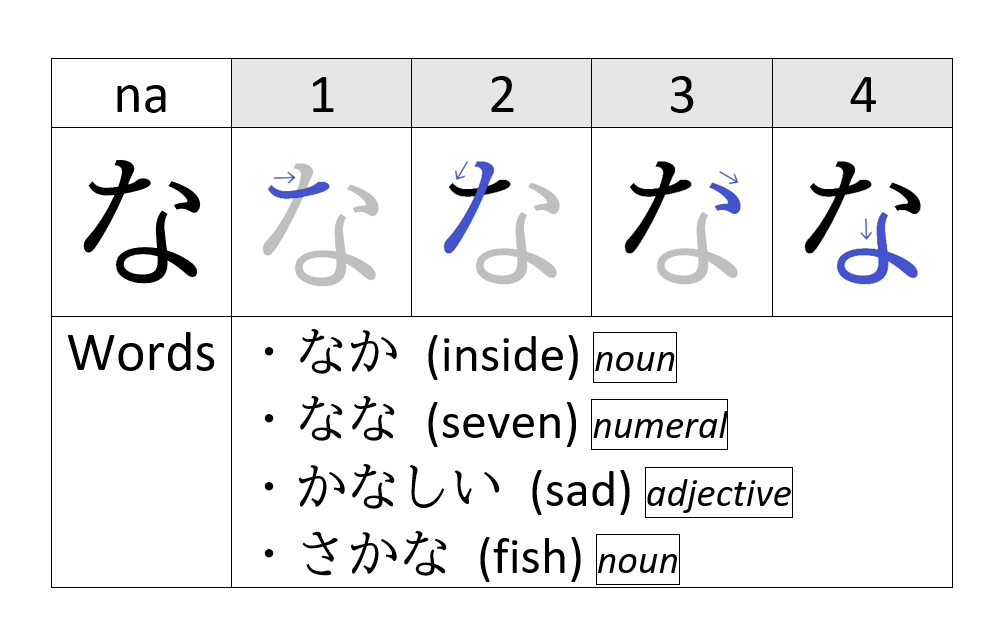
※ The number 7 is read as either [nana] or [shichi].


※ In modern Japanese, the only verb ending in ぬ is しぬ.

※ あね is a formal way of saying おねえさん [oneesan]. It usually means my older sister.
※ おかね means the same as かね [kane]. It is more polite to say it with お.

This is the Hiragana from な to の.
I changed the font of ね a little to make it look more like handwritten Hiragana. The first stroke is slightly different. When I write Hiragana by hand, I usually write it like the Hiragana shown in the stroke order. So please look at the Hiragana shown in the stroke order and practise.
Hiragana は, ひ, ふ, へ, ほ
Next is は, ひ, ふ, へ and ほ.
The Hiragana characters は, ひ, ふ, へ and ほ are a combination of the consonant [h] and a vowel.
But ふ is [fu]. Please be careful!

※ The particle は is always pronounced as [wa].

※ ひく means to play a musical instrument. For example: to play the piano / to play the guitar
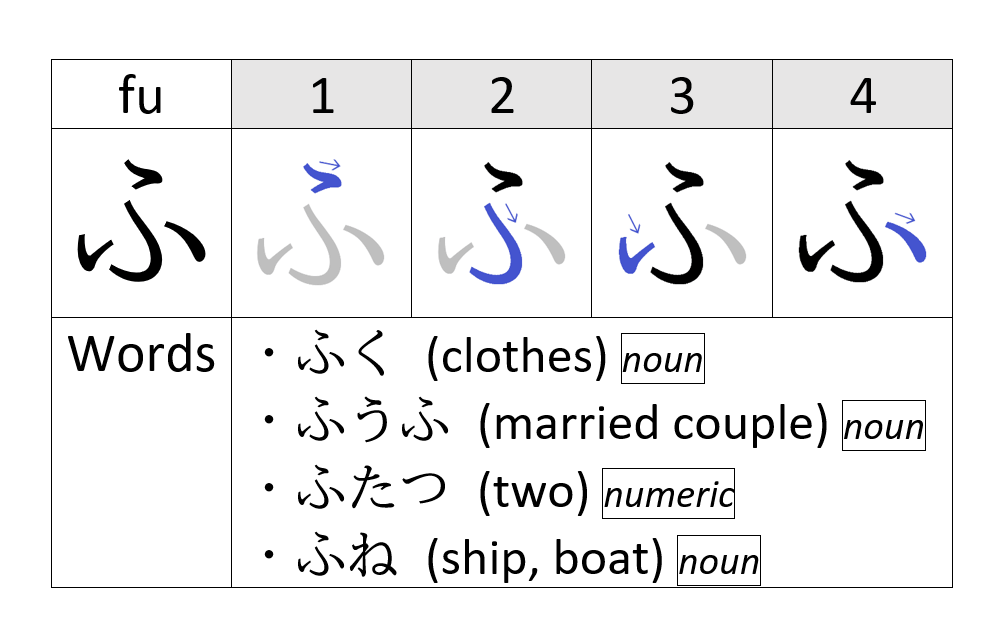

※ The particle へ is always pronounced as [e].

※ ほお is also called ほほ [hoho].
This is the Hiragana from は to ほ.
Don’t confuse は with ほ as they are very similar!
You have now learnt 30 Hiragana, from あ to ほ. There are only 16 basic Hiragana left!
Let’s keep up the great work!
Hiragana Quiz: from あ to ほ
Now it’s time for the quiz!
The questions in this quiz cover the Hiragana characters from あ to ほ.
Here is a short quiz on the 30 Hiragana we have studied so far. As usual, the answers to the quiz will be given at the beginning of the next lesson.
Are you all ready?
When you’re ready, just take the quiz below!
Hiragana Quiz 7: Please choose the correct answer from A or B.
[ha]

[ho]

[o]
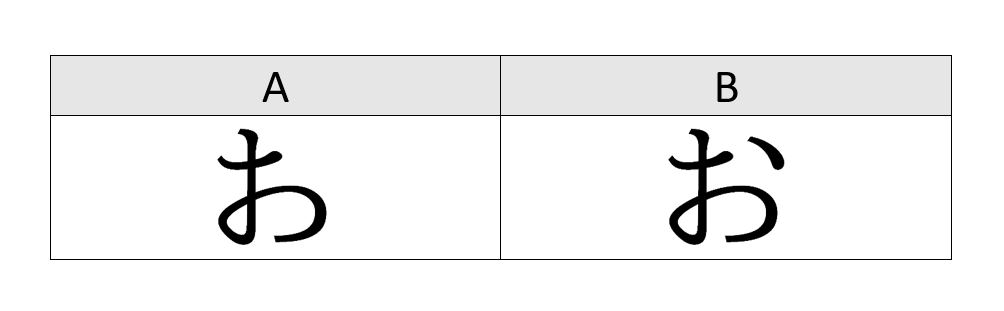
[ki]

[nu]

Hiragana Quiz 8: Please read the words below.
- かなしい
- へた
- ほのお
- にく
- ねこ
Hiragana Quiz 9: Please write the words below in Hiragana.
- shinu
- tanoshii
- fuufu
- hai
- hitotsu
That’s it for the quiz! Are you confident that you can answer all the questions correctly this time?
If you have any questions, just drop me a message via our contact form!
Homework
Now, at the end of the lesson, I will give you some homework.
If you have the workbook, practise the Hiragana in the workbook. The homework is on page 119 of the second edition workbook and page 123 of the third edition workbook.
If you don’t have a workbook, write each of the Hiragana you have studied in this lesson ten times carefully. When you write, read the Hiragana as you write! This will help you to remember both the pronunciation and the letters of the Hiragana.
I have another homework assignment for you. Try to write all the Hiragana we have studied so far!
I have made a table below as an example, so please have a look.
| | a | i | u | e | o |
| | あ | い | う | え | お |
| k | | | | | |
| s | | | | | |
| t | | | | | |
| n | | | | | |
| h | | | | | |
To begin, draw a table like the one above in your notebook. The table above is just an example so I haven’t written all the Hiragana, but you should write all of them.
When you have finished writing the table, read the Hiragana!
First, read the Hiragana in the table horizontally from left to right. The order is あ, い, う, え, お, か, き, く, け, こ ……
Next, read the table vertically from top to bottom. The order is あ, か, さ, た, な, は, い, き, し, ち, に, ひ ……
Learning how to read vertically will help you remember the changes in verbs.
If you can remember how to read both, you’ll be perfect! A little bit of practice every day and you’ll be on your way!
That’s it for this lesson.
We have two more lessons of basic Hiragana. In the next lesson we will learn 8 Hiragana. We are almost there. Let’s do our best!
Thank you for reading!
See you in the next lesson!
You can check out other Hiragana lessons here!

And here’s our Hiragana practice page!

日本語(にほんご)のレッスン

みなさん、こんにちは!
前回(ぜんかい)のレッスンは、どうでしたか。もう20個(こ)のひらがなは覚(おぼ)えましたか。
今回(こんかい)も、まず前回(ぜんかい)のレッスンのクイズの答(こた)えを発表(はっぴょう)します。それから、ひらがなの「な」から「ほ」まで、10個(こ)のひらがなを勉強(べんきょう)します。
クイズの答(こた)えを見(み)なくてもいい人(ひと)は、下(した)の「クイズの答(こた)えをスキップ」をクリックしてください。
それでは、クイズの答(こた)えと解説(かいせつ)です。
ひらがなクイズ④:はいかいいえで答(こた)えてください。
Q1 「さ」「し」「す」「せ」「そ」は、子音(しいん) [s] + 母音(ぼいん)である。
A はい
「さ」「し」「す」「せ」「そ」は、[sa] [shi] [su] [se] [so] です。
Q2 「し」の発音(はつおん)は、 [si] である。
A いいえ
「し」の発音(はつおん)は、 [shi] です。
Q3 「つ」の発音(はつおん)は、 [tsu] である。
A はい
「つ」の発音(はつおん)は [tu] じゃないです。注意(ちゅうい)しましょう。
Q4 「ち」の発音(はつおん)は、 [thi] である。
A いいえ
「ち」の発音(はつおん)は、 [chi] です。「ち」だけは特別(とくべつ)で、 [t] じゃなくて [ch] になります。
Q5 「あ」「い」「う」「え」「お」じゃないひらがなは、たいてい子音(しいん)一(ひと)つ + 母音(ぼいん)一(ひと)つの組(く)み合(あ)わせである。
A はい
でも、ときどき [tsu] や [chi] のように子音(しいん)が二(ふた)つあるものもあります。
ひらがなクイズ⑤:下(した)の単語(たんご)を読(よ)んでください。
- おさけ [osake]
- かえす [kaesu]
- せき [seki] (seat) / [seki] (cough)
- つくえ [tsukue]
- あした [ashita]
正(ただ)しく発音(はつおん)できましたか。アクセントがあるところ(太(ふと)くなっているところ)を、より高(たか)く発音(はつおん)しましょう。
三番(さんばん)の「せき」は、アクセントが違(ちが)うと、意味(いみ)が違(ちが)います。
ひらがなクイズ⑥:下(した)の単語(たんご)を、ひらがなで書(か)いてください。
- soshite (そして)
- kutsu (くつ)
- uchi (うち)
- sekai (せかい)
- isu (いす)
正(ただ)しく書(か)けましたか。クイズに出(で)なかったひらがなも、練習(れんしゅう)して覚(おぼ)えましょう!
答(こた)えのフォントは、教科書(きょうかしょ)のフォントじゃないです。でも、教科書(きょうかしょ)のフォントで書(か)いてもいいです。
ひらがなを練習(れんしゅう)する時(とき)は、たいてい教科書(きょうかしょ)のフォントで練習(れんしゅう)します。もちろん、どのフォントを使(つか)ってもいいですよ。
ひらがなが書(か)けたら、単語(たんご)を読(よ)んでみましょう!発音(はつおん)も正(ただ)しく覚(おぼ)えましょう。
これが、クイズの答(こた)えです。全部(ぜんぶ)できましたか。
今回(こんかい)は、ひらがなが20個(こ)あったので、少(すこ)し難(むずか)しかったですね。まだ覚(おぼ)えていないひらがながあったら、レッスンの前(まえ)に練習(れんしゅう)して覚(おぼ)えましょう!
それでは、今回(こんかい)は、「な」から「ほ」まで、10個(こ)のひらがなを紹介(しょうかい)します。教科書(きょうかしょ)がある人(ひと)は、第二版(だいにはん)の教科書(きょうかしょ)の24ページ/第三版(だいさんぱん)の教科書(きょうかしょ)の20ページを見(み)てください。ひらがなの表(ひょう)があります。
教科書(きょうかしょ)がない人(ひと)は、何(なに)も見(み)なくていいです。下(した)にあるひらがなの説明(せつめい)を見(み)て、一緒(いっしょ)に勉強(べんきょう)しましょう!
ひらがな「な」「に」「ぬ」「ね」「の」
ひらがなの「な」「に」「ぬ」「ね」「の」は、子音(しいん) [n] + 母音(ぼいん)です。
「ぬ」は、次(つぎ)のレッスンで勉強(べんきょう)する「め [me]」と似(に)ています。形(かたち)をよく見(み)て、正(ただ)しく覚(おぼ)えましょう。
下(した)に、それぞれのひらがなの書(か)き方(かた)と、そのひらがなを使(つか)った単語(たんご)を紹介(しょうかい)します。たくさん練習(れんしゅう)して、覚(おぼ)えましょう!

※数字(すうじ)の7は、「なな」か「しち」と読(よ)みます。
※現代(げんだい)の日本語(にほんご)では、「ぬ」で終(お)わる動詞(どうし)は、「しぬ」だけです。
※「あね」は、「おねえさん」のフォーマルな言(い)い方(かた)です。たいてい自分(じぶん)のお姉(ねえ)さんの意味(いみ)です。
※「おかね」は、「かね」でもいいです。「お」がついたほうが、ていねいです。
これが、ひらがなの「な」から「の」までです。
「ね」は、フォントの形(かたち)を少(すこ)し変(か)えました。書(か)き方(かた)の1の部分(ぶぶん)が違(ちが)います。手(て)で書(か)く時(とき)は、たいてい書(か)き方(かた)のひらがなのように書(か)きます。なので、書(か)き方(かた)のひらがなを見(み)て、練習(れんしゅう)してください。
ひらがな「は」「ひ」「ふ」「へ」「ほ」
次(つぎ)は、「は」「ひ」「ふ」「へ」「ほ」です。
「は」「ひ」「ふ」「へ」「ほ」は、子音(しいん) [h] と母音(ぼいん)の組(く)み合(あ)わせです。
でも、「ふ」は [fu] になります。注意(ちゅうい)しましょう!
※助詞(じょし)の「は」は、いつも [wa] と発音(はつおん)します。
※「ひく」は楽器(がっき)と使(つか)う動詞(どうし)です。例(れい): ピアノをひく。ギターをひく。
※助詞(じょし)の「へ」は、いつも [e] と発音(はつおん)します。
※「ほお」は「ほほ」とも言(い)います。
これが、ひらがなの「は」から「ほ」までです。
「は」と「ほ」は似(に)ていますね。気(き)をつけましょう!
これで、みなさんは「あ」から「ほ」まで、30個(こ)のひらがなを勉強(べんきょう)しました。基本(きほん)のひらがなは、あと16個(こ)だけですよ!
この調子(ちょうし)でがんばりましょう!
ひらがなクイズ:「あ」から「ほ」
それでは、ここでクイズタイム!
今回(こんかい)のクイズは、「あ」から「ほ」までです。
これまでに勉強(べんきょう)した30個(こ)のひらがなについて、簡単(かんたん)なクイズを出(だ)します。クイズの答(こた)えは、次(つぎ)のレッスンの最初(さいしょ)で説明(せつめい)します。
みなさん、準備(じゅんび)はいいですか。
準備(じゅんび)ができたら、下(した)のクイズに挑戦(ちょうせん)してみてください!
ひらがなクイズ⑦: AとBのどちらが正(ただ)しいですか。
[ha]
[ho]
[o]
[ki]
[nu]
ひらがなクイズ⑧:下(した)の単語(たんご)を読(よ)んでください。
- かなしい
- へた
- ほのお
- にく
- ねこ
ひらがなクイズ⑨:下(した)の単語(たんご)を、ひらがなで書(か)いてください。
- shinu
- tanoshii
- fuufu
- hai
- hitotsu
クイズは以上(いじょう)です!おつかれさまでした!
何(なに)か質問(しつもん)があったら、お問(と)い合(あ)わせフォームからメッセージをお願(ねが)いします!
宿題(しゅくだい)
最後(さいご)に、宿題(しゅくだい)です。
ワークブックがある人(ひと)は、ワークブックにあるひらがなの練習(れんしゅう)をしましょう。第二版(だいにはん)のワークブックは119ページ、第三版(だいさんぱん)のワークブックは123ページが宿題(しゅくだい)です。
ワークブックがない人(ひと)は、このレッスンで勉強(べんきょう)したひらがなを、それぞれ10回(かい)ずつていねいに書(か)いてください。書(か)く時(とき)は、ひらがなを読(よ)みながら書(か)きましょう! ひらがなの発音(はつおん)と文字(もじ)を一緒(いっしょ)に覚(おぼ)えられますよ。
もう一(ひと)つ宿題(しゅくだい)があります。これまでに勉強(べんきょう)したひらがなを、全部(ぜんぶ)表(ひょう)に書(か)いてみましょう!
下(した)の表(ひょう)は、例(れい)です。
| a | i | u | e | o | |
| あ | い | う | え | お | |
| k | |||||
| s | |||||
| t | |||||
| n | |||||
| h |
はじめに、上(うえ)のような表(ひょう)をノートに書(か)いてください。上(うえ)の表(ひょう)は例(れい)なので、全部(ぜんぶ)書(か)いていません。みなさんは、ひらがなを全部(ぜんぶ)書(か)いてくださいね。
表(ひょう)を書(か)いたら、ひらがなを読(よ)みましょう!
まず、表(ひょう)のひらがなを、左(ひだり)から右(みぎ)へ、横(よこ)に読(よ)みましょう。「あ」「い」「う」「え」「お」、「か」「き」「く」「け」「こ」……の順番(じゅんばん)です。
それから、次(つぎ)に表(ひょう)を、上(うえ)から下(した)へ、縦(たて)に読(よ)んでみましょう。「あ」「か」「さ」「た」「な」「は」、「い」「き」「し」「ち」「に」「ひ」……の順番(じゅんばん)です。
縦(たて)の読(よ)み方(かた)を覚(おぼ)えると、動詞(どうし)の変化(へんか)を覚(おぼ)える時(とき)に便利(べんり)です。
どちらの読(よ)み方(かた)も覚(おぼ)えたら、かんぺきです!毎日(まいにち)少(すこ)しずつでも練習(れんしゅう)すれば、すぐに覚(おぼ)えられますよ!
それでは、今回(こんかい)のレッスンはこれで終(お)わりです。
基本(きほん)のひらがなのレッスンは、あと二回(にかい)です。次(つぎ)のレッスンでは、8個(こ)のひらがなを勉強(べんきょう)します。あと少(すこ)しですね。がんばりましょう!
最後(さいご)までお読(よ)みくださり、ありがとうございます!
次(つぎ)のレッスンで 、お会(あ)いしましょう!
他(ほか)のひらがなのレッスンはこちらからチェックできます!
ひらがな練習(れんしゅう)のページはこちらです!