
Lessons can be read in English and Japanese. Read whichever you prefer!
レッスンは英語と日本語で読めます。お好きな方をお読みください!
English Lesson

Hello, everyone!
In the previous lesson, we studied the sentence pattern that express regret and the completion of an action, using the verb て form and しまう.
There is a big difference between casual and polite expressions, so pay attention and learn them.
If you find it difficult to use ちゃう/じゃう when you are speaking, it is okay not to use it.
However, it is important to remember it so that when you hear or read it, you can recognise it as a casual expression for (て form) しまう.
In this lesson, you will learn sentences that express premises and consequences.
The sentence pattern we will study this time is similar in meaning to (た form) ら we studied in Lesson 17, so check the differences in the lesson and learn how to use it correctly!
Now, let’s start by announcing the answers to the homework questions from the previous lesson.
I have made a Word document and a PDF file, which you can download if you want to see the answers!
Answers to Lesson 31 homework
If you have any questions about the original homework, please feel free to send a message!
Answers to the previous round’s summary quiz
What did you think of the previous summary quiz?
Please refer to the examples of answers below and think about various expressions.
Quiz 1: Use (て form) しまいました to write about what you have already done today.
- もうシャワーを浴(あ)びてしまいました。
- もう宿題(しゅくだい)をしてしまいました。
- もう晩(ばん)ご飯(はん)を食(た)べてしまいました。
- もう歯(は)を磨(みが)いてしまいました。
- もうパジャマ (pyjamas) を着(き)てしまいました。
Quiz 2: Use (て form stem) ちゃった/じゃった to write about something you regret.
- 子供(こども)の時(とき)祖母(そぼ) (grandmother) の大事(だいじ)なお皿(さら)を割(わ)ったけど、うそをついちゃった。
- 学生(がくせい)の時(とき)友達(ともだち)と遊(あそ)んでいた時(とき)に、学校(がっこう)の物(もの)を壊(こわ)しちゃった。
- 去年(きょねん)五年(ごねん)ぐらい付(つ)き合(あ)っていた彼女(かのじょ)と別(わか)れちゃった。
- 先週(せんしゅう)会社(かいしゃ)に遅刻(ちこく)しちゃった。
- 昨日(きのう)駅(えき)で転(ころ)んじゃった。
If you have any questions about the summary quiz, please send me a message!
Review of the Short form present tense
In this lesson, we will use the present tense of the Short form, so let’s review the conjugations first.
The rules for conjugating the present tense in the Short form can be found in the lesson below.

You can find the conjugation table on the Bookshelf page!

Review
1. Write the Short present tense of the following verbs.
| Verbs | Present Affirmative | ない form |
| to make dirty | ||
| to fall down | ||
| to wait | ||
| (something) goes off | ||
| to take off (clothes) | ||
| to apologise | ||
| to die | ||
| to bring (a thing) | ||
| to take (someone) to (a place) | ||
| to become lost to lose one’s way | ||
| to bloom | ||
| to ask (a favour) | ||
| to place an order |
2. Write the following adjectives and nouns in their Short forms present tenses.
| Adjectives Nouns | Present Affirmative | ない form |
| bright | ||
| anxious / worried | ||
| evening | ||
| dark | ||
| impossible | ||
| outside |
For answers, see the PDF below!
Grammar of this lesson
First, check the contents of this lesson with an illustration and example sentences!
Contents of this lesson
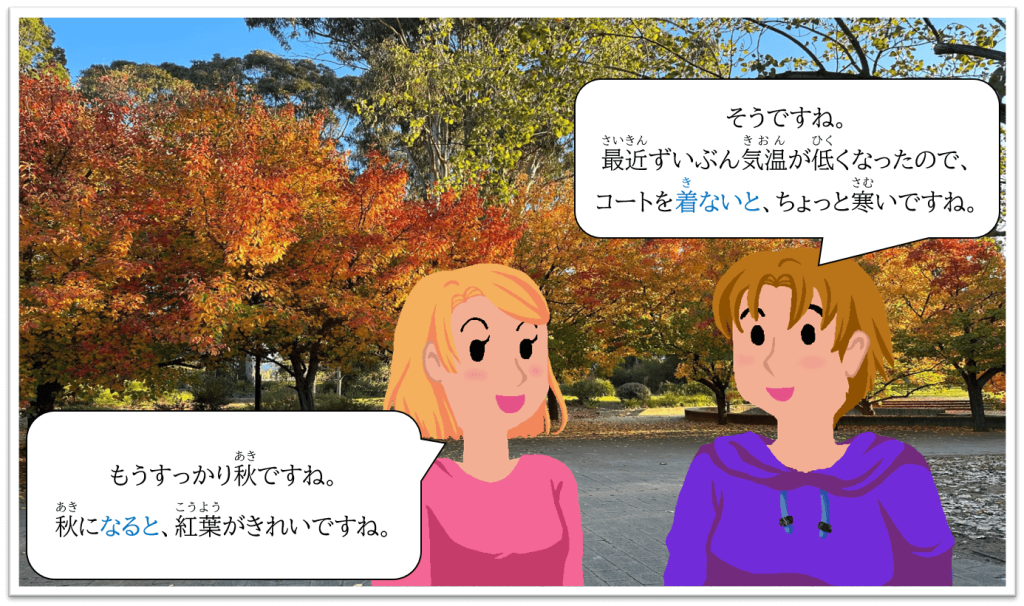
In this lesson, you will learn the sentence pattern combining the present tense of the Short form with と.
The parts written in blue are the sentence patterns we will study this time.
Consider the meaning of the sentence by focusing on the relationship between the sentence before and after the word と.
I have written examples using verbs because we often use them, but adjectives and nouns can also be used in this sentence pattern.
For more detailed explanations and examples, check them together in the lesson!
Explanations of the grammar we will study this time can be found in the following pages of the textbook.
| Second edition | 146ページと147ページ: 3 ~と |
| Third edition | 142ページと143ページ: 4 ~と |
(Short form present tense) と
In Lesson 17, you learnt the sentence pattern (た form) ら.
Before explaining the sentence pattern for this lesson, let’s have a quick review.
The sentence pattern (た form) ら has two meanings.
- Imagine and say things that are not true.
Example: 私(わたし)が猫(ねこ)だったら、一日中(いちにちじゅう)寝(ね)ます。 - Say about after the action is over.
Example: 試験(しけん)が終(お)わったら、たくさん遊(あそ)びます。
In the (た form) ら sentence pattern, the first half of the sentence assumes that the action or state of being (た form) ら has been performed, and the second half continues with a statement of the speaker’s plans or feelings in response to the assumption in the first half.
If you would like to review more sentence pattern of (た form) ら, please see the lesson below.

The sentence form we will study, (Short form present tense) と, uses the Short present tense.
The past tense cannot be used.
The past tense has the meaning of completion, while the present tense expresses a habit or an unchanging state.
For example, saying 学校(がっこう)に行(い)きました indicates that the action of ‘going to school’ has been completed in the past.
On the other hand, using the present tense to say 学校(がっこう)に行(い)きます indicates that you are planning to do the action of ‘going to school’ or that you often go to school as a student or teacher.
The same applies to noun sentences: 先生(せんせい)でした indicates that you were a teacher in the past, but not now.
This is because when you use the past tense, it indicates that the state of being a teacher has already ended.
On the other hand, saying 先生(せんせい)です in the present tense indicates that you are in the state of ‘being a teacher’ at the moment and that this state is continuing unchanged.
What I have explained above may have been a little difficult to understand because it is about grammar called ‘aspect’.
The important point is that, as written at the beginning, the present tense has the function of expressing a habit or an unchanging state.
If you remember this, it will be easier to understand why only the present tense can be used in this time’s sentence pattern.
This is a bit of a long explanation, but let’s look at some examples of the sentence pattern below to confirm the meaning!
(Short form present tense) と

夏(なつ)になると、暑(あつ)くなります。

何(なに)も食(た)べないと、おなかがすきます。
As explained above, only the present tense can be used in this sentence pattern.
Let’s look at the examples above and think about why.
See Emma’s example, 夏(なつ)になると、暑(なつ)くなります.
Summer is a hot season, so it is normal for it to always be hot in summer.
So, the sentence pattern (Short form present tense) と expresses that in the premise of (Short form present tense), there is always some action taking place or some state of affairs.
The reason why only the present tense can be used is that it is a sentence pattern that sets up an unchanging situation as a premise and states the result of that situation.
‘Always the same’ is the most important point, so remember it well.
John’s example is an example of using the verb ない form, but it is natural to be hungry if you haven’t eaten food, isn’t it?
The point of (Short form present tense) と is that the assumption always leads to the same result, or naturally so.
So it is NOT possible to continue after a statement of a result that is not a natural consequence.
Examples
✓ 何(なに)も食(た)べないと、おなかがすきます。
× 何(なに)も食(た)べないと、時々(ときどき)コーヒーだけ飲(の)みます。
× 何(なに)も食(た)べないと、友達(ともだち)がお菓子(かし)をくれました。
So, how can we make the sentence with the × above into a correct sentence?
In this case, use the sentence patterns (Short form) 時(とき) and (た form) ら instead.
例(れい)
× 何(なに)も食(た)べないと、時々(ときどき)コーヒーだけ飲(の)みます。
→ ✓ 何(なに)も食(た)べない時(とき)、時々(ときどき)コーヒーだけ飲(の)みます。
× 何(なに)も食(た)べないと、友達(ともだち)がお菓子(かし)をくれました。
→ ✓ 何(なに)も食(た)べなかったら、友達(ともだち)がお菓子(かし)をくれました。
(Short form) 時(とき) VS (た form) ら VS (Short form present tense) と
The meanings of (Short form) 時(とき), (た form) ら and (Short form present tense) と are very similar and can easily be mistaken for each other.
Let’s check the differences between these three sentence patterns again!
| Sentence Patterns | Conjugations | Meaning |
| (Short form) 時(とき) | Short form present/past | Indicates a specific time or period of time in which some action or situation is taking place. |
| (た form) ら | Short form past | Indicates what would happen assuming that some action is completed or some situation is reached. |
| (Short form present tense) と | Short form present | Represents a result that is naturally so, on the basis of some action or situation. |
This is the end of the explanation of sentence pattern.
Did you understand the meaning of sentence pattern and how it differs from other sentence patterns that are very similar?
Now, let’s practice using this sentence pattern a lot in real life!
Practice
1. Use the (Short form present tense) と to form a sentence.
*Note whether (a) or (b) is a precondition!
Example
(a) 何(なに)も食(た)べません。
(b) 死(し)にます。
→ 何(なに)も食(た)べないと、死(し)にます。
- (a) 冷蔵庫(れいぞうご)が壊(こわ)れます。
(b) 困(こま)ります。 - (a) 電気(でんき)がつきます。
(b) スイッチを押(お)します。 - (a) 夕方(ゆうがた)になります。
(b) 暗(くら)くなります。 - (a) お皿(さら)が割(わ)れます。
(b) お皿(さら)を落(お)とします。 - (a) ヒーターをつけます。
(b) 部屋(へや)が暖(あたた)かくなります。 - (a) お金(かね)がありません。
(b) 買(か)い物(もの)ができません。 - (a) 教科書(きょうかしょ)が読(よ)めません。
(b) ひらがなとカタカナを覚(おぼ)えません。 - (a) 注文(ちゅうもん)しません。
(b) レストランで料理(りょうり)を食(た)べられません。 - (a) ソファが大(おお)きくないです。
(b) 三人(さんにん)座(すわ)れません。 - (a) 大人(おとな)じゃないです。
(b) お酒(さけ)を飲(の)んではいけません。
2. Think about the part (Short form present tense) と and write it down.
Example
→ 冬(ふゆ)になると、雪(ゆき)が降(ふ)ります。
- ________と、明(あか)るくなります。
- ________と、日本語(にほんご)が上手(じょうず)になりません。
- ________と、桜(さくら)が咲(さ)きます。
- ________と、助(たす)かります。
- ________と、家賃(やちん)が払(はら)えません。
- ________と、ポップコーンが食(た)べたくなります。
- ________と、本(ほん)が読(よ)めません。
- ________と、違(ちが)いがわかります。
- ________と、危(あぶ)ないです。
- ________と、とても不安(ふあん)です。
For answers and examples of answers, check out the PDF below!
Practise your textbook!
| Second edition | 155ページ: III 春になると暖かくなります A 156ページ: B と C |
| Third edition | 151ページ: IV 秋になると涼しくなります A 152ページ: B と C |
Summary quiz
What did you think of this grammar lesson?
Before you do the summary quiz, review the key points of the lesson once more!
(Short form present tense) と
Represents the natural consequence of assuming that action or state of affairs.
Conjugations
Use the Short form present tense of verbs, adjectives and nouns.
Sentence pattern
- (Short form present tense) と、Verb/Adjective
Examples
暗(くら)くなると、電気(でんき)をつけます。
エアコンをつけないと、暑(あつ)いです。
*Various sentence patterns can be used for the second half of the sentence.
After checking the points above, take the quiz!
Quiz 1: Use (Short form present tense) と to complete the sentences.
- ___________と、寒(さむ)くなります。
- ___________と、疲(つか)れます。
- ___________と、すぐに忘(わす)れます。
- ___________と、部屋(へや)を片付(かたづ)けません。
- ___________と、学校(がっこう)が楽(たの)しくないです。
Quiz 2: Answer the following questions.
- お酒(さけ)を飲(の)みすぎると、どうなりますか。
- 冬(ふゆ)になると、外(そと)で何(なに)ができますか。
- 子供(こども)の時(とき)、休(やす)みになると、何(なに)をしましたか。
- 何(なに)がないと、一番(いちばん)困(こま)りますか。どうしてですか。
- 何(なに)をしてしまうと、恥(は)ずかしいですか。どうしてですか。
That’s all for the quiz!
Thank you to everyone who took the quiz! Answers will be announced in the next lesson.
If you have any questions, please leave a message using the contact form!
Homework
The workbook homework is on the following pages.
| Second edition | 54ページ |
| Third edition | 55ページ |
If you don’t have a workbook, do the homework below.
Download the Word or PDF version, whichever you prefer!
Those who have workbook homework should also take up the challenge!
Check the answers in the workbook by looking at the answer book.
Answers to original homework assignments will be presented in the next lesson.
The sentence pattern (Short form present tense) と, which we practised this time, is often mistaken for the sentence pattern (た form) ら in particular.
For example, saying お金(かね)があると、日本(にほん)に行(い)きたいです means ‘Whenever I have money, I want to go to Japan’, which is unnatural.
In this case, use (た form) ら and say: お金(かね)があったら、日本(にほん)に行(い)きたいです.
(Short form present tense) と is always followed by a natural consequence.
So the sentence before and after と is a premise-consequence relationship.
Various sentences can be continued after (た form) ら.
This is because (た form) ら is hypothetical, meaning ‘if you complete the action’, so it is a sentence pattern in which you imagine the completion of the action and say what you are thinking or planning to do.
If you are in doubt about which sentence pattern to use, think carefully about whether you are talking about an unchanging premise and consequence, or whether you are imagining the completion of an action.
Next time, you will learn the sentence pattern that expresses two actions at the same time.
Verb stem is used, so you should check that you say all the verb stems in Lesson 18 correctly.
Thank you for reading!
See you in the next lesson!
See other lessons in Lesson 18 here!

You can check out other lessons from GENKI here!


Click here to practise your Hiragana, Katakana and Kanji!


Also check out the resources and exercises on the Bookshelf page!
日本語(にほんご)のレッスン

みなさん、こんにちは!
前回(ぜんかい)は動詞(どうし)のて形(けい)と「しまう」を使(つか)って、後悔(こうかい)やアクションの完了(かんりょう)を表(あらわ)す文型(ぶんけい)を勉強(べんきょう)しました。
カジュアルな表現(ひょうげん)と丁寧(ていねい)な表現(ひょうげん)が全然(ぜんぜん)違(ちが)うので、注意(ちゅうい)して覚(おぼ)えましょう。
「ちゃう/じゃう」を話(はな)す時(とき)に使(つか)うのが難(むずか)しい人(ひと)は、使(つか)わなくても大丈夫(だいじょうぶ)です。
でも、その表現(ひょうげん)を聞(き)いたり読(よ)んだりした時(とき)に、「(て form) しまう」のカジュアルな表現(ひょうげん)だとわかるように覚(おぼ)えておくことが大事(だいじ)ですよ。
今回(こんかい)は前提(ぜんてい)と結果(けっか)を表(あらわ)す文(ぶん)を学(まな)びます。
今回(こんかい)勉強(べんきょう)する文型(ぶんけい)は、第十七課(だいじゅうななか)で勉強(べんきょう)した「(た form) ら」と意味(いみ)が似(に)ているので、レッスンで違(ちが)いを確認(かくにん)して、正(ただ)しく使(つか)えるようになりましょう!
それでは、最初(さいしょ)に前回(ぜんかい)の宿題(しゅくだい)の答(こた)えを発表(はっぴょう)します。
WordとPDFを作(つく)ったので、答(こた)えを見(み)たい人(ひと)はダウンロードしてください!
レッスン31の宿題(しゅくだい)の答(こた)え
オリジナルの宿題(しゅくだい)について質問(しつもん)がある人(ひと)は、気軽(きがる)にメッセージをくださいね!
前回(ぜんかい)のまとめのクイズの答(こた)え
前回(ぜんかい)のまとめのクイズはどうでしたか。
下(した)の答(こた)えの例(れい)を参考(さんこう)にして、色々(いろいろ)な表現(ひょうげん)を考(かんが)えてみてくださいね。
クイズ1:「(て form) しまいました」を使(つか)って、今日(きょう)もうしたことを書(か)いてください。
- もうシャワーを浴(あ)びてしまいました。
- もう宿題(しゅくだい)をしてしまいました。
- もう晩(ばん)ご飯(はん)を食(た)べてしまいました。
- もう歯(は)を磨(みが)いてしまいました。
- もうパジャマ (pyjamas) を着(き)てしまいました。
クイズ2:「(て form stem) ちゃった/じゃった」を使(つか)って、後悔(こうかい)していることを書(か)いてください。
- 子供(こども)の時(とき)祖母(そぼ) (grandmother) の大事(だいじ)なお皿(さら)を割(わ)ったけど、うそをついちゃった。
- 学生(がくせい)の時(とき)友達(ともだち)と遊(あそ)んでいた時(とき)に、学校(がっこう)の物(もの)を壊(こわ)しちゃった。
- 去年(きょねん)五年(ごねん)ぐらい付(つ)き合(あ)っていた彼女(かのじょ)と別(わか)れちゃった。
- 先週(せんしゅう)会社(かいしゃ)に遅刻(ちこく)しちゃった。
- 昨日(きのう)駅(えき)で転(ころ)んじゃった。
まとめのクイズについて質問(しつもん)がある人(ひと)は、ぜひメッセージを送(おく)ってください!
普通形(ふつうけい)現在形(げんざいけい)の復習(ふくしゅう)
今回(こんかい)の文型(ぶんけい)では普通形(ふつうけい)の現在形(げんざいけい)を使(つか)うので、最初(さいしょ)に活用(かつよう)を復習(ふくしゅう)しましょう。
普通形(ふつうけい)の現在形(げんざいけい)の活用(かつよう)のルールは下(した)のレッスンで確認(かくにん)できます。
活用表(かつようひょう)は本棚(ほんだな)のページにありますよ!
復習(ふくしゅう)
1.次(つぎ)の動詞(どうし)の普通形(ふつうけい)現在形(げんざいけい)を書(か)きましょう。
| 動詞(どうし) | 現在形(げんざいけい) 肯定形(こうていけい) | ない形(けい) |
| to make dirty | ||
| to fall down | ||
| to wait | ||
| (something) goes off | ||
| to take off (clothes) | ||
| to apologise | ||
| to die | ||
| to bring (a thing) | ||
| to take (someone) to (a place) | ||
| to become lost to lose one’s way | ||
| to bloom | ||
| to ask (a favour) | ||
| to place an order |
2.次(つぎ)の形容詞(けいようし)と名詞(めいし)の普通形(ふつうけい)現在形(げんざいけい)を書(か)きましょう。
| 形容詞(けいようし) 名詞(めいし) | 現在形(げんざいけい) 肯定形(こうていけい) | ない形(けい) |
| bright | ||
| anxious / worried | ||
| evening | ||
| dark | ||
| impossible | ||
| outside |
答(こた)えは下(した)のPDFを見(み)ましょう!
今回(こんかい)の文型(ぶんけい)
はじめに、今回(こんかい)のレッスンの内容(ないよう)をイラストと例文(れいぶん)でチェックしましょう!
今回(こんかい)のレッスン
今回(こんかい)は、普通形(ふつうけい)の現在形(げんざいけい)と「と」を組(く)み合(あ)わせた文型(ぶんけい)を学(まな)びます。
青(あお)で書(か)いた部分(ぶぶん)が、今回(こんかい)勉強(べんきょう)する文型(ぶんけい)です。
「と」の前(まえ)の文(ぶん)と後(あと)の文(ぶん)の関係(かんけい)に注目(ちゅうもく)して、文(ぶん)の意味(いみ)を考(かんが)えてみましょう。
動詞(どうし)をよく使(つか)うので動詞(どうし)を使(つか)った例(れい)を書(か)きましたが、形容詞(けいようし)と名詞(めいし)もこの文型(ぶんけい)で使(つか)えます。
詳(くわ)しい説明(せつめい)と例(れい)は、レッスンで一緒(いっしょ)に確認(かくにん)しましょう!
今回(こんかい)勉強(べんきょう)する文法(ぶんぽう)の説明(せつめい)は、教科書(きょうかしょ)の以下(いか)のページにあります。
| 第二版(だいにはん) | 146ページと147ページ: 3 ~と |
| 第三版(だいさんぱん) | 142ページと143ページ: 4 ~と |
~と
第十七課(だいじゅうななか)で「(た form) ら」の文型(ぶんけい)を勉強(べんきょう)しましたね。
今回(こんかい)の文型(ぶんけい)を説明(せつめい)する前(まえ)に、ちょっと復習(ふくしゅう)しましょう。
「(た form) ら」には、下(した)の二(ふた)つの意味(いみ)があります。
- 本当(ほんとう)じゃないことを想像(そうぞう)して言(い)う。
例(れい):私(わたし)が猫(ねこ)だったら、一日中(いちにちじゅう)寝(ね)ます。 - アクションが終(お)わった後(あと)について言(い)う。
例(れい):試験(しけん)が終(お)わったら、たくさん遊(あそ)びます。
「(た form) ら」の文型(ぶんけい)では、「(た form) ら」のアクションをしたり、その状態(じょうたい)になったことが前提(ぜんてい)で、その後(あと)に話(はな)す人(ひと)の予定(よてい)や気持(きも)ちを表(あらわ)す文(ぶん)を続(つづ)けます。
「(た form) ら」の文型(ぶんけい)をもっと復習(ふくしゅう)したい人(ひと)は、下(した)のレッスンを見(み)てくださいね。
今回(こんかい)勉強(べんきょう)する「(Short form present tense) と」は、普通形(ふつうけい)の現在形(げんざいけい)を使(つか)います。
過去形(かこけい)は使(つか)えません。
過去形(かこけい)には完了(かんりょう)の意味(いみ)がありますが、現在形(げんざいけい)は習慣(しゅうかん)や変(か)わらない状態(じょうたい)を表(あらわ)します。
例(たと)えば、「学校(がっこう)に行(い)きました」と言(い)ったら、「学校(がっこう)に行(い)く」というアクションを過去(かこ)に完了(かんりょう)したことを表(あらわ)しますね。
一方(いっぽう)、現在形(げんざいけい)を使(つか)って「学校(がっこう)に行(い)きます」と言(い)うと、「学校(がっこう)に行(い)く」というアクションをする予定(よてい)があることや、学生(がくせい)や先生(せんせい)としてよく学校(がっこう)に行(い)くことを表(あらわ)します。
名詞(めいし)の文(ぶん)でも同(おな)じで、「先生(せんせい)でした」と言(い)ったら、過去(かこ)に先生(せんせい)だったけれど、今(いま)は違(ちが)うことを表(あらわ)しますね。これは、過去形(かこけい)で表現(ひょうげん)すると、「先生(せんせい)である」という状態(じょうたい)がもう終(お)わったことを表(あらわ)すからです。
一方(いっぽう)、「先生(せんせい)です」と現在形(げんざいけい)で言(い)うと、今(いま)「先生(せんせい)である」という状態(じょうたい)で、その状態(じょうたい)が変(か)わらないで続(つづ)いていることを表(あらわ)します。
上(うえ)で説明(せつめい)したことは「アスペクト」という文法(ぶんぽう)の話(はなし)なのでちょっと難(むずか)しかったかもしれません。
大事(だいじ)なポイントは、最初(さいしょ)に書(か)いた通(とお)り、現在形(げんざいけい)には習慣(しゅうかん)や変(か)わらない状態(じょうたい)を表(あらわ)す働(はたら)きがあることです。
これを覚(おぼ)えておくと、どうして今回(こんかい)の文型(ぶんけい)では現在形(げんざいけい)しか使(つか)えないのかがわかりやすいと思(おも)います。
ちょっと説明(せつめい)が長(なが)くなりましたが、下(した)で文型(ぶんけい)の例(れい)を見(み)ながら意味(いみ)を確認(かくにん)しましょう!
(Short form present tense) と
夏(なつ)になると、暑(あつ)くなります。
何(なに)も食(た)べないと、おなかがすきます。
上(うえ)で説明(せつめい)したように、この文型(ぶんけい)では現在形(げんざいけい)しか使(つか)えません。
どうしてなのか、上(うえ)の例(れい)を見(み)ながら考(かんが)えてみましょう。
エマさんの例(れい)、「夏(なつ)になると、暑(なつ)くなります」を見(み)てください。
夏(なつ)は、暑(あつ)い季節(きせつ)ですから、夏(なつ)になったらいつも暑(あつ)いのが普通(ふつう)ですよね。
つまり、「(Short form present tense) と」の文型(ぶんけい)は、「(Short form present tense)」の前提(ぜんてい)では、いつも何(なに)かをする・何(なに)かの状態(じょうたい)になることを表(あらわ)すんです。
現在形(げんざいけい)しか使(つか)えない理由(りゆう)は、「いつも同(おな)じ状態(じょうたい)」を前提(ぜんてい)にして、その結果(けっか)を述(の)べる文型(ぶんけい)だからです。
「いつも同(おな)じ」というのが、一番(いちばん)大事(だいじ)なポイントなので、よく覚(おぼ)えておいてくださいね。
ジョンさんの例(れい)は動詞(どうし)のない形(けい)を使(つか)った例(れい)ですが、ご飯(はん)を食(た)べなかったらおなかがすくのは当然(とうぜん)ですね。
「(Short form present tense) と」のポイントは、その前提(ぜんてい)ではいつも同(おな)じになる・当然(とうぜん)そうなることです。
なので、当然(とうぜん)ではない結果(けっか)の文(ぶん)を後(あと)に続(つづ)けることはできません。
例(れい)
✓ 何(なに)も食(た)べないと、おなかがすきます。
× 何(なに)も食(た)べないと、時々(ときどき)コーヒーだけ飲(の)みます。
× 何(なに)も食(た)べないと、友達(ともだち)がお菓子(かし)をくれました。
それでは、上(うえ)の × の文(ぶん)を正(ただ)しい文(ぶん)にするには、どうしたらいいでしょうか。
この場合(ばあい)は、「(Short form) 時(とき)」や「(た form) ら」を使(つか)いましょう。
例(れい)
× 何(なに)も食(た)べないと、時々(ときどき)コーヒーだけ飲(の)みます。
→ ✓ 何(なに)も食(た)べない時(とき)、時々(ときどき)コーヒーだけ飲(の)みます。
× 何(なに)も食(た)べないと、友達(ともだち)がお菓子(かし)をくれました。
→ ✓ 何(なに)も食(た)べなかったら、友達(ともだち)がお菓子(かし)をくれました。
(Short form) 時(とき) VS (た form) ら VS (Short form present tense) と
「(Short form) 時(とき)」と「(た form) ら」と「(Short form present tense) と」は意味(いみ)がよく似(に)ているので、間違(まちが)いやすいです。
もう一度(いちど)これら三(みっ)つの文型(ぶんけい)の違(ちが)いをチェックしておきましょう!
| 文型(ぶんけい) | 活用(かつよう) | 意味(いみ) |
| (Short form) 時(とき) | Short form present/past | 何(なに)かのアクションや状況(じょうきょう)がある時間(じかん)や期間(きかん)を表(あらわ)す。 |
| (た form) ら | Short form past | 何(なに)かのアクションを完了(かんりょう)した場合(ばあい)、何(なに)かの状況(じょうきょう)になった場合(ばあい)を想像(そうぞう)して、どうなのかを表(あらわ)す。 |
| (Short form present tense) と | Short form present | 何(なに)かのアクションや状況(じょうきょう)がある場合(ばあい)、当然(とうぜん)そうなる結果(けっか)を表(あらわ)す。 |
文型(ぶんけい)の説明(せつめい)は、これで終(お)わりです。
文型(ぶんけい)の意味(いみ)と、よく似(に)た他(ほか)の文型(ぶんけい)との違(ちが)いがわかりましたか。
それでは、実際(じっさい)にこの文型(ぶんけい)をたくさん使(つか)って練習(れんしゅう)してみましょう!
練習(れんしゅう)
1.「(Short form present tense) と」の文型(ぶんけい)を使(つか)って、一(ひと)つの文(ぶん)にしましょう。
※ (a) と (b) のどちらを「と」の前(まえ)にするか注意(ちゅうい)しましょう!
例(れい)
(a) 何(なに)も食(た)べません。
(b) 死(し)にます。
→ 何(なに)も食(た)べないと、死(し)にます。
- (a) 冷蔵庫(れいぞうご)が壊(こわ)れます。
(b) 困(こま)ります。 - (a) 電気(でんき)がつきます。
(b) スイッチを押(お)します。 - (a) 夕方(ゆうがた)になります。
(b) 暗(くら)くなります。 - (a) お皿(さら)が割(わ)れます。
(b) お皿(さら)を落(お)とします。 - (a) ヒーターをつけます。
(b) 部屋(へや)が暖(あたた)かくなります。 - (a) お金(かね)がありません。
(b) 買(か)い物(もの)ができません。 - (a) 教科書(きょうかしょ)が読(よ)めません。
(b) ひらがなとカタカナを覚(おぼ)えません。 - (a) 注文(ちゅうもん)しません。
(b) レストランで料理(りょうり)を食(た)べられません。 - (a) ソファが大(おお)きくないです。
(b) 三人(さんにん)座(すわ)れません。 - (a) 大人(おとな)じゃないです。
(b) お酒(さけ)を飲(の)んではいけません。
2.「(Short form present tense) と」の部分(ぶぶん)を考(かんが)えて、書(か)きましょう。
例(れい)
→ 冬(ふゆ)になると、雪(ゆき)が降(ふ)ります。
- ________と、明(あか)るくなります。
- ________と、日本語(にほんご)が上手(じょうず)になりません。
- ________と、桜(さくら)が咲(さ)きます。
- ________と、助(たす)かります。
- ________と、家賃(やちん)が払(はら)えません。
- ________と、ポップコーンが食(た)べたくなります。
- ________と、本(ほん)が読(よ)めません。
- ________と、違(ちが)いがわかります。
- ________と、危(あぶ)ないです。
- ________と、とても不安(ふあん)です。
答(こた)えと答(こた)えの例(れい)は、下(した)のPDFを見(み)てチェックしてくださいね!
教科書(きょうかしょ)の練習(れんしゅう)もしましょう!
| 第二版(だいにはん) | 155ページ: III 春になると暖かくなります A 156ページ: B と C |
| 第三版(だいさんぱん) | 151ページ: IV 秋になると涼しくなります A 152ページ: B と C |
まとめのクイズ
今回(こんかい)の文法(ぶんぽう)レッスンはどうでしたか。
まとめのクイズをする前(まえ)に、もう一度(いちど)レッスンのポイントを復習(ふくしゅう)しましょう!
(Short form present tense) と
そのアクションをする・その状態(じょうたい)になると、いつもそうなる・そうする。
活用(かつよう)
動詞(どうし)・形容詞(けいようし)・名詞(めいし)の普通形(ふつうけい)現在形(げんざいけい)を使(つか)う。
文型(ぶんけい)
- (Short form present tense) と、Verb/Adjective
例(れい)
暗(くら)くなると、電気(でんき)をつけます。
エアコンをつけないと、暑(あつ)いです。
※後半(こうはん)の文(ぶん)には、色々(いろいろ)な文型(ぶんけい)を使(つか)える。
上(うえ)のポイントをチェックしたら、クイズに挑戦(ちょうせん)してください!
クイズ1:「(Short form present tense) と」を使(つか)って、文(ぶん)を完成(かんせい)させましょう。
- ___________と、寒(さむ)くなります。
- ___________と、疲(つか)れます。
- ___________と、すぐに忘(わす)れます。
- ___________と、部屋(へや)を片付(かたづ)けません。
- ___________と、学校(がっこう)が楽(たの)しくないです。
クイズ2:質問(しつもん)に答(こた)えましょう。
- お酒(さけ)を飲(の)みすぎると、どうなりますか。
- 冬(ふゆ)になると、外(そと)で何(なに)ができますか。
- 子供(こども)の時(とき)、休(やす)みになると、何(なに)をしましたか。
- 何(なに)がないと、一番(いちばん)困(こま)りますか。どうしてですか。
- 何(なに)をしてしまうと、恥(は)ずかしいですか。どうしてですか。
クイズは以上(いじょう)です!
クイズに挑戦(ちょうせん)してくれたみなさん、ありがとうございます!
答(こた)えは次(つぎ)のレッスンで発表(はっぴょう)します。
何(なに)か質問(しつもん)があったら、お問(と)い合(あ)わせフォームからメッセージをお願(ねが)いします!
宿題(しゅくだい)
ワークブックの宿題(しゅくだい)は、以下(いか)のページです。
| 第二版(だいにはん) | 54ページ |
| 第三版(だいさんぱん) | 55ページ |
ワークブックがない人(ひと)は、下(した)の宿題(しゅくだい)をしてください。
WordとPDFのうち、好(す)きな方(ほう)をダウンロードしてください!
ワークブックの宿題(しゅくだい)がある人(ひと)も挑戦(ちょうせん)しましょう!
ワークブックの答(こた)えは、答(こた)えの本(ほん)を見(み)てチェックしてください。
オリジナルの宿題(しゅくだい)の答(こた)えは、次(つぎ)のレッスンで発表(はっぴょう)します。
今回(こんかい)練習(れんしゅう)した「(Short form present tense) と」は、特(とく)に「(た form) ら」と間違(まちが)える人(ひと)が多(おお)いです。
例(たと)えば、「お金(かね)があると、日本(にほん)に行(い)きたいです」と言(い)うと、「お金(かね)がある場合(ばあい)はいつでも日本(にほん)に行(い)きたい」という意味(いみ)になるので、不自然(ふしぜん)です。
この場合(ばあい)は「(た form) ら」を使(つか)って、「お金(かね)があったら、日本(にほん)に行(い)きたいです」と言(い)いましょう。
「(Short form present tense) と」の後(あと)には、いつもそうする・そうなることを表(あらわ)す文(ぶん)を続(つづ)けます。
なので、「と」の前(まえ)と後(あと)の文(ぶん)が前提(ぜんてい)とその結果(けっか)の関係(かんけい)になります。
「(た form) ら」の後(あと)には、色々(いろいろ)な文(ぶん)を続(つづ)けることができます。
なぜなら、「(た form) ら」は「もしそのアクションを完了(かんりょう)した場合(ばあい)」の意味(いみ)なので、そのアクションの完了(かんりょう)を想像(そうぞう)して、自分(じぶん)の考(かんが)えや予定(よてい)を言(い)う文型(ぶんけい)だからです。
どちらの文型(ぶんけい)を使(つか)うのか迷(まよ)った時(とき)は、「そのアクションをする時(とき)はいつもそうなる」のか、それとも「アクションの完了(かんりょう)を想像(そうぞう)して言(い)っている」のかをよく考(かんが)えましょうね。
次回(じかい)は二(ふた)つのアクションを同時(どうじ)にすることを表(あらわ)す文型(ぶんけい)を学(まな)びます。
Verb stem を使(つか)うので、第十八課(だいじゅうはっか)の動詞(どうし)の Verb stem が全部(ぜんぶ)正(ただ)しく言(い)えるかどうかチェックしておくといいですよ。
最後(さいご)までお読(よ)みくださり、ありがとうございます!
次(つぎ)のレッスンで 、お会(あ)いしましょう!
第十八課(だいじゅうはっか)の他(ほか)のレッスンはこちらを見(み)てください!
『げんき』の他(ほか)のレッスンはこちらでチェックできます!
ひらがな・カタカナ・漢字(かんじ)の練習(れんしゅう)はこちらです!
本棚(ほんだな)のページの資料(しりょう)と練習(れんしゅう)もぜひチェックしてください!

