Lessons can be read in English and Japanese. Read whichever you prefer!
レッスンは英語と日本語で読めます。お好きな方をお読みください!
English Lesson
Hello, everyone!
Last time we studied the conjugation of the past tense in the Short form.
Did you practise a lot?
The way verbs are conjugated in the affirmative and negative is completely different.
It can be difficult at first, so practice at your own pace.
If you are already familiar with the conjugation of the past tense in the Short form, practice the present and past tenses together.
If you learn how to conjugate the Short form, you will be able to read Japanese manga and books, and enjoy anime and games even more!
So, let’s practice using the Short form a lot this time too!
Now, let’s start by announcing the answers to the homework questions from the previous lesson.
I have made a Word document and a PDF file, which you can download if you want to see the answers!
Answers to Lesson 65 homework
Next, I will announce the answers to the previous round’s summary quiz.
If you don’t need to see the answers to the quiz, please skip it.
When learning conjugations, just practice a lot.
It may sound a bit boring, but if you practise it over and over again every day, you will learn to say it naturally.
Any practice will help you later on.
Even if you don’t get good at it straight away, don’t give up!
Answers to the quiz are as follows.
Quiz 1: Write the conjugation of the following verbs in their Short forms.
| verbs | Short form Present Affirmative | ない form | た form | なかった form |
| to think | 思(おも)う | 思(おも)わない | 思(おも)った | 思(おも)わなかった |
| to sleep | 寝(ね)る | 寝(ね)ない | 寝(ね)た | 寝(ね)なかった |
| there is (a thing) | ある | ない | あった | なかった |
| to clean | 掃除(そうじ)する | 掃除(そうじ)しない | 掃除(そうじ)した | 掃除(そうじ)しなかった |
| to come | 来(く)る | 来(こ)ない | 来(き)た | 来(こ)なかった |
Note that the change of the verb ある is special.
The pronunciation of the stem part of the verb 来(く)る also changes frequently (くる, こない, きた), so be careful and learn it.
Quiz 2: Write the conjugations of the following adjectives and nouns in their Short forms.
| adjectives nouns | Short form Present Affirmative | ない form | た form | なかった form |
| cute | 可愛(かわい)い | 可愛(かわい)くない | 可愛(かわい)かった | 可愛(かわい)くなかった |
| not busy | 暇(ひま)だ | 暇(ひま)じゃない | 暇(ひま)だった | 暇(ひま)じゃなかった |
| good | いい | よくない | よかった | よくなかった |
| car | 車(くるま)だ | 車(くるま)じゃない | 車(くるま)だった | 車(くるま)じゃなかった |
| rain | 雨(あめ)だ | 雨(あめ)じゃない | 雨(あめ)だった | 雨(あめ)じゃなかった |
As for the conjugation of adjectives and nouns in their Short forms, the key point is the change of な adjective and noun.
Pay attention to the endings of な-adjectives and nouns in the affirmative form.
Now let’s start this lesson!
At the beginning, check the lesson with a little reading practice.
This time, let’s read Emma’s diary!
Contents of this lesson
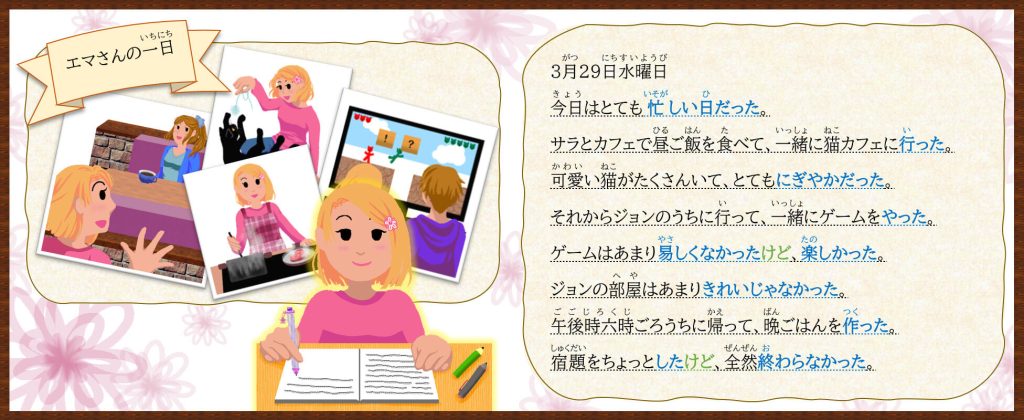
猫(ねこ)カフェ: cat cafe
Next, think about the answers to the following questions.
- エマさんの今日(きょう)はどんな日(ひ)でしたか。
- エマさんは今日(きょう)何(なに)をしましたか。
- エマさんは今日(きょう)料理(りょうり)しましたか。
Did you understand the content of the example sentences?
All the answers to the questions can be found in the example sentences.
If you didn’t understand it well, read it again after the lesson!
In this lesson, we will practise informal speech using the past tense of the Short form.
The word けど written in green in the example sentences has approximately the same meaning as でも or が.
It can also be used as けれど or けれども.
It is often used in casual expressions, so I have introduced it here.
Many Japanese use けど rather than が when speaking in casual conversation.
Please try using it!
けど can be used instead of が and can be used with the polite form.
Example: この辞書(じしょ)は高(たか)かったですけど、とても便利(べんり)です。
Explanations of the grammar we will study this time can be found in the following pages of the textbook.
If you have a second edition textbook, you only need to look at page 213.
| Second edition | 213ページ: 1 Past Tense Short Forms |
| Third edition | 214ページと215ページ: 2 Past Tense Short Forms in Informal Speech |
To begin with, here are some new nouns from Lesson 9 that we will be using in this exercise.
The words are slightly different between the second and third editions, so they are listed in the table below.
Words already taught in previous lessons are not written on the chart.
vocabulary
| 日本語(にほんご) | 英語(えいご) |
| 単語(たんご) | word / vocabulary |
| 作文(さくぶん) | essay / composition |
| 試験(しけん) | exam |
| ギター | guitar |
| ピアノ | piano |
| コンサート | concert |
| チケット | ticket |
| 歌舞伎(かぶき) | Kabuki / traditional Japanese theatrical art |
| スキー | ski |
| お弁当(おべんとう) | bento / boxed lunch |
| ピザ | pizza |
| 病気(びょうき) | illness / sickness |
| 薬(くすり) | medicine |
| いい子(いいこ) | good child / good boy / good girl |
| 色(いろ) | colour |
| 今度(こんど) | near future / next time / this time |
| 先月(せんげつ) | last month |
| 去年(きょねん) | last year |
Accents vary slightly from person to person and region to region.
いい子(こ) can also be used for pets and other animals.
Example: 私(わたし)の犬(いぬ)はとてもいい子(こ)だ。 (My dog is a very good boy.)
Expressions relating to musical instruments
In Lesson 9 of the textbook, you will learn the verb 弾(ひ)く.
The verb 弾(ひ)く is used with stringed instruments like the guitar and with the piano.
So how would you describe playing other instruments? Let’s take a look at a few!
吹(ふ)く: to play (a wind instrument) / to blow (a whistle, trumpet, etc.)
| 日本語(にほんご) | 英語(えいご) |
| トランペットを吹(ふ)く | to play the trumpet |
| サックスを吹(ふ)く | to play the saxophone (sax) |
| フルートを吹(ふ)く | to play the flute |
| 口笛(くちぶえ)を吹(ふ)く | to whistle |
叩(たた)く: to play (a percussion instrument or the drums)
| 日本語(にほんご) | 英語(えいご) |
| ドラム / 太鼓(たいこ)を叩(たた)く | to play the drum |
| タンバリンを叩(たた)く | to play the tambourine |
| 手(て)を叩(たた)く | to clap one’s hands |
Other expressions
| 日本語(にほんご) | 英語(えいご) |
| 演奏(えんそう)する | to play / to perform (music or musical instruments) |
| やる バンドをやる | to play (musical instruments) to play (in a band) |
The verb 演奏(えんそう)する can be used with any instrument.
It is a slightly more formal way of saying 弾(ひ)く or 吹(ふ)く.
The verb やる can also be used with any instrument. This is a very casual expression.
If you play guitar as a hobby, say ギターをやっている.
The verb やる can be used to describe band activities as well as musical instruments.
A person who is in a band is described as バンドをやっている.
The verb する has a similar meaning to やる, but やる is usually used to describe hobby activities.
Review
In the previous lesson, we studied the conjugation of the past tense in the Short form.
We will use a lot of past tense Short forms again, so let’s review a few first.
The present tense is not used in the exercises in this lesson, but review it together so you don’t forget!
Review
1. Write the past tense of the Short form of the following verbs.
| verbs | た form | なかった form |
| to sleep | ||
| to speak / to talk | ||
| to come | ||
| to go back | ||
| to see | ||
| to read | ||
| to do | ||
| to listen / to hear | ||
| to get up | ||
| to drink | ||
| to go | ||
| to study | ||
| to eat |
2. Write the conjugations of the following verbs, adjectives and nouns in their Short forms.
| English | Present Affirmative | ない form | た form | なかった form |
| to take (a picture) | ||||
| there is (a thing) | ||||
| to understand | ||||
| to write | ||||
| to meet | ||||
| to wait | ||||
| there is (a living thing) | ||||
| to buy | ||||
| good | ||||
| early | ||||
| beautiful / clean | ||||
| healthy / energetic | ||||
| magazine | ||||
| part-time job |
Check the answers in the PDF below!
Informal Speech: Past tense
The key points of informal speech were explained in the Lesson 8 lesson, so I won’t repeat them.
If you want to review the key points, see the lesson below.

Below you will find examples of conversations, so please use them as a reference.

ジョンは先週(せんしゅう)忙(いそが)しかった?

ううん、あまり忙(いそが)しくなかった。
エマの大学(だいがく)はどうだった?
ちょっと忙(いそが)しかった。
でも、週末(しゅうまつ)は暇(ひま)だったよ。
だから、友達(ともだち)と町(まち)で買(か)い物(もの)をして、カラオケに行(い)った。
よかったね。
楽(たの)しかった?
うん、とても楽(たの)しかった。
ジョンは週末(しゅうまつ)何(なに)かした?
うちで日本語(にほんご)の作文(さくぶん)の宿題(しゅくだい)をしていたよ。
The rules of informal speech are the same in the present and past tenses.
So, basically, just say the end of the sentence in the past tense Short forms.
Question sentences do not end with a か as in the present tense.
Instead, a question mark is added to indicate that it is a question sentence.
In the present tense, the affirmative ending だ of な-adjectives and nouns is not required, but the past tense ending だった is necessary.
Without it, it is difficult to tell whether the sentence is in the past tense or not.
As in Emma’s example, you can also add the particle よ or ね and say だったよ or だったね.
The conjugated form of the Short form is short and simple, so just saying it as it is tends to give the impression that something is missing or that you are being blunt.
Therefore, the particles ね and よ are often added to make the sentences more structured and nuanced.
When texting with friends, I often pay attention to the end of sentences.
This is because the end of a sentence is very important in Japanese.
It is very difficult to express feelings in sentences alone, isn’t it?
That is why the particles よ and ね are important to show what kind of feeling you are expressing.
For example, there is a slight difference in impression between simply saying 暇(ひま)だった and 暇(ひま)だったよ.
Saying 暇(ひま)だったよ gives a softer impression.
It is a very small thing, but I think it is very typical of the Japanese language.
It is interesting to look at the various ways Japanese people use particles.
Now let’s practise!
Practice
1. Change the following sentences in the Long form to sentences in the Short form.
Example: 昨日(きのう)公園(こうえん)に行(い)きました。
→ 昨日(きのう)公園(こうえん)に行(い)った。
- 今日(きょう)友達(ともだち)と一緒(いっしょ)にお弁当(べんとう)を食(た)べました。
- 誕生日(たんじょうび)に友達(ともだち)に花(はな)をもらいました。
- 子供(こども)の時(とき)、よくピアノを弾(ひ)きました。
- 先月(せんげつ)は日本語(にほんご)の試験(しけん)がありませんでした。
- 昨日(きのう)作文(さくぶん)を書(か)きませんでした。
- 私(わたし)の高校(こうこう)の先生(せんせい)は若(わか)かったです。
- 先週(せんしゅう)は病気(びょうき)でした。だから、薬(くすり)を飲(の)んでいました。
- 子供(こども)の時(とき)、私(わたし)は友達(ともだち)がたくさんいて、全然(ぜんぜん)寂(さび)しくなかったです。
- 英語(えいご)の先生(せんせい)はアメリカ人(じん)で、目(め)が青(あお)かったです。
- 去年(きょねん)はあまり運動(うんどう)しませんでした。だから、ちょっと太(ふと)っていました。
2. Answer the questions.
- 子供(こども)の時(とき)、いい子(こ)だった?
- 子供(こども)の時(とき)、クラスメイト (classmate) は意地悪(いじわる)だった?
- 高校(こうこう)の時(とき)、ギターを弾(ひ)くのが好(す)きだった?
- 今日(きょう)運動(うんどう)した?
- 子供(こども)の時(とき)、ピザが好(す)きだった?
- 昨日(きのう)家(いえ)を出(で)た?何(なに)をした?
- 学生(がくせい)の時(とき)、どんな作文(さくぶん)を書(か)いた?
- 子供(こども)の時(とき)、どんな食(た)べ物(もの)が人気(にんき)があった?
- 高校(こうこう)の時(とき)、何時(なんじ)にクラスが始(はじ)まった?何時(なんじ)に終(お)わった?
- 去年(きょねん)はどうだった?
3. Write 5 sets of questions and answers about the last week.
Example
Q. 先週(せんしゅう)買(か)い物(もの)をした?
A. うん、した。スーパーに行(い)って、食(た)べ物(もの)を買(か)った。
- Q.
A. - Q.
A. - Q.
A. - Q.
A. - Q.
A.
4. Write down 5 things you did and 5 things you did not do yesterday.
| Things you did yesterday | Things you didn’t do yesterday |
| Example: コーヒーを飲(の)んだ。 | Example: 本(ほん)を読(よ)まなかった。 |
| 1. | 1. |
| 2. | 2. |
| 3. | 3. |
| 4. | 4. |
| 5. | 5. |
Check the PDF below for answers and examples!
If you have a textbook, try practising the textbook as well!
| Second edition | 218ページと219ページ: II Informal Speech A と B |
| Third edition | 220ページと221ページ: II Informal Speech A と B と C |
Practice C in the third edition is pair work.
Practise lots of casual conversation using a variety of the expressions you have studied so far!
If you are studying on your own, try practising your own questions and answers!
Summary quiz
I think it was easier this time because we didn’t study any new sentence patterns.
Let’s use a lot of Short forms and get used to conjugating them.
If you like manga, you can try reading Japanese manga.
It can be difficult if you only read Japanese, so it’s a good idea to compare the Japanese ones with those translated into English or your mother tongue.
If you like anime and games, listen to a lot of Japanese!
It is also good to listen to Japanese songs while looking at the lyrics.
If you like singing, try it out.
You can also practise your pronunciation.
Let’s finish the lesson with a summary quiz!
Quiz 1: Make affirmative and negative sentences in the past tense of the Short form.
Example: 本(ほん)を読(よ)む
→ 本(ほん)を読(よ)んだ。/本(ほん)を読(よ)まなかった。
- 単語(たんご)を覚(おぼ)える
- 友達(ともだち)と遊(あそ)ぶ
- スキーが上手(じょうず)
- 赤(あか)が好(す)き
- 天気(てんき)がいい
Quiz 2: Answer the following questions.
- 子供(こども)の時(とき)、踊(おど)るのが好(す)きだった?
- 昨日(きのう)公園(こうえん)で散歩(さんぽ)した?
- 子供(こども)の時(とき)、どんな色(いろ)が好(す)きだった?
- 去年(きょねん)の誕生日(たんじょうび)に何(なに)をもらった?
- 先週(せんしゅう)いつ日本語(にほんご)を勉強(べんきょう)した?
That’s all for the quiz!
Thank you to everyone who took the quiz! Answers will be announced in the next lesson.
If you have any questions, please leave a message using the contact form!
Homework
The workbook homework is on the following pages.
| Second edition | 83ページ |
| Third edition | 88ページ |
If you don’t have a workbook, do the homework below.
Download the Word or PDF version of the workbook whichever you prefer!
Those who have workbook homework should also take up the challenge!
Check the answers in the workbook by looking at the answer book.
Answers to original homework assignments will be presented in the next lesson.
Next time, we will practise the sentence pattern (Short form) と思(おも)います using the past tense of the Short form.
Please review the Lesson 8 lesson again and look at the key points of the sentence pattern!
Emma’s diary was the illustration for the introduction of this lesson content.
You should also try writing a diary in Japanese, using many past tenses in the Short form!
It’s good practice!
Thank you for reading!
See you in the next lesson!
Check out more lessons from GENKI 1 here!

For more lessons from Lesson 9, check here!

Click here to practise your Hiragana, Katakana and Kanji!


And be sure to check out the resources and practices on our Bookshelf page!

日本語(にほんご)のレッスン
みなさん、こんにちは!
前回(ぜんかい)は普通形(ふつうけい)の過去形(かこけい)の活用(かつよう)を勉強(べんきょう)しました。
たくさん練習(れんしゅう)しましたか。
動詞(どうし)の変化(へんか)は肯定形(こうていけい)と否定形(ひていけい)で作(つく)り方(かた)が全然(ぜんぜん)違(ちが)います。
最初(さいしょ)は難(むずか)しいと思(おも)うので、ゆっくり練習(れんしゅう)してくださいね。
普通形(ふつうけい)の過去形(かこけい)の活用(かつよう)も慣(な)れた人(ひと)は、現在形(げんざいけい)と過去形(かこけい)を全部(ぜんぶ)言(い)う練習(れんしゅう)をしてください。
普通形(ふつうけい)の活用(かつよう)を覚(おぼ)えると、日本(にほん)の漫画(まんが)や本(ほん)が読(よ)めますし、アニメやゲームももっと楽(たの)しめますよ!
なので、今回(こんかい)もたくさん普通形(ふつうけい)を使(つか)って練習(れんしゅう)しましょう!
それでは、最初(さいしょ)に前回(ぜんかい)の宿題(しゅくだい)の答(こた)えを発表(はっぴょう)します。
WordとPDFを作(つく)ったので、答(こた)えを見(み)たい人(ひと)はダウンロードしてください!
レッスン65の宿題(しゅくだい)の答(こた)え
次(つぎ)に、前回(ぜんかい)のまとめのクイズの答(こた)えを発表(はっぴょう)します。
クイズの答(こた)えを見(み)なくてもいい人(ひと)は、スキップしてください。
活用(かつよう)を覚(おぼ)える時(とき)は、たくさん練習(れんしゅう)しましょう。
ちょっとつまらないかもしれませんが、毎日(まいにち)繰(く)り返(かえ)し練習(れんしゅう)していると、自然(しぜん)と言(い)えるようになります。
どんな練習(れんしゅう)も後(あと)で必(かなら)ず役(やく)に立(た)ちます。
すぐに上手(じょうず)にできなくても、諦(あきら)めないでがんばりましょう!
クイズの答(こた)えは、以下(いか)の通(とお)りです。
クイズ1:次(つぎ)の動詞(どうし)の普通形(ふつうけい)の活用(かつよう)を書(か)いてください。
| verbs | Short form Present Affirmative | ない form | た form | なかった form |
| to think | 思(おも)う | 思(おも)わない | 思(おも)った | 思(おも)わなかった |
| to sleep | 寝(ね)る | 寝(ね)ない | 寝(ね)た | 寝(ね)なかった |
| there is (a thing) | ある | ない | あった | なかった |
| to clean | 掃除(そうじ)する | 掃除(そうじ)しない | 掃除(そうじ)した | 掃除(そうじ)しなかった |
| to come | 来(く)る | 来(こ)ない | 来(き)た | 来(こ)なかった |
「ある」の変化(へんか)は特別(とくべつ)なので注意(ちゅうい)です。
「来(く)る」も「来」の部分(ぶぶん)の発音(はつおん)が変(か)わるので、気(き)を付(つ)けて覚(おぼ)えましょう。
クイズ2:次(つぎ)の形容詞(けいようし)と名詞(めいし)の普通形(ふつうけい)の活用(かつよう)を書(か)いてください。
| adjectives nouns | Short form Present Affirmative | ない form | た form | なかった form |
| cute | 可愛(かわい)い | 可愛(かわい)くない | 可愛(かわい)かった | 可愛(かわい)くなかった |
| not busy | 暇(ひま)だ | 暇(ひま)じゃない | 暇(ひま)だった | 暇(ひま)じゃなかった |
| good | いい | よくない | よかった | よくなかった |
| car | 車(くるま)だ | 車(くるま)じゃない | 車(くるま)だった | 車(くるま)じゃなかった |
| rain | 雨(あめ)だ | 雨(あめ)じゃない | 雨(あめ)だった | 雨(あめ)じゃなかった |
形容詞(けいようし)と名詞(めいし)の普通形(ふつうけい)の活用(かつよう)は、な形容詞(けいようし)と名詞(めいし)の変化(へんか)がポイントです。
な形容詞(けいようし)と名詞(めいし)の肯定形(こうていけい)の語尾(ごび)に注意(ちゅうい)してくださいね。
それでは、今回(こんかい)のレッスンを始(はじ)めましょう!
はじめに、ちょっと読(よ)む練習(れんしゅう)をしながら、レッスンの内容(ないよう)をチェックします。
今回(こんかい)は、エマさんの日記(にっき)を読(よ)んでみましょう!
今回(こんかい)のレッスン
猫(ねこ)カフェ: cat cafe
次(つぎ)に、以下(いか)の質問(しつもん)の答(こた)えを考(かんが)えてみてください。
- エマさんの今日(きょう)はどんな日(ひ)でしたか。
- エマさんは今日(きょう)何(なに)をしましたか。
- エマさんは今日(きょう)料理(りょうり)しましたか。
例文(れいぶん)の内容(ないよう)はわかりましたか。
質問(しつもん)の答(こた)えは全部(ぜんぶ)例文(れいぶん)の中(なか)にありますよ。
よくわからなかった人(ひと)は、レッスンの後(あと)でもう一度(いちど)読(よ)んでみましょう!
今回(こんかい)は、普通形(ふつうけい)の過去形(かこけい)を使(つか)ったカジュアルな会話(かいわ)を練習(れんしゅう)します。
例文(れいぶん)の中(なか)に緑(みどり)で書(か)いた「けど」は、「でも」や「が」とだいたい同(おな)じ意味(いみ)です。「けれど」や「けれども」と言(い)うこともあります。
カジュアルな表現(ひょうげん)でよく使(つか)うので、紹介(しょうかい)しました。
カジュアルな会話(かいわ)の表現(ひょうげん)を使(つか)って話(はな)す時(とき)は、「が」よりも「けど」を使(つか)う日本人(にほんじん)が多(おお)いと思(おも)います。
ぜひ使(つか)ってみてくださいね!
「けど」は「が」の代(か)わりに使(つか)えるので、丁寧形(ていねいけい)と一緒(いっしょ)に使(つか)うこともできますよ。
例(れい):この辞書(じしょ)は高(たか)かったですけど、とても便利(べんり)です。
今回(こんかい)勉強(べんきょう)する文法(ぶんぽう)の説明(せつめい)は、教科書(きょうかしょ)の以下(いか)のページにあります。
第二版(だいにはん)の教科書(きょうかしょ)を持(も)っている人(ひと)は、213ページだけ見(み)れば大丈夫(だいじょうぶ)です。
| 第二版(だいにはん) | 213ページ: 1 Past Tense Short Forms |
| 第三版(だいさんぱん) | 214ページと215ページ: 2 Past Tense Short Forms in Informal Speech |
はじめに、今回(こんかい)の練習(れんしゅう)で使(つか)う第九課(だいきゅうか)の新(あたら)しい名詞(めいし)を紹介(しょうかい)します。
第二版(だいにはん)と第三版(だいさんぱん)で単語(たんご)が少(すこ)し違(ちが)うので、下(した)の表(ひょう)にまとめて書(か)きますね。
もうレッスンで教(おし)えた単語(たんご)は表(ひょう)に書(か)きません。
単語(たんご)
| 日本語(にほんご) | 英語(えいご) |
| 単語(たんご) | word / vocabulary |
| 作文(さくぶん) | essay / composition |
| 試験(しけん) | exam |
| ギター | guitar |
| ピアノ | piano |
| コンサート | concert |
| チケット | ticket |
| 歌舞伎(かぶき) | Kabuki / traditional Japanese theatrical art |
| スキー | ski |
| お弁当(おべんとう) | bento / boxed lunch |
| ピザ | pizza |
| 病気(びょうき) | illness / sickness |
| 薬(くすり) | medicine |
| いい子(いいこ) | good child / good boy / good girl |
| 色(いろ) | colour |
| 今度(こんど) | near future / next time / this time |
| 先月(せんげつ) | last month |
| 去年(きょねん) | last year |
アクセントは人(ひと)や地方(ちほう)によって少(すこ)し違(ちが)います。
「いい子(こ)」はペットなどの動物(どうぶつ)にも使(つか)えます。
例(れい):私(わたし)の犬(いぬ)はとてもいい子(こ)だ。 (My dog is a very good boy.)
楽器(がっき)の表現(ひょうげん)
教科書(きょうかしょ)の第九課(だいきゅうか)では、「弾(ひ)く」と言(い)う動詞(どうし)を覚(おぼ)えます。
「弾(ひ)く」はギターのように弦(げん)がある楽器(がっき)やピアノと一緒(いっしょ)に使(つか)います。
それでは、それ以外(いがい)の楽器(がっき)を演奏(えんそう)する時(とき)は、どう表現(ひょうげん)するでしょうか。ちょっと見(み)てみましょう!
吹(ふ)く: to play (a wind instrument) / to blow (a whistle, trumpet, etc.)
| 日本語(にほんご) | 英語(えいご) |
| トランペットを吹(ふ)く | to play the trumpet |
| サックスを吹(ふ)く | to play the saxophone (sax) |
| フルートを吹(ふ)く | to play the flute |
| 口笛(くちぶえ)を吹(ふ)く | to whistle |
叩(たた)く: to play (a percussion instrument or the drums)
| 日本語(にほんご) | 英語(えいご) |
| ドラム / 太鼓(たいこ)を叩(たた)く | to play the drum |
| タンバリンを叩(たた)く | to play the tambourine |
| 手(て)を叩(たた)く | to clap one’s hands |
その他(ほか)の表現(ひょうげん)
| 日本語(にほんご) | 英語(えいご) |
| 演奏(えんそう)する | to play / to perform (music or musical instruments) |
| やる バンドをやる | to play (musical instruments) to play (in a band) |
「演奏(えんそう)する」はどの楽器(がっき)とも使(つか)えます。
「弾(ひ)く」や「吹(ふ)く」よりもちょっとフォーマルな言(い)い方(かた)です。
「やる」もどの楽器(がっき)とも使(つか)えます。こちらはとてもカジュアルな表現(ひょうげん)です。
趣味(しゅみ)でギターをひく人(ひと)は、「ギターをやっている」と言(い)いましょう。
「やる」は楽器(がっき)だけじゃなくて、バンド活動(かつどう)の表現(ひょうげん)にも使(つか)えます。
バンド活動(かつどう)をしている人(ひと)は、「バンドをやっている」と言(い)います。
「やる」とよく似(に)た意味(いみ)の動詞(どうし)で「する」がありますが、趣味(しゅみ)の活動(かつどう)の表現(ひょうげん)は普通(ふつう)「やる」を使(つか)います。
復習(ふくしゅう)
前回(ぜんかい)は普通形(ふつうけい)の過去形(かこけい)の活用(かつよう)を勉強(べんきょう)しました。
今回(こんかい)もたくさん普通形(ふつうけい)の過去形(かこけい)を使(つか)うので、最初(さいしょ)に少(すこ)し復習(ふくしゅう)しましょう。
現在形(げんざいけい)はこのレッスンの練習(れんしゅう)で使(つか)いませんが、忘(わす)れないように一緒(いっしょ)に復習(ふくしゅう)しましょう!
復習(ふくしゅう)
1.次(つぎ)の動詞(どうし)の普通形(ふつうけい)の過去形(かこけい)を書(か)きましょう。
| verbs | た form | なかった form |
| to sleep | ||
| to speak / to talk | ||
| to come | ||
| to go back | ||
| to see | ||
| to read | ||
| to do | ||
| to listen / to hear | ||
| to get up | ||
| to drink | ||
| to go | ||
| to study | ||
| to eat |
2.次(つぎ)の動詞(どうし)・形容詞(けいようし)・名詞(めいし)の普通形(ふつうけい)の活用(かつよう)を書(か)きましょう。
| English | Present Affirmative | ない form | た form | なかった form |
| to take (a picture) | ||||
| there is (a thing) | ||||
| to understand | ||||
| to write | ||||
| to meet | ||||
| to wait | ||||
| there is (a living thing) | ||||
| to buy | ||||
| good | ||||
| early | ||||
| beautiful / clean | ||||
| healthy / energetic | ||||
| magazine | ||||
| part-time job |
答(こた)えは下(した)のPDFでチェックしてください!
カジュアルな会話(かいわ):過去形(かこけい)
カジュアルな会話(かいわ)のポイントは第八課(だいはっか)のレッスンで説明(せつめい)したので、もう一度(いちど)言(い)いません。
ポイントを復習(ふくしゅう)したい人(ひと)は、下(した)のレッスンを見(み)てください。
下(した)に会話(かいわ)の例(れい)を書(か)くので、参考(さんこう)にしてくださいね。
ジョンは先週(せんしゅう)忙(いそが)しかった?
ううん、あまり忙(いそが)しくなかった。
エマの大学(だいがく)はどうだった?
ちょっと忙(いそが)しかった。
でも、週末(しゅうまつ)は暇(ひま)だったよ。
だから、友達(ともだち)と町(まち)で買(か)い物(もの)をして、カラオケに行(い)った。
よかったね。
楽(たの)しかった?
うん、とても楽(たの)しかった。
ジョンは週末(しゅうまつ)何(なに)かした?
うちで日本語(にほんご)の作文(さくぶん)の宿題(しゅくだい)をしていたよ。
カジュアルな会話(かいわ)のルールは、現在形(げんざいけい)と過去形(かこけい)で同(おな)じです。
なので、基本的(きほんてき)には、文(ぶん)の最後(さいご)を普通形(ふつうけい)の過去形(かこけい)で言(い)うだけです。
質問文(しつもんぶん)は、現在形(げんざいけい)の時(とき)と同(おな)じで、「か」を付(つ)けません。
代(か)わりに、「?」を付(つ)けて、質問文(しつもんぶん)だと示(しめ)します。
現在形(げんざいけい)の時(とき)は、な形容詞(けいようし)と名詞(めいし)の肯定形(こうていけい)の語尾(ごび)「だ」が要(い)りませんでしたが、過去形(かこけい)の語尾(ごび)「だった」は必(かなら)ず要(い)ります。
「だった」がないと、過去形(かこけい)なのかわかりませんから。
エマさんの例(れい)のように、助詞(じょし)の「よ」か「ね」を付(つ)けて、「だったよ」や「だったね」と言(い)ってもいいです。
普通形(ふつうけい)の活用形(かつようけい)は短(みじか)くてシンプルなので、そのまま言(い)うだけだと何(なに)か物足(ものた)りない気(き)がします。
なので、助詞(じょし)の「ね」や「よ」を付(つ)けて、文(ぶん)を整(ととの)えたり、ニュアンスを出(だ)したりすることが多(おお)いです。
友達(ともだち)とメールをする時(とき)、私(わたし)はよく文(ぶん)の終(お)わり方(かた)を気(き)にします。
日本語(にほんご)は文(ぶん)の最後(さいご)が大事(だいじ)な言語(げんご)だからです。
文(ぶん)だけで気持(きも)ちを表(あらわ)すのはとても難(むずか)しいですよね。
だから、どんな気持(きも)ちで言(い)っているのかを示(しめ)すために、助詞(じょし)の「よ」や「ね」は大事(だいじ)なんです。
例(たと)えば、単純(たんじゅん)に「暇(ひま)だった」と言(い)うのと、「暇(ひま)だったよ」と言(い)うのでは印象(いんしょう)が少(すこ)し違(ちが)います。
「暇(ひま)だったよ」と言(い)う方(ほう)が、やわらかい印象(いんしょう)になります。
とても細(こま)かいことですが、とても日本語(にほんご)らしいことだと思(おも)います。
日本人(にほんじん)の助詞(じょし)の使(つか)い方(かた)を色々(いろいろ)見(み)てみると、面白(おもしろ)いですよ。
それでは、練習(れんしゅう)しましょう!
練習(れんしゅう)
1.次(つぎ)の丁寧形(ていねいけい)の文(ぶん)を普通形(ふつうけい)の文(ぶん)に変(か)えましょう。
例(れい):昨日(きのう)公園(こうえん)に行(い)きました。
→ 昨日(きのう)公園(こうえん)に行(い)った。
- 今日(きょう)友達(ともだち)と一緒(いっしょ)にお弁当(べんとう)を食(た)べました。
- 誕生日(たんじょうび)に友達(ともだち)に花(はな)をもらいました。
- 子供(こども)の時(とき)、よくピアノを弾(ひ)きました。
- 先月(せんげつ)は日本語(にほんご)の試験(しけん)がありませんでした。
- 昨日(きのう)作文(さくぶん)を書(か)きませんでした。
- 私(わたし)の高校(こうこう)の先生(せんせい)は若(わか)かったです。
- 先週(せんしゅう)は病気(びょうき)でした。だから、薬(くすり)を飲(の)んでいました。
- 子供(こども)の時(とき)、私(わたし)は友達(ともだち)がたくさんいて、全然(ぜんぜん)寂(さび)しくなかったです。
- 英語(えいご)の先生(せんせい)はアメリカ人(じん)で、目(め)が青(あお)かったです。
- 去年(きょねん)はあまり運動(うんどう)しませんでした。だから、ちょっと太(ふと)っていました。
2.質問(しつもん)に答(こた)えましょう。
- 子供(こども)の時(とき)、いい子(こ)だった?
- 子供(こども)の時(とき)、クラスメイト (classmate) は意地悪(いじわる)だった?
- 高校(こうこう)の時(とき)、ギターを弾(ひ)くのが好(す)きだった?
- 今日(きょう)運動(うんどう)した?
- 子供(こども)の時(とき)、ピザが好(す)きだった?
- 昨日(きのう)家(いえ)を出(で)た?何(なに)をした?
- 学生(がくせい)の時(とき)、どんな作文(さくぶん)を書(か)いた?
- 子供(こども)の時(とき)、どんな食(た)べ物(もの)が人気(にんき)があった?
- 高校(こうこう)の時(とき)、何時(なんじ)にクラスが始(はじ)まった?何時(なんじ)に終(お)わった?
- 去年(きょねん)はどうだった?
3.先週(せんしゅう)について、質問(しつもん)と答(こた)えのセットを五(いつ)つ書(か)いてください。
例(れい)
Q. 先週(せんしゅう)買(か)い物(もの)をした?
A. うん、した。スーパーに行(い)って、食(た)べ物(もの)を買(か)った。
- Q.
A. - Q.
A. - Q.
A. - Q.
A. - Q.
A.
4.昨日(きのう)した事(こと)としなかった事(こと)を五(いつ)つずつ普通形(ふつうけい)で書(か)いてください。
| Things you did yesterday | Things you didn’t do yesterday |
| 例(れい):コーヒーを飲(の)んだ。 | 例(れい):本(ほん)を読(よ)まなかった。 |
| 1. | 1. |
| 2. | 2. |
| 3. | 3. |
| 4. | 4. |
| 5. | 5. |
答(こた)えと例(れい)は下(した)のPDFでチェックしましょう!
教科書(きょうかしょ)がある人(ひと)は、教科書(きょうかしょ)の練習(れんしゅう)もやってみましょう!
| 第二版(だいにはん) | 218ページと219ページ: II Informal Speech A と B |
| 第三版(だいさんぱん) | 220ページと221ページ: II Informal Speech A と B と C |
第三版(だいさんぱん)の練習(れんしゅう) C はペアワークです。
これまでに勉強(べんきょう)した表現(ひょうげん)を色々(いろいろ)使(つか)って、たくさんカジュアルな会話(かいわ)の練習(れんしゅう)をしましょう!
一人(ひとり)で勉強(べんきょう)している人(ひと)も、質問(しつもん)と答(こた)えを自分(じぶん)で練習(れんしゅう)してみてくださいね!
まとめのクイズ
今回(こんかい)は新(あたら)しい文型(ぶんけい)は勉強(べんきょう)しなかったので、簡単(かんたん)だったと思(おも)います。
たくさん普通形(ふつうけい)を使(つか)って、活用(かつよう)に慣(な)れましょうね。
漫画(まんが)が好(す)きな人(ひと)は、日本(にほん)の漫画(まんが)を読(よ)んでみるのもいいですよ。
日本語(にほんご)だけだと難(むずか)しいと思(おも)うので、英語(えいご)や自分(じぶん)の母語(ぼご)に翻訳(ほんやく)されたものと比(くら)べてみるといいと思(おも)います。
アニメやゲームが好(す)きな人(ひと)は、日本語(にほんご)をたくさん聞(き)きましょう!
歌詞(かし)を見(み)ながら日本語(にほんご)の歌(うた)を聞(き)くのもいいですね。
歌(うた)が好(す)きな人(ひと)は、ぜひ歌(うた)ってみてください。
発音練習(はつおんれんしゅう)もできますよ。
それでは、最後(さいご)にまとめのクイズをして、レッスンを終(お)わりましょう!
クイズ1:普通形(ふつうけい)の過去形(かこけい)で肯定文(こうていぶん)と否定文(ひていぶん)を作(つく)ってください。
例(れい):本(ほん)を読(よ)む
→ 本(ほん)を読(よ)んだ。/本(ほん)を読(よ)まなかった。
- 単語(たんご)を覚(おぼ)える
- 友達(ともだち)と遊(あそ)ぶ
- スキーが上手(じょうず)
- 赤(あか)が好(す)き
- 天気(てんき)がいい
クイズ2:質問(しつもん)に答(こた)えてください。
- 子供(こども)の時(とき)、踊(おど)るのが好(す)きだった?
- 昨日(きのう)公園(こうえん)で散歩(さんぽ)した?
- 子供(こども)の時(とき)、どんな色(いろ)が好(す)きだった?
- 去年(きょねん)の誕生日(たんじょうび)に何(なに)をもらった?
- 先週(せんしゅう)いつ日本語(にほんご)を勉強(べんきょう)した?
クイズは以上(いじょう)です!
クイズに挑戦(ちょうせん)してくれたみなさん、ありがとうございます!
答(こた)えは次(つぎ)のレッスンで発表(はっぴょう)します。
何(なに)か質問(しつもん)があったら、お問(と)い合(あ)わせフォームからメッセージをお願(ねが)いします!
宿題(しゅくだい)
ワークブックの宿題(しゅくだい)は、以下(いか)のページです。
| 第二版(だいにはん) | 83ページ |
| 第三版(だいさんぱん) | 88ページ |
ワークブックがない人(ひと)は、下(した)の宿題(しゅくだい)をしてください。
WordとPDFのうち、好(す)きな方(ほう)をダウンロードしてください!
ワークブックの宿題(しゅくだい)がある人(ひと)も挑戦(ちょうせん)しましょう!
ワークブックの答(こた)えは、答(こた)えの本(ほん)を見(み)てチェックしてください。
オリジナルの宿題(しゅくだい)の答(こた)えは、次(つぎ)のレッスンで発表(はっぴょう)します。
次回(じかい)は普通形(ふつうけい)の過去形(かこけい)を使(つか)って、「(Short form) と思(おも)います」の文型(ぶんけい)を練習(れんしゅう)をします。
第八課(だいはっか)のレッスンをもう一度(いちど)復習(ふくしゅう)して、文型(ぶんけい)のポイントを見(み)ておいてくださいね!
今回(こんかい)のレッスン内容(ないよう)の紹介(しょうかい)のイラストは、エマさんの日記(にっき)でした。
みなさんも、普通形(ふつうけい)の過去形(かこけい)をたくさん使(つか)って、日本語(にほんご)で日記(にっき)を書(か)いてみましょう!
いい練習(れんしゅう)になりますよ!
最後(さいご)までお読(よ)みくださり、ありがとうございます!
次(つぎ)のレッスンで 、お会(あ)いしましょう!
『げんき1』の他(ほか)のレッスンはこちらでチェックできます!
第九課(だいきゅうか)の他(ほか)のレッスンはこちらを見(み)てください!
ひらがな・カタカナ・漢字(かんじ)の練習(れんしゅう)はこちらです!

