
Lessons can be read in English and Japanese. Read whichever you prefer!
レッスンは英語と日本語で読めます。お好きな方をお読みください!
English Lesson
Hello, everyone!
In the previous lesson, we practised simple SOV sentence patterns and questions.
This time, we will add more place words to the sentence patterns we studied in the previous lesson.
There are new particles and words, and the sentences are longer, so it may be a little difficult.
Let’s practise slowly, a little at a time!
From this lesson, examples will be written using Kanji.
You don’t have to learn difficult Kanji yet.
Get used to Japanese sentences using Hiragana, Katakana and Kanji!
You can practise the Kanji characters studied in Lesson 3 of the textbook on the Kanji practice page!
Have a look if you like!
Now, before we start the lesson, I would like to announce the answers to the homework questions from the previous lesson.
I have made a Word document and a PDF file, which you can download if you want to see the answers!
Answers to Lesson 28 homework
There were many questions in your homework. Did you answer all of them?
The last question is a bit more difficult.
It is an applied question using a word you already know, so if you know the word, you should be able to understand the meaning of the question.
However, we will study the sentence patterns that use the time words more next time, so it’s okay if you don’t get it right now!
Next, I will announce the answers to the previous summary quiz.
If you don’t need to see the answers to the quiz, you can skip ahead.
The previous quiz was on translations and questions.
Translation questions are designed to check whether the sentence patterns and word meanings are understood.
Don’t forget to put さん after someone’s name!
Now check out the answers to our quiz!
Quiz 1: Translate the following English sentences into Japanese.
- Emma studies Japanese history.
エマさんは 日本(にほん)の歴史(れきし)を 勉強(べんきょう)します。 - John does not drink coffee.
ジョンさんは コーヒーを 飲(の)みません。 - I read music magazines.
私(わたし)は 音楽(おんがく)の雑誌(ざっし)を 読(よ)みます。 - What does Yukiko do?
ゆきこさんは 何(なに)を しますか。 - What does Taro eat?
たろうさんは 何(なに)を 食(た)べますか。
The first one, ‘Japanese history’, can also be translated as 日本語(にほんご)の歴史(れきし).
However, it is usually translated as 日本(にほん)の歴史(れきし).
In number three, the English word is ‘magazines’, but both ‘magazine’ and ‘magazines’ are said to be 雑誌(ざっし), as the Japanese language basically makes no distinction between singular and plural words.
Quiz 2: Answer the questions.
- にほんごを はなしますか。
はい、話(はな)します。/いいえ、話(はな)しません。 - えいごのおんがくを ききますか。
はい、聞(き)きます。/いいえ、聞(き)きません。 - なにを みますか。
(noun)を 見(み)ます。
Example: テレビを 見(み)ます。 - なにを のみますか。
(noun)を 飲(の)みます。
Example: コーヒーを 飲(の)みます。 - さかなを たべますか。
はい、食(た)べます。/いいえ、食(た)べません。
The question (noun)を verbますか can be answered with either はい、verbます or いいえ、verbません.
To the question 何(なに)を verbますか, use the object noun and say (noun)を verbます.
Let’s begin the second lesson on verb sentence patterns!
This time I will introduce three new particles.
But two of them have roughly the same meaning. So you only need to learn two of them this time.
First, let’s learn the words for the places we’ll be using in this lesson!
Textbook vocabulary pages can be found on the following pages.
| Second edition | Pages 86 and 87 |
| Third edition | Pages 84 and 85 |
Only the nouns for the places used in this lesson are written in the table below.
The third edition has one more word than the second edition.
The table below shows all the words in the second and third editions.
vocabulary
| 日本語(にほんご) | 英語(えいご) |
| 家(いえ) | home / house |
| うち | home / house / my place |
| 学校(がっこう) | school |
| カフェ | café |
Accents vary slightly from person to person and region to region.
- カフェ has the same meaning as 喫茶店(きっさてん).
- The words 家(いえ) and うち have roughly the same meaning.
The word うち sounds a little more casual.
The only new words you will learn this time are the four words in the table above.
カフェ is the same as 喫茶店(きっさてん), so you can use either one.
We will also use some of the place words we studied in Lessons 1 and 2, so if you’ve forgotten some, check them out!
First, review before the lesson.
Some people don’t need to review, but it’s better to practise a lot, so let’s review together!
Review
1. Write down the dictionary form and the ます form of the verbs.
| English | dictionary form | masu form (affirmative) | masu form (negative) |
| to sleep to go to sleep | |||
| to study | |||
| to go back to return | |||
| to get up | |||
| to go | |||
| to listen to hear | |||
| to speak to talk | |||
| to do | |||
| to drink | |||
| to eat | |||
| to read | |||
| to come | |||
| to see to look at to watch |
2. Use the following verbs to make affirmative and negative sentences.
Example: 食(た)べる
私(わたし)は 朝(あさ)ご飯(はん)を 食(た)べます。
私(わたし)は 昼(ひる)ご飯(はん)を 食(た)べません。
- 聞(き)く
- 話(はな)す
- 見(み)る
- 読(よ)む
3. Answer the questions.
- 何(なに)を 飲(の)みますか。
- 英語(えいご)を 勉強(べんきょう)しますか。
- デートを しますか。
- 何(なに)を 食(た)べますか。
This is a review of everything you have studied so far in Lesson 3.
There are many, but the verb conjugations, SOV sentence patterns and questions are very important as you will use them in your future studies.
Practise again and again to get it right!
Check out the PDF below for the answers!
Now you’ve got all the grammar you’ve studied so far!
Let’s have a look at the illustrations for this lesson!
Contents of this lesson
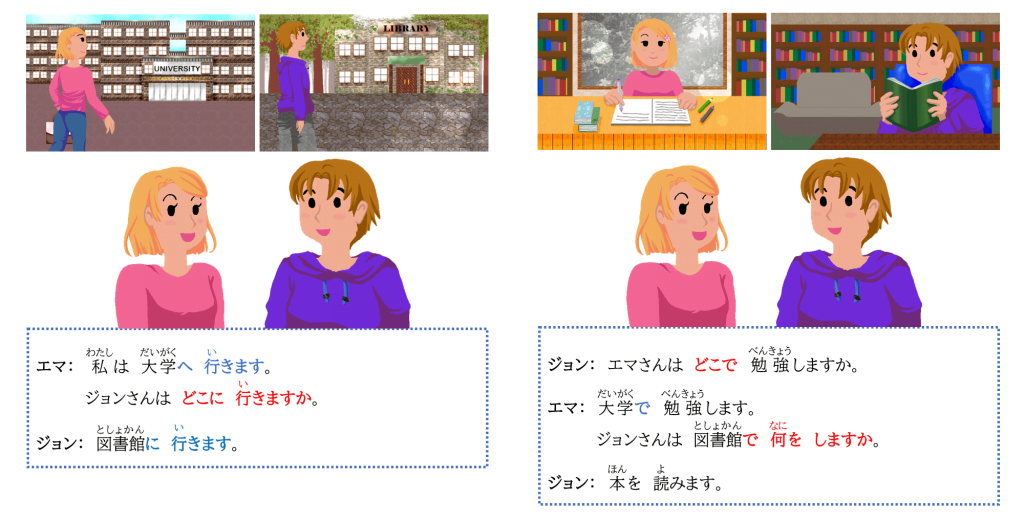
This time, we will add more places to the SOV sentence patterns we studied in the previous lesson.
The particles used with place are へ, に and で.
In the illustration on the left, Emma and John are talking about where they are going.
The sentence patterns in the examples are the blue ones, (subject / topic) は (place) へ 行(い)きます and the question-answer ones, (place) に 行(い)きます.
The に and へ particles have approximately the same meaning, so you can use either one.
In the examples, only the verb 行(い)く was used, but 帰(かえ)る and 来(く)る also use the particle に or へ after the place noun.
Therefore, the sentence pattern we will be practising this time is: (subject / topic) は (place) に/へ 行(い)きます/来(き)ます/帰(かえ)ります.
Negative sentences use the negative form of verb ます form: verbません.
The question is about a place, so use the question word どこ, marked in red.
You can also use either どこに or どこへ.
In the illustration on the right, Emma and John are talking about places to study and read books.
When moving towards a place, you use the particle に or へ, but when indicating a place to do something, you use the particle で.
The sentence pattern is: (subject / topic) は (place) で (object) を verbます.
I wrote two questions.
One question asks the place where the action indicated by the verb is performed using どこで, and the other question combines the object question 何(なに)を verbますか that we studied in the previous lesson with the sentence pattern that we will study this time.
It’s not a difficult grammar, so let’s calm down and practise one thing at a time!
If you have a textbook, read the explanations of particles in the textbook.
| Second edition | Pages 90 and 91: 3 Particles で and に (1) goal of movement, へ |
| Third edition | Page 89: 3 Particles で and に (1) Goal of movement, へ |
Verb sentence pattern 2: (subject / topic) は (place) で verbます/ません
First, let’s study sentence patterns using the particle で!
The particle で is a tag indicating the place where an action takes place.
The place indicated by the noun preceding で is where the action of the verb occurs.
| Sentence pattern | (subject / topic) は (place) で verbます/ません |
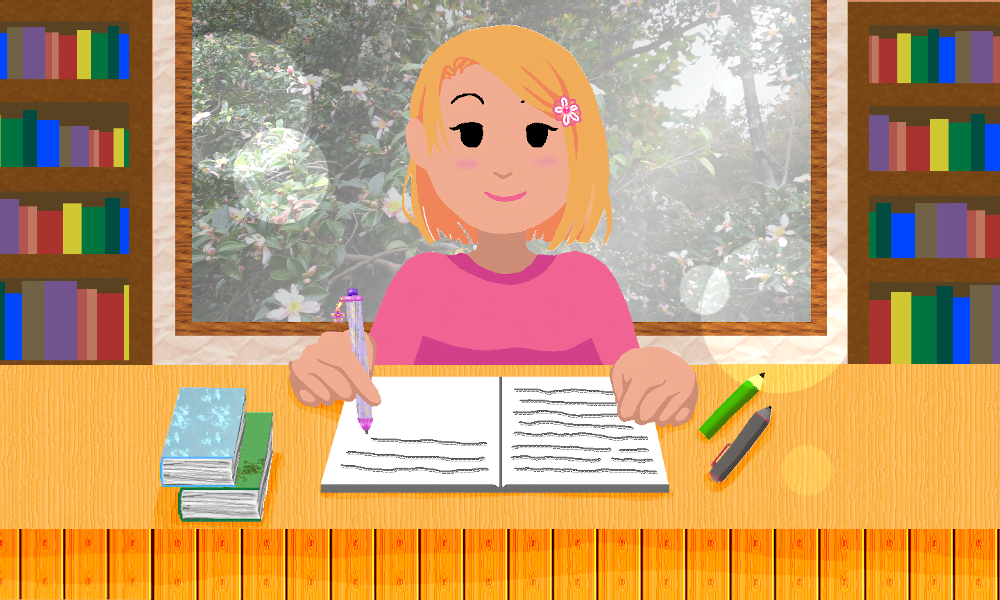 | エマさんは 大学(だいがく)で 勉強(べんきょう)します。 |
| Sentence pattern | (subject / topic) は (place) で (object) を verbます/ません |
 | ジョンさんは 図書館(としょかん)で 本(ほん)を 読(よ)みます。 |
When there is an object word, as in the example above, the word for the place is inserted before the object word.
The word order will be explained in more detail later.
Now let’s have a bit of practice!
Practice
1. Look at the table below and make sentences.
✓: affirmative sentence / ×: negative sentence
Example: エマ / to listen
エマさんは うちで アメリカの音楽(おんがく)を 聞(き)きます。
エマさんは うちで 中国(ちゅうごく)の音楽(おんがく)を 聞(き)きません。
| エマ | ジョン | |||
| verbs | place | object | place | object |
| 1. to listen | Example: home | Example: ✓ American music × Chinese music | friend’s house | ✓ Australian music |
| 2. to drink | café | × green tea | home | ✓ alcohol |
| 3. to speak | university | × Chinese | Japanese language school | ✓ Japanese |
| 4. to read | library | ✓ a history book | library | × a Japanese newspaper |
| 5. to eat | mother’s house | ✓ dinner | café | × a hamburger |
| 6. to sleep | ✓ home | N/A | × toilet | N/A |
| 7. to watch | Sarah’s house | × an Australian movie | grandfather’s house | ✓ British TV |
| 8. to do | friend’s school | × tennis | Tokyo | ✓ dating |
| 9. to study | home | ✓ history | business school | × computer |
2. Use the following words for places to make sentences of the form (subject / topic) は (place) で (object) を verbます/ません.
・ The subject is 私(わたし).
・Compose affirmative and negative sentences.
Example: うち
私(わたし)は うちで 日本(にほん)の音楽(おんがく)を 聞(き)きます。
私(わたし)は うちで お酒(さけ)を 飲(の)みません。
- 学校(がっこう)
- 喫茶店(きっさてん)
- 友達(ともだち)の家(いえ)
- 図書館(としょかん)
Good job! You did your best!
Check out the answers in the PDF below!
If you have a textbook, do the exercises in it too!
| Second edition | Page 96: (b) |
| Third edition | Page 95: II 図書館で雑誌を読みます A (b) |
For the third edition exercise, look at the illustrations in I, (1) to (7), on page 94 to make sentences.
Sentence patterns of questions
There are three sentence patterns for questions.
See the table below.
| 質問(しつもん) | 答(こた)え | |
| verb? | (subject / topic) は (place) で (object) を verbますか | はい、verbます いいえ、verbません |
| object? | (subject / topic) は (place) で 何(なに)を verbますか | (noun) を verbます |
| place? | (subject / topic) は どこで (object) を verbますか | (place) で verbます |
Example

ジョンさんは うちで 本(ほん)を 読(よ)みますか。

はい、読(よ)みます。
エマさんは うちで 何(なに)を しますか。
音楽(おんがく)を 聞(き)きます。
ジョンさんは どこで 昼(ひる)ご飯(はん)を 食(た)べますか。
喫茶店(きっさてん)で 食(た)べます。
The first question is a question with か at the end of the sentence.
Answer with はい or いいえ.
The second question asks for the object using the interrogative 何(なに).
Answer with (noun) を verbます.
The third question asks for a place using the interrogative どこ.
Answer with (place) で verbます.
You can also use the interrogatives 何(なに) and どこ together to ask: (subject / topic) は どこで 何(なに)を verbますか.
But normally, as shown in the table above, you use one interrogative for one question.
Now, let’s practise the sentence patterns for the questions!
Practice
1. Look at the table below and answer the questions.
| エマ | ジョン | |
| place | object | object |
| home | ✓TV × a hamburger | ✓ breakfast × dating |
| café | ✓ ice cream × water | ✓ lunch × coffee |
| school | ✓ sports × alcohol | ✓ Japanese × American music |
| library | ✓ a Japanese book × green tea | ✓ a music magazine × meat |
| friend’s house | ✓ Japanese movie × dating | ✓ dinner × Japanese |
- エマさんは うちで テレビを 見(み)ますか。
- ジョンさんは どこで 晩(ばん)ご飯(はん)を 食(た)べますか。
- エマさんは 図書館(としょかん)で 何(なに)を しますか。
- ジョンさんは うちで デートを しますか。
- エマさんは どこで スポーツを しますか。
- ジョンさんは 喫茶店(きっさてん)で 何(なに)を しますか。
2. Use the table above to make three sets of questions and answers.
Example: (subject / topic) は (place) で (object) を verbますか
Q. エマさんは うちで ハンバーガーを 食(た)べますか。
A. いいえ、食(た)べません。
- (subject / topic) は (place) で (object) を verbますか
Q.
A. - (subject / topic) は (place) で 何(なに)を verbますか
Q.
A. - (subject / topic) は どこで (object) を verbますか
Q.
A.
3. Answer the questions.
- うちで 野菜(やさい)を 食(た)べますか。
- カフェで 何(なに)を 飲(の)みますか。
- どこで 日本語(にほんご)を 勉強(べんきょう)しますか。
When you’re done, check out the answers in the PDF below!
The third edition of the textbook includes some pair works.
If you have friends to practise with, try it!
Practice B allows you to practise questions and answers by yourself.
| Third edition | Pages 95 and 96: B and C, D |
Verb sentence pattern 3: (subject / topic) は (place) に/へ 行(い)きます/来(き)ます/帰(かえ)ります
The verbs 行(い)く, 来(く)る and 帰(かえ)る, which are studied in Lesson 3, use the particle に or へ.
Many people make the mistake of using the particle を to say 大学(だいがく)を 行(い)きます, so be careful!
The particles に and へ are tags that indicate where you are heading.
The place in front of に and へ is the goal.
The particle へ is pronounced as [e].
As written in textbooks, the particle に has many meanings.
Let’s study the particle に used in time expressions next time.
Before we start practising sentence patterns, I would like to explain a little more about the verbs 行(い)く, 来(く)る and 帰(かえ)る.
行(い)く, 来(く)る, 帰(かえ)る
First, let me explain about 行(い)く and 来(く)る.
行(い)く is translated as ‘to go’ and 来(く)る as ‘to come’ in English, but there are slight differences in the way the verbs are used in Japanese and English.
See the illustrations below.
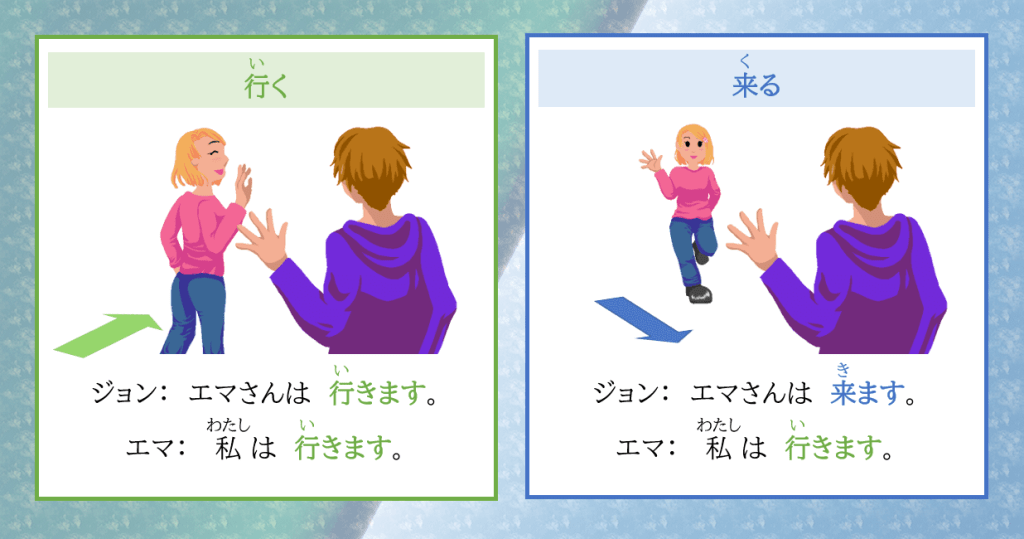
The verb 行(い)く is used when the speaker leaves the place.
Look at the illustration on the left.
Emma is moving away from John, so John uses 行(い)く.
Emma is moving away from where she is, so she uses 行(い)く too.
On the other hand, 来(く)る is used when a person is approaching the place of the speaker.
Look at the illustration on the right.
John uses 来(く)る as Emma approaches him.
But Emma uses 行(い)く because she is leaving her place.
In English she says ‘I’m coming’, but in Japanese it will be 行(い)きます.
The verbs 行(い)く and 来(く)る are reversed in Japanese and English.
Languages cannot be translated perfectly, so it is important not to rely on translations alone.
Remember the basic rules for 行(い)く and 来(く)る introduced here, and be careful not to make mistakes!
There are also explanations of 行(い)く and 来(く)る in Expression Notes 4 / 表現(ひょうげん)ノート4 of the textbook.
The contents are the same as those explained here, but please have a look if you like.
| Second edition | Page 94: 表現ノート4 行く/来る |
| Third edition | Page 93: 表現ノート4 行く/来る |
Next, we discuss the verb 帰(かえ)る.
The basic meaning of the verb 帰(かえ)る is ‘to return home’.
So the place words used with the verb 帰(かえ)る are nouns that indicate the place to which you belong, such as 家(いえ) and うち, the name of your home country or town.
Some people may simply use the verb 帰(かえ)る in the sense of ‘to return’, as in 大学(だいがく)に帰(かえ)る.
But there is another verb, 戻(もど)る, which means ‘to go back to where you were originally’. If you intend to say you are going back to your original place, it is better to use the verb 戻(もど)る to say 大学(だいがく)に戻(もど)る.
The only place you describe as 帰(かえ)る is your own home and hometown!
Explanation and practice of sentence patterns
Verbs that express movement, such as 行(い)く, 来(く)る and 帰(かえ)る, use the particle に or へ.
The affirmative and negative sentence patterns are summarised in the table below.
| affirmative | 行(い)く | (subject / topic) は (place) に/へ 行(い)きます |
| 来(く)る | (subject / topic) は (place) に/へ 来(き)ます | |
| 帰(かえ)る | (subject / topic) は (place) に/へ 帰(かえ)ります | |
| negative | 行(い)く | (subject / topic) は (place) に/へ 行(い)きません |
| 来(く)る | (subject / topic) は (place) に/へ 来(き)ません | |
| 帰(かえ)る | (subject / topic) は (place) に/へ 帰(かえ)りません |
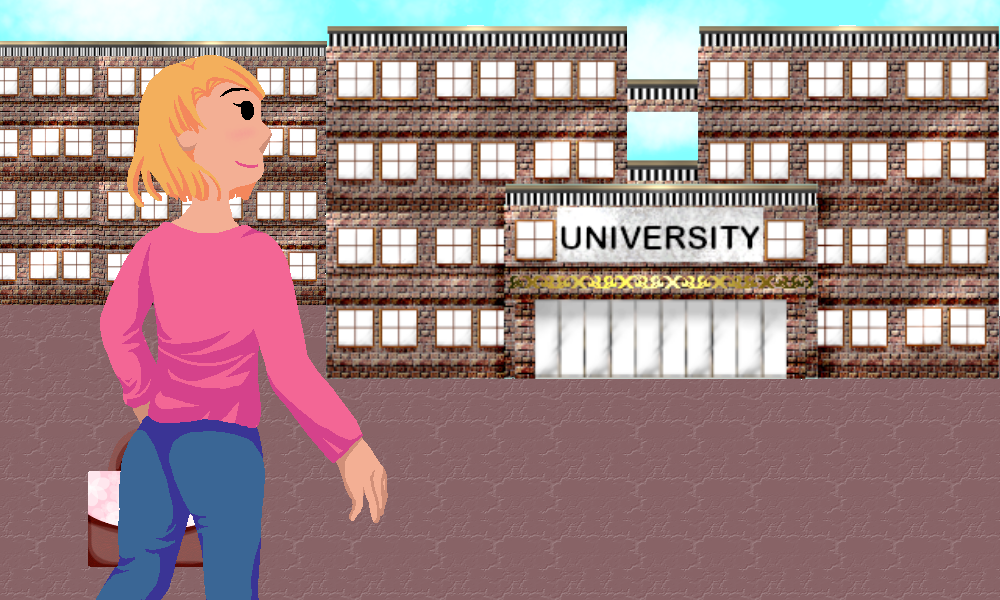 | エマさんは 大学(だいがく)に 行(い)きます。 |
 | ジョンさんは カフェに 来(き)ます。 |
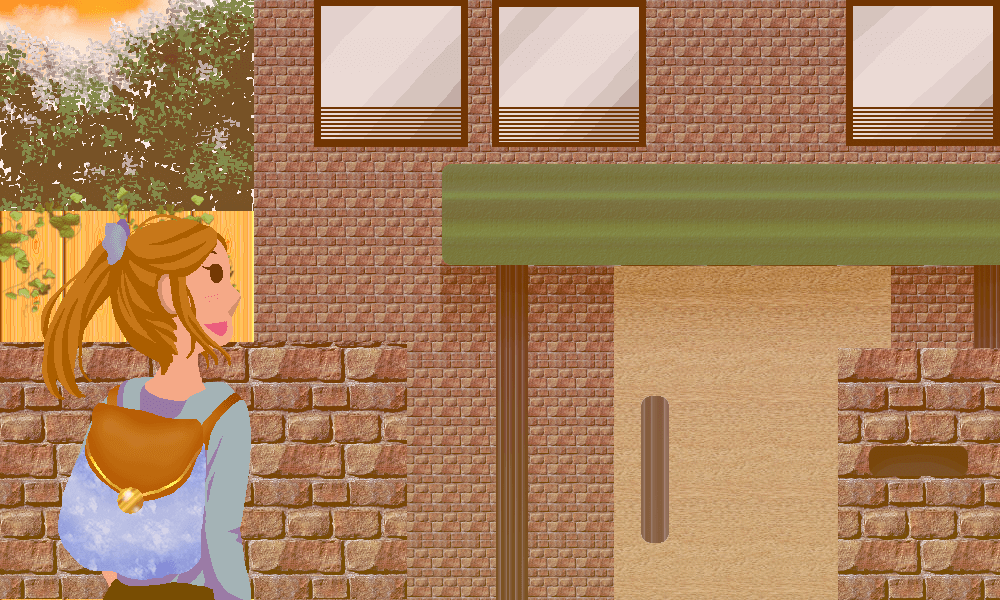 | サラさんは うちへ 帰(かえ)ります。 |
The key point is (place) に/へ.
Let’s practise!
Practice
Make sentences using the verbs 行(い)く, 来(く)る and 帰(かえ)る.
Example 1: エマ / to go / university
エマさんは 大学(だいがく)に 行(い)きます。
Example 2: エマ / not to go / library
エマさんは 図書館(としょかん)へ 行(い)きません。
- エマ / to go / bank
- ジョン / not to come / this café
- たろう / to return / Japan
- ユミ / not to go / convenience store
- サラ / to come / that post office
- ジュン / not to return / home
Check out the PDF below for the answers!
If you have a textbook, do the exercises in it too!
| Second edition | Page 96: C |
| Third edition | Page 96: III 学校に行きます A |
Sentence patterns of questions
There are two types of question.
One is a question with か at the end of the sentence, and the other is a question asking about a place by using どこ.
| 質問(しつもん) | 答(こた)え | |
| verb? | (subject / topic) は (place) に/へ 行(い)きますか (subject / topic) は (place) に/へ 来(き)ますか (subject / topic) は (place) に/へ 帰(かえ)りますか | はい、行(い)きます/いいえ、行(い)きません はい、来(き)ます/いいえ、来(き)ません はい、帰(かえ)ります/いいえ、帰(かえ)りません |
| place? | (subject / topic) は どこに/どこへ 行(い)きますか (subject / topic) は どこに/どこへ 来(き)ますか (subject / topic) は どこに/どこへ 帰(かえ)りますか | (place) に/へ 行(い)きます。 (place) に/へ 来(き)ます。 (place) に/へ 帰(かえ)ります。 |
Example
ジョンさんは 学校(がっこう)に 行(い)きますか。
はい、行(い)きます。
エマさんは どこに 行(い)きますか。
郵便局(ゆうびんきょく)に 行(い)きます。
When asking questions, you can use either of the two particles に or へ.
However, it is better to use the same particle in questions and answers.
Example
Q. どこに 行(い)きますか。
A. 学校(がっこう)に 行(い)きます。
Q. どこへ 帰(かえ)りますか。
A. うちへ 帰(かえ)ります。
There’s not much practice in the textbook, so let’s do the practice below together!
Practice
1. Practise asking and answering questions.
Example: Q. エマ / to go — A. school
Q. エマさんは どこに 行(い)きますか。
A. 学校(がっこう)に 行(い)きます。
- Q. エマ / to come — A. bank
- Q. ジョン / to go — A. post office
- Q. たろう / to go — A. university
- Q. サラ / to return — A. home
- Q. ジャック / to come — A. café
- Q. ゆきこ / to return — A. Japan
2. Answer the questions.
- 日本語(にほんご)の学校(がっこう)に 行(い)きますか。
- 日本(にほん)に 来(き)ますか。
- どこへ 帰(かえ)りますか。
How was it?
Now you can ask and answer questions without problems.
You can check the answers in the PDF below!
The third edition of the textbook includes a pair work.
It’s an exercise you do while looking at the illustrations in the textbook, so you can practise your questions and answers on your own!
| Third edition | Page 97: B |
Summary quiz
How did you practise verb sentence patterns with place nouns?
Again, lots of practice!
Lastly, let’s have a quiz to sum up the lesson!
Quiz 1: Translate the following English sentences into Japanese.
- Emma reads an English book in the library.
- John goes to a Japanese language school.
- Sarah doesn’t eat ice cream at home.
- Yoshio comes to the university.
- Hanako doesn’t drink green tea in a café.
Quiz 2: Answer the questions.
- うちで 何(なに)を しますか。
- どこで 映画(えいが)を 見(み)ますか。
- 銀行(ぎんこう)に 行(い)きますか。
- 学校(がっこう)で 昼(ひる)ご飯(はん)を 食(た)べますか。
- カフェで 何(なに)を 飲(の)みますか。
That’s it for the quiz!
Thank you to everyone who took the quiz! Answers will be announced in the next lesson.
If you have any questions, please leave a message using the contact form!
Homework
The workbook homework is on the following pages.
| Second edition | Page 29 |
| Third edition | Page 34 |
If you don’t have a workbook, do the homework below.
Download the Word or PDF version whichever you prefer!
Even if you have workbook homework to do, give it a go!
Check the answers in the workbook by looking at the answer book.
Answers to original homework assignments will be presented in the next lesson.
If you have any thoughts about the lessons or homework, please tell me!
In the next lesson, you will study verb sentence patterns using time expressions.
Please review the time phrases you studied in Lesson 1!
This time, too, let’s use the sentence patterns we have studied to describe our day in Japanese.
Example: うちで 朝(あさ)ご飯(はん)を 食(た)べます。 → 学校(がっこう)に 行(い)きます。 → 学校(がっこう)で 日本語(にほんご)を 勉強(べんきょう)します。 → カフェで 昼(ひる)ご飯(はん)を 食(た)べます → ……
In this lesson we studied sentence patterns using places, so now you can describe your day in more detail in Japanese! Please try practising!
Thank you for reading!
See you in the next lesson!
If you are interested in Japanese particles, read our blog!

For more lessons from Lesson 3, click here!

Click here to go to the Hiragana and Katakana, Kanji practice pages!


And be sure to check out the resources and practices on our Bookshelf page!

日本語(にほんご)のレッスン

みなさん、こんにちは!
前回(ぜんかい)のレッスンでは、簡単(かんたん)なSOVの文型(ぶんけい)と質問(しつもん)を練習(れんしゅう)しました。
今回(こんかい)は、前回(ぜんかい)勉強(べんきょう)した文型(ぶんけい)に場所(ばしょ)の単語(たんご)を増(ふ)やします。
新(あたら)しい助詞(じょし)と単語(たんご)もあるし、文(ぶん)が長(なが)くなるので、ちょっと大変(たいへん)かもしれません。
ゆっくり少(すこ)しずつ練習(れんしゅう)しましょう!
今回(こんかい)のレッスンから、例(れい)は漢字(かんじ)を使(つか)って書(か)きます。
難(むずか)しい漢字(かんじ)は覚(おぼ)えなくてもいいです。
ひらがなとカタカナと漢字(かんじ)を使(つか)った日本語(にほんご)の文(ぶん)に慣(な)れましょう!
教科書(きょうかしょ)の第三課(だいさんか)で勉強(べんきょう)する漢字(かんじ)は、漢字練習(かんじれんしゅう)のページで練習(れんしゅう)できますよ!
よかったら、見(み)てみてください!
それでは、レッスンを始(はじ)める前(まえ)に、まず前回(ぜんかい)の宿題(しゅくだい)の答(こた)えを発表(はっぴょう)します。
WordとPDFを作(つく)ったので、答(こた)えを見(み)たい人(ひと)はダウンロードしてください!
レッスン28の宿題(しゅくだい)の答(こた)え
たくさん質問(しつもん)がありましたね。全部(ぜんぶ)答(こた)えられましたか。
最後(さいご)の質問(しつもん)は、ちょっと難(むずか)しくしました。
みなさんがもう知(し)っている単語(たんご)を使(つか)ったアレンジなので、単語(たんご)がわかれば質問(しつもん)の意味(いみ)もわかると思(おも)います。
でも、時間(じかん)の単語(たんご)を使(つか)う文型(ぶんけい)は、次回(じかい)もっと勉強(べんきょう)するので、今(いま)は正解(せいかい)できなくても大丈夫(だいじょうぶ)ですよ!
それでは次(つぎ)に、前回(ぜんかい)のまとめのクイズの答(こた)えを発表(はっぴょう)します。
クイズの答(こた)えを見(み)なくてもいい人(ひと)は、スキップしてください。
前回(ぜんかい)のクイズは翻訳(ほんやく)と質問(しつもん)でした。
翻訳(ほんやく)の問題(もんだい)は、文型(ぶんけい)と単語(たんご)の意味(いみ)がわかっているかどうかのチェックのために作(つく)りました。
人(ひと)の名前(なまえ)の後(あと)に「さん」を付(つ)けるのを忘(わす)れないでくださいね!
それでは、クイズの答(こた)えをチェックしてみましょう!
クイズ1:次(つぎ)の英語(えいご)の文(ぶん)を日本語(にほんご)に翻訳(ほんやく)してください。
- Emma studies Japanese history.
エマさんは 日本(にほん)の歴史(れきし)を 勉強(べんきょう)します。 - John does not drink coffee.
ジョンさんは コーヒーを 飲(の)みません。 - I read music magazines.
私(わたし)は 音楽(おんがく)の雑誌(ざっし)を 読(よ)みます。 - What does Yukiko do?
ゆきこさんは 何(なに)を しますか。 - What does Taro eat?
たろうさんは 何(なに)を 食(た)べますか。
一番(いちばん)の ‘Japanese history’ は「日本語(にほんご)の歴史(れきし)」でもいいです。
でも、たいていは「日本(にほん)の歴史(れきし)」と翻訳(ほんやく)します。
三番(さんばん)は ‘magazines’ ですが、日本語(にほんご)は単数(たんすう)の ‘magazine’ も複数(ふくすう)の ‘magazines’ も「雑誌(ざっし)」と言(い)います。
クイズ2:質問(しつもん)に答(こた)えましょう。
- にほんごを はなしますか。
はい、話(はな)します。/いいえ、話(はな)しません。 - えいごのおんがくを ききますか。
はい、聞(き)きます。/いいえ、聞(き)きません。 - なにを みますか。
(noun)を 見(み)ます。
例(れい):テレビを 見(み)ます。 - なにを のみますか。
(noun)を 飲(の)みます。
例(れい):コーヒーを 飲(の)みます。 - さかなを たべますか。
はい、食(た)べます。/いいえ、食(た)べません。
「(noun)を verbますか」の質問(しつもん)には「はい、verbます」か「いいえ、verbません」で答(こた)えます。
「何(なに)を verbますか」の質問(しつもん)には、目的語(もくてきご)の名詞(めいし)を使(つか)って「(noun)を verbます」と答(こた)えます。
それでは、動詞(どうし)の文型(ぶんけい)二回目(にかいめ)のレッスンを始(はじ)めましょう!
今回(こんかい)は新(あたら)しい助詞(じょし)を三(みっ)つ紹介(しょうかい)します。
でも、そのうちの二(ふた)つはだいたい同(おな)じ意味(いみ)です。
なので、今回(こんかい)覚(おぼ)える助詞(じょし)は二(ふた)つで大丈夫(だいじょうぶ)です。
まず、今回(こんかい)のレッスンで使(つか)う場所(ばしょ)の単語(たんご)を覚(おぼ)えましょう!
教科書(きょうかしょ)の単語(たんご)のページは、下(した)のページです。
| 第二版(だいにはん) | 86ページと87ページ |
| 第三版(だいさんぱん) | 84ページと85ページ |
このレッスンで使(つか)う場所(ばしょ)の名詞(めいし)だけ下(した)の表(ひょう)に書(か)きます。
第三版(だいさんぱん)は第二版(だいにはん)より一(ひと)つだけ単語(たんご)が多(おお)いです。
下(した)の表(ひょう)には、第二版(だいにはん)と第三版(だいさんぱん)の全部(ぜんぶ)の単語(たんご)があります。
単語(たんご)
| 日本語(にほんご) | 英語(えいご) |
| 家(いえ) | home / house |
| うち | home / house / my place |
| 学校(がっこう) | school |
| カフェ | café |
アクセントは人(ひと)や地方(ちほう)によって少(すこ)し違(ちが)います。
- 「カフェ」は「喫茶店(きっさてん)」と同(おな)じ意味(いみ)です。
- 「家(いえ)」と「うち」はだいたい同(おな)じ意味(いみ)です。
「うち」のほうが少(すこ)しカジュアルに聞(き)こえます。
今回(こんかい)新(あたら)しく覚(おぼ)える単語(たんご)は、上(うえ)の表(ひょう)の四(よっ)つだけです。
「カフェ」は「喫茶店(きっさてん)」と同(おな)じなので、どちらを使(つか)ってもいいです。
第一課(だいいっか)と第二課(だいにか)で勉強(べんきょう)した場所(ばしょ)の単語(たんご)も使(つか)うので、忘(わす)れた人(ひと)はチェックしておきましょう!
まず、レッスンの前(まえ)に復習(ふくしゅう)をします。
復習(ふくしゅう)をしなくても大丈夫(だいじょうぶ)な人(ひと)もいると思(おも)います。
でも、練習(れんしゅう)はたくさんした方(ほう)がいいので、一緒(いっしょ)に復習(ふくしゅう)しましょう!
復習(ふくしゅう)
1.動詞(どうし)の辞書形(じしょけい)とます形(けい)を書(か)きましょう。
| English | dictionary form | masu form (affirmative) | masu form (negative) |
| to sleep to go to sleep | |||
| to study | |||
| to go back to return | |||
| to get up | |||
| to go | |||
| to listen to hear | |||
| to speak to talk | |||
| to do | |||
| to drink | |||
| to eat | |||
| to read | |||
| to come | |||
| to see to look at to watch |
2.次(つぎ)の動詞(どうし)を使(つか)って、「verbます」と「verbません」の文(ぶん)を作(つく)ってください。
例(れい):食(た)べる
私(わたし)は 朝(あさ)ご飯(はん)を 食(た)べます。
私(わたし)は 昼(ひる)ご飯(はん)を 食(た)べません。
- 聞(き)く
- 話(はな)す
- 見(み)る
- 読(よ)む
3.質問(しつもん)に答(こた)えてください。
- 何(なに)を 飲(の)みますか。
- 英語(えいご)を 勉強(べんきょう)しますか。
- デートを しますか。
- 何(なに)を 食(た)べますか。
第三課(だいさんか)でこれまでに勉強(べんきょう)した内容(ないよう)全部(ぜんぶ)の復習(ふくしゅう)です。
たくさんありますが、動詞(どうし)の変化(へんか)とSOVの文型(ぶんけい)と質問(しつもん)は、これからの勉強(べんきょう)でも使(つか)うのでとても大事(だいじ)です。
繰(く)り返(かえ)し練習(れんしゅう)して、かんぺきにしましょう!
答(こた)えは下(した)のPDFでチェックしましょう!
これで、これまでに勉強(べんきょう)した文法(ぶんぽう)はかんぺきですね!
それでは、今回(こんかい)のレッスンのイラストを見(み)てみましょう!
今回(こんかい)のレッスン
今回(こんかい)は、前回(ぜんかい)勉強(べんきょう)したSOVの文型(ぶんけい)に場所(ばしょ)を増(ふ)やします。
場所(ばしょ)と一緒(いっしょ)に使(つか)う助詞(じょし)は、「へ」「に」「で」です。
左(ひだり)のイラストで、エマさんとジョンさんはそれぞれが行(い)く場所(ばしょ)について話(はな)しています。
例(れい)の中(なか)の文型(ぶんけい)は青(あお)で示(しめ)した「(subject / topic) は (place) へ 行(い)きます」と質問(しつもん)の答(こた)えの「(place) に 行(い)きます」です。
この「に」と「へ」はだいたい同(おな)じ意味(いみ)なので、どちらを使(つか)ってもいいです。
そして、例(れい)では動詞(どうし)の「行(い)く」だけを使(つか)いましたが、「帰(かえ)る」と「来(く)る」も場所(ばしょ)の名詞(めいし)の後(あと)に 助詞(じょし)の「に」か「へ」を使(つか)います。
なので、今回(こんかい)練習(れんしゅう)する文型(ぶんけい)は「(subject / topic) は (place) に/へ 行(い)きます/来(き)ます/帰(かえ)ります」になります。
否定文(ひていぶん)は動詞(どうし)を「verbません」の形(かたち)にします。
質問(しつもん)は、場所(ばしょ)についてなので赤(あか)で示(しめ)した「どこ」を使(つか)います。
これも、「どこに」と「どこへ」のどちらでもいいです。
右(みぎ)のイラストでは、エマさんとジョンさんが勉強(べんきょう)したり本(ほん)を読(よ)んだりする場所(ばしょ)について話(はな)しています。
場所(ばしょ)に向(む)かって移動(いどう)する時(とき)は、助詞(じょし)の「に」か「へ」を使(つか)いますが、何(なに)かをする場所(ばしょ)を表(あらわ)す時(とき)は助詞(じょし)の「で」を使(つか)います。
文型(ぶんけい)は、「(subject / topic) は (place) で (object) を verbます」です。
質問(しつもん)は二(ふた)つ書(か)きました。
何(なに)かをする場所(ばしょ)を聞(き)く「どこで」を使(つか)った質問(しつもん)と、前回(ぜんかい)勉強(べんきょう)した「何(なに)を verbますか」と今回(こんかい)勉強(べんきょう)する文型(ぶんけい)を組(く)み合(あ)わせた質問(しつもん)です。
難(むずか)しい文法(ぶんぽう)ではないので、落(お)ち着(つ)いて一(ひと)つずつ練習(れんしゅう)しましょう!
教科書(きょうかしょ)がある人(ひと)は、教科書(きょうかしょ)にある助詞(じょし)の説明(せつめい)を読(よ)んでみましょう。
| 第二版(だいにはん) | 90ページと91ページ: 3 Particles で と に (1) goal of movement と へ |
| 第三版(だいさんぱん) | 89ページ: 3 Particles で と に (1) Goal of movement と へ |
動詞(どうし)の文型(ぶんけい)2:(subject / topic) は (place) で verbます/ません
まず、助詞(じょし)の「で」を使(つか)った文型(ぶんけい)を勉強(べんきょう)しましょう!
助詞(じょし)の「で」は、何(なに)かをする場所(ばしょ)を示(しめ)すタグです。
「で」の前(まえ)にある場所(ばしょ)が、動詞(どうし)のアクションをする場所(ばしょ)になります。
| 文型(ぶんけい) | (subject / topic) は (place) で verbます/ません |
| エマさんは 大学(だいがく)で 勉強(べんきょう)します。 |
| 文型(ぶんけい) | (subject / topic) は (place) で (object) を verbます/ません |
| ジョンさんは 図書館(としょかん)で 本(ほん)を 読(よ)みます。 |
上(うえ)の例(れい)のように、目的語(もくてきご)がある時(とき)は、目的語(もくてきご)の前(まえ)に場所(ばしょ)の単語(たんご)を入(い)れます。
語順(ごじゅん)については、あとで詳(くわ)しく説明(せつめい)します。
それでは、ちょっと練習(れんしゅう)してみましょう!
練習(れんしゅう)
1.下(した)の表(ひょう)を見(み)て文(ぶん)を作(つく)りましょう。
✓:肯定文(こうていぶん)/×:否定文(ひていぶん)
例(れい):エマ / to listen
エマさんは うちで アメリカの音楽(おんがく)を 聞(き)きます。
エマさんは うちで 中国(ちゅうごく)の音楽(おんがく)を 聞(き)きません。
| エマ | ジョン | |||
| verbs | place | object | place | object |
| 1. to listen | Example: home | Example: ✓ American music × Chinese music | friend’s house | ✓ Australian music |
| 2. to drink | café | × green tea | home | ✓ alcohol |
| 3. to speak | university | × Chinese | Japanese language school | ✓ Japanese |
| 4. to read | library | ✓ a history book | library | × a Japanese newspaper |
| 5. to eat | mother’s house | ✓ dinner | café | × a hamburger |
| 6. to sleep | ✓ home | N/A | × toilet | N/A |
| 7. to watch | Sarah’s house | × an Australian movie | grandfather’s house | ✓ British TV |
| 8. to do | friend’s school | × tennis | Tokyo | ✓ dating |
| 9. to study | home | ✓ history | business school | × computer |
2.次(つぎ)の場所(ばしょ)の単語(たんご)を使(つか)って、「(subject / topic) は (place) で (object) を verbます/ません」の文(ぶん)を作(つく)りましょう。
・主語(しゅご)は「私(わたし)」です。
・肯定(こうてい)と否定(ひてい)の文(ぶん)を作(つく)りましょう。
例(れい):うち
私(わたし)は うちで 日本(にほん)の音楽(おんがく)を 聞(き)きます。
私(わたし)は うちで お酒(さけ)を 飲(の)みません。
- 学校(がっこう)
- 喫茶店(きっさてん)
- 友達(ともだち)の家(いえ)
- 図書館(としょかん)
おつかれさまでした!がんばりましたね!
下(した)のPDFで答(こた)えをチェックしてください!
教科書(きょうかしょ)がある人(ひと)は、教科書(きょうかしょ)の練習(れんしゅう)もしましょう!
| 第二版(だいにはん) | 96ページ: (b) |
| 第三版(だいさんぱん) | 95ページ: II 図書館で雑誌を読みます A (b) |
第三版(だいさんぱん)の練習(れんしゅう)は、94ページの I の (1) から (7) のイラストを見(み)て文(ぶん)を作(つく)ります。
質問(しつもん)の文型(ぶんけい)
質問(しつもん)の文型(ぶんけい)は、全部(ぜんぶ)で三(みっ)つあります。
下(した)の表(ひょう)を見(み)てください。
| 質問(しつもん) | 答(こた)え | |
| verb? | (subject / topic) は (place) で (object) を verbますか | はい、verbます いいえ、verbません |
| object? | (subject / topic) は (place) で 何(なに)を verbますか | (noun) を verbます |
| place? | (subject / topic) は どこで (object) を verbますか | (place) で verbます |
例(れい)
ジョンさんは うちで 本(ほん)を 読(よ)みますか。
はい、読(よ)みます。
エマさんは うちで 何(なに)を しますか。
音楽(おんがく)を 聞(き)きます。
ジョンさんは どこで 昼(ひる)ご飯(はん)を 食(た)べますか。
喫茶店(きっさてん)で 食(た)べます。
一番目(いちばんめ)の質問(しつもん)は、文(ぶん)の最後(さいご)に「か」を付(つ)けた質問(しつもん)です。
「はい」か「いいえ」で答(こた)えます。
二番目(にばんめ)の質問(しつもん)は、「何(なに)」を使(つか)って目的語(もくてきご)を聞(き)く質問(しつもん)です。
「(noun) を verbます」で答(こた)えます。
三番目(さんばんめ)の質問(しつもん)は、「どこ」を使(つか)って場所(ばしょ)を聞(き)く質問(しつもん)です。
「(place) で verbます」で答(こた)えます。
「何(なに)」と「どこ」を一緒(いっしょ)に使(つか)って、「(subject / topic) は どこで 何(なに)を verbますか」と聞(き)くこともできます。
でも、普通(ふつう)は上(うえ)の表(ひょう)に書(か)いたように、一(ひと)つの質問(しつもん)に一(ひと)つの疑問詞(ぎもんし)を使(つか)います。
それでは、質問(しつもん)の文型(ぶんけい)を練習(れんしゅう)してみましょう!
練習(れんしゅう)
1.下(した)の表(ひょう)を見て、質問(しつもん)に答(こた)えてください。
| エマ | ジョン | |
| place | object | object |
| home | ✓TV × a hamburger | ✓ breakfast × dating |
| café | ✓ ice cream × water | ✓ lunch × coffee |
| school | ✓ sports × alcohol | ✓ Japanese × American music |
| library | ✓ a Japanese book × green tea | ✓ a music magazine × meat |
| friend’s house | ✓ Japanese movie × dating | ✓ dinner × Japanese |
- エマさんは うちで テレビを 見(み)ますか。
- ジョンさんは どこで 晩(ばん)ご飯(はん)を 食(た)べますか。
- エマさんは 図書館(としょかん)で 何(なに)を しますか。
- ジョンさんは うちで デートを しますか。
- エマさんは どこで スポーツを しますか。
- ジョンさんは 喫茶店(きっさてん)で 何(なに)を しますか。
2.上(うえ)の表(ひょう)を使(つか)って、質問(しつもん)と答(こた)えのセットを三(みっ)つ作(つく)ってください。
例(れい):(subject / topic) は (place) で (object) を verbますか
Q. エマさんは うちで ハンバーガーを 食(た)べますか。
A. いいえ、食(た)べません。
- (subject / topic) は (place) で (object) を verbますか
Q.
A. - (subject / topic) は (place) で 何(なに)を verbますか
Q.
A. - (subject / topic) は どこで (object) を verbますか
Q.
A.
3.質問(しつもん)に答(こた)えてください。
- うちで 野菜(やさい)を 食(た)べますか。
- カフェで 何(なに)を 飲(の)みますか。
- どこで 日本語(にほんご)を 勉強(べんきょう)しますか。
できたら、下(した)のPDFで答(こた)えをチェックしてみてください!
第三版(だいさんぱん)の教科書(きょうかしょ)にペアワークがあります。
一緒(いっしょ)に練習(れんしゅう)する友達(ともだち)がいる人(ひと)は、ぜひやってみてください!
B の練習(れんしゅう)は質問(しつもん)と答(こた)えを一人(ひとり)で練習(れんしゅう)できます。
| 第三版(だいさんぱん) | 95ページと96ページ: B と C と D |
動詞(どうし)の文型(ぶんけい)3:(subject / topic) は (place) に/へ 行(い)きます/来(き)ます/帰(かえ)ります
第三課(だいさんか)で勉強(べんきょう)する動詞(どうし)の「行(い)く」「来(く)る」「帰(かえ)る」は、助詞(じょし)の「に」か「へ」を使(つか)います。
助詞(じょし)の「を」を使(つか)って「大学(だいがく)を行(い)きます」と言(い)う間違(まちが)いが多(おお)いので、気(き)を付(つ)けましょう!
助詞(じょし)の「に」と「へ」は、自分(じぶん)が向(む)かう場所(ばしょ)を示(しめ)すタグです。
「に」と「へ」の前(まえ)にある場所(ばしょ)がゴールになります。
助詞(じょし)の「へ」は [e] と発音(はつおん)します。
教科書(きょうかしょ)にも書(か)いてありますが、助詞(じょし)の「に」にはたくさんの意味(いみ)があります。
時間(じかん)の表現(ひょうげん)で使(つか)う助詞(じょし)の「に」については、次回(じかい)勉強(べんきょう)しましょう。
早速(さっそく)文型(ぶんけい)を練習(れんしゅう)する前(まえ)に、まず動詞(どうし)の「行(い)く」「来(く)る」「帰(かえ)る」についてもう少(すこ)し説明(せつめい)したいと思(おも)います。
「行(い)く」、「来(く)る」、「帰(かえ)る」
はじめに、「行(い)く」と「来(く)る」について説明(せつめい)します。
英語(えいご)では ‘to go’ と ‘to come’ と翻訳(ほんやく)しますが、動詞(どうし)の使(つか)い方(かた)が少(すこ)し違(ちが)います。
下(した)のイラストを見(み)てください。
「行(い)く」は、話(はな)す人(ひと)の場所(ばしょ)から離(はな)れる時(とき)に使(つか)います。
左(ひだり)のイラストを見(み)てください。
エマさんはジョンさんから離(はな)れていくので、ジョンさんは「行(い)く」を使(つか)います。
エマさんは自分(じぶん)がいる場所(ばしょ)から離(はな)れていくので、「行(い)く」を使(つか)います。
「来(く)る」は、話(はな)す人(ひと)の場所(ばしょ)に近付(ちかづ)いてくる時(とき)に使(つか)います。
右(みぎ)のイラストを見(み)てください。
ジョンさんは、エマさんが近付(ちかづ)いてくるので、「来(く)る」を使(つか)います。
でも、エマさんは自分(じぶん)がいた場所(ばしょ)から離(はな)れるので「行(い)く」を使(つか)います。
英語(えいご)では ‘I’m coming’ ですが、日本語(にほんご)では「行(い)きます」になります。
日本語(にほんご)と英語(えいご)で「行(い)く」と「来(く)る」が逆(ぎゃく)になっていますね。
言語(げんご)はかんぺきに翻訳(ほんやく)できないので、翻訳(ほんやく)だけを頼(たよ)りにしないことが大切(たいせつ)です。
ここで紹介(しょうかい)した「行(い)く」と「来(く)る」の基本(きほん)ルールを覚(おぼ)えておいて、間違(まちが)えないように気(き)を付(つ)けましょう!
教科書(きょうかしょ)の「表現(ひょうげん)ノート4」にも「行(い)く」と「来(く)る」の説明(せつめい)があります。
内容(ないよう)はここで説明(せつめい)したことと同(おな)じですが、よかったら見(み)てみてください。
| 第二版(だいにはん) | 94ページ: 表現ノート4 行く/来る |
| 第三版(だいさんぱん) | 93ページ: 表現ノート4 行く/来る |
次(つぎ)に、「帰(かえ)る」についてです。
「帰(かえ)る」の基本的(きほんてき)な意味(いみ)は、「うちに帰(かえ)る」です。
なので、「帰(かえ)る」と一緒(いっしょ)に使(つか)う場所(ばしょ)の単語(たんご)は、「家(いえ)」と「うち」、ふるさとの国(くに)や町(まち)の名前(なまえ)です。
‘to return’ の意味(いみ)で、「大学(だいがく)に帰(かえ)る」のように言(い)う人(ひと)もいるかもしれません。
でも、同(おな)じ意味(いみ)で「戻(もど)る」と言(い)う別(べつ)の動詞(どうし)があるので、「大学(だいがく)に戻(もど)る」と言(い)った方(ほう)がいいです。
「帰(かえ)る」を使(つか)うのは、自分(じぶん)の家(いえ)とふるさとだけですよ!
文型(ぶんけい)の説明(せつめい)と練習(れんしゅう)
動詞(どうし)の「行(い)く」「来(く)る」「帰(かえ)る」のように、移動(いどう)を表(あらわ)す動詞(どうし)は、助詞(じょし)の「に」か「へ」を使(つか)います。
肯定(こうてい)と否定(ひてい)の文型(ぶんけい)を下(した)の表(ひょう)にまとめますね。
| 肯定(こうてい) | 行(い)く | (subject / topic) は (place) に/へ 行(い)きます |
| 来(く)る | (subject / topic) は (place) に/へ 来(き)ます | |
| 帰(かえ)る | (subject / topic) は (place) に/へ 帰(かえ)ります | |
| 否定(ひてい) | 行(い)く | (subject / topic) は (place) に/へ 行(い)きません |
| 来(く)る | (subject / topic) は (place) に/へ 来(き)ません | |
| 帰(かえ)る | (subject / topic) は (place) に/へ 帰(かえ)りません |
| エマさんは 大学(だいがく)に 行(い)きます。 |
| ジョンさんは カフェに 来(き)ます。 |
| サラさんは うちへ 帰(かえ)ります。 |
「(place) に/へ」がポイントです。
練習(れんしゅう)してみましょう!
練習(れんしゅう)
動詞(どうし)の「行(い)く」「来(く)る」「帰(かえ)る」を使(つか)って文(ぶん)を作(つく)りましょう。
例(れい)1:エマ / to go / university
エマさんは 大学(だいがく)に 行(い)きます。
例(れい)2:エマ / not to go / library
エマさんは 図書館(としょかん)へ 行(い)きません。
- エマ / to go / bank
- ジョン / not to come / this café
- たろう / to return / Japan
- ユミ / not to go / convenience store
- サラ / to come / that post office
- ジュン / not to return / home
答(こた)えは下(した)のPDFでチェックしましょう!
教科書(きょうかしょ)がある人(ひと)は、教科書(きょうかしょ)の練習(れんしゅう)もしましょう!
| 第二版(だいにはん) | 96ページ: C |
| 第三版(だいさんぱん) | 96ページ: III 学校に行きます A |
質問(しつもん)の文型(ぶんけい)
質問(しつもん)の文型(ぶんけい)は二(ふた)つあります。
文(ぶん)の最後(さいご)に「か」を付(つ)けた質問(しつもん)と、「どこ」を使(つか)って場所(ばしょ)を聞(き)く質問(しつもん)です。
| 質問(しつもん) | 答(こた)え | |
| verb? | (subject / topic) は (place) に/へ 行(い)きますか (subject / topic) は (place) に/へ 来(き)ますか (subject / topic) は (place) に/へ 帰(かえ)りますか | はい、行(い)きます/いいえ、行(い)きません はい、来(き)ます/いいえ、来(き)ません はい、帰(かえ)ります/いいえ、帰(かえ)りません |
| place? | (subject / topic) は どこに/どこへ 行(い)きますか (subject / topic) は どこに/どこへ 来(き)ますか (subject / topic) は どこに/どこへ 帰(かえ)りますか | (place) に/へ 行(い)きます (place) に/へ 来(き)ます (place) に/へ 帰(かえ)ります |
例(れい)
ジョンさんは 学校(がっこう)に 行(い)きますか。
はい、行(い)きます。
エマさんは どこに 行(い)きますか。
郵便局(ゆうびんきょく)に 行(い)きます。
質問(しつもん)の時(とき)も、助詞(じょし)の「に」と「へ」はどちらを使(つか)ってもいいです。
でも、質問(しつもん)と答(こた)えで助詞(じょし)を同(おな)じにした方(ほう)がいいと思(おも)います。
例(れい)
Q. どこに 行(い)きますか。
A. 学校(がっこう)に 行(い)きます。
Q. どこへ 帰(かえ)りますか。
A. うちへ 帰(かえ)ります。
教科書(きょうかしょ)にはあまり練習(れんしゅう)がないので、下(した)の練習(れんしゅう)を一緒(いっしょ)にしましょう!
練習(れんしゅう)
1.質問(しつもん)と答(こた)えを練習(れんしゅう)しましょう。
例(れい):Q. エマ / to go — A. school
Q. エマさんは どこに 行(い)きますか。
A. 学校(がっこう)に 行(い)きます。
- Q. エマ / to come — A. bank
- Q. ジョン / to go — A. post office
- Q. たろう / to go — A. university
- Q. サラ / to return — A. home
- Q. ジャック / to come — A. café
- Q. ゆきこ / to return — A. Japan
2.質問(しつもん)に答(こた)えてください。
- 日本語(にほんご)の学校(がっこう)に 行(い)きますか。
- 日本(にほん)に 来(き)ますか。
- どこへ 帰(かえ)りますか。
どうでしたか。
これで質問(しつもん)も大丈夫(だいじょうぶ)ですね。
答(こた)えは下(した)のPDFでチェックできます!
第三版(だいさんぱん)の教科書(きょうかしょ)に、ペアワークがあります。
教科書(きょうかしょ)のイラストを見(み)て練習(れんしゅう)するので、質問(しつもん)と答(こた)えを一人(ひとり)で練習(れんしゅう)できますよ!
| 第三版(だいさんぱん) | 97ページ: B |
まとめのクイズ
場所(ばしょ)を使(つか)った動詞(どうし)の文型(ぶんけい)の練習(れんしゅう)は、どうでしたか。
今回(こんかい)もたくさん練習(れんしゅう)しましたね!
最後(さいご)に、レッスンのまとめのクイズに挑戦(ちょうせん)しましょう!
クイズ1:次(つぎ)の英語(えいご)の文(ぶん)を日本語(にほんご)に翻訳(ほんやく)してください。
- Emma reads an English book in the library.
- John goes to a Japanese language school.
- Sarah doesn’t eat ice cream at home.
- Yoshio comes to the university.
- Hanako doesn’t drink green tea in a café.
クイズ2:質問(しつもん)に答(こた)えましょう。
- うちで 何(なに)を しますか。
- どこで 映画(えいが)を 見(み)ますか。
- 銀行(ぎんこう)に 行(い)きますか。
- 学校(がっこう)で 昼(ひる)ご飯(はん)を 食(た)べますか。
- カフェで 何(なに)を 飲(の)みますか。
クイズは以上(いじょう)です!
クイズに挑戦(ちょうせん)してくれたみなさん、ありがとうございます!答(こた)えは次(つぎ)のレッスンで発表(はっぴょう)します。
何(なに)か質問(しつもん)があったら、お問(と)い合(あ)わせフォームからメッセージをお願(ねが)いします!
宿題(しゅくだい)
ワークブックの宿題(しゅくだい)は、下(した)のページです。
| 第二版(だいにはん) | 29ページ |
| 第三版(だいさんぱん) | 34ページ |
ワークブックがない人(ひと)は、下(した)の宿題(しゅくだい)をしてください。
WordとPDFのうち、好(す)きな方(ほう)をダウンロードしてください!
ワークブックの宿題(しゅくだい)がある人(ひと)も挑戦(ちょうせん)しましょう!
ワークブックの答(こた)えは、答(こた)えの本(ほん)を見(み)てチェックしてください。
オリジナルの宿題(しゅくだい)の答(こた)えは、次(つぎ)のレッスンで発表(はっぴょう)します。
レッスンや宿題(しゅくだい)についての感想(かんそう)があったら、教(おし)えてくださいね!
次(つぎ)のレッスンでは、時間(じかん)を使(つか)った動詞(どうし)の文型(ぶんけい)を勉強(べんきょう)します。
第一課(だいいっか)で勉強(べんきょう)した時間(じかん)の言(い)い方(かた)をちょっと復習(ふくしゅう)してみてくださいね!
今回(こんかい)も、勉強(べんきょう)した文型(ぶんけい)を使(つか)って自分(じぶん)の一日(いちにち)を日本語(にほんご)で言(い)ってみましょう。
例(れい):うちで 朝(あさ)ご飯(はん)を 食(た)べます。 → 学校(がっこう)に 行(い)きます。 → 学校(がっこう)で 日本語(にほんご)を 勉強(べんきょう)します。 → カフェで 昼(ひる)ご飯(はん)を 食(た)べます → ……
今回(こんかい)のレッスンで場所(ばしょ)を使(つか)った文型(ぶんけい)を勉強(べんきょう)したので、みなさんの一日(いちにち)をもっと詳(くわ)しく日本語(にほんご)で言えるようになりました!ぜひ練習(れんしゅう)してみてくださいね!
最後(さいご)までお読(よ)みくださり、ありがとうございます!
次(つぎ)のレッスンで 、お会(あ)いしましょう!
日本語(にほんご)の助詞(じょし)について興味(きょうみ)がある人(ひと)は、ブログを読(よ)んでみてください!
第三課(だいさんか)の他(ほか)のレッスンはこちらからどうぞ!
ひらがな・カタカナ・漢字(かんじ)の練習(れんしゅう)はこちらです!

