Lessons can be read in English and Japanese. Read whichever you prefer!
レッスンは英語と日本語で読めます。お好きな方をお読みください!
English Lesson
Hello, everyone!
In the previous lesson, we practised sentence patterns for verbs using places.
Now you can say sentences with the subject + place + object + verb!
This time, we will study sentence patterns of verbs using time.
You will also get some practice with longer sentences that use all the time, place and object words.
If you pay attention to the order of words and particles, even long sentences won’t be difficult. Let’s work together!
By the way, do you practise Kanji?
You can write Japanese using Hiragana and Katakana alone.
However, it is more convenient if you know Kanji.
Many Japanese people cannot write difficult Kanji, so it is not necessary to be able to write them. However, it is better if you can read Kanji.
If you are planning to take the JLPT, please practise Kanji.
In order to take the JLPT N5, you should memorise all the Kanji studied in the GENKI 1 textbook.
There are a lot of them, so let’s study and learn a few at a time!
Take a look at the Kanji Practice page if you like!
Before starting the lesson, first present the answers to the previous homework assignment.
I have made a Word document and a PDF file, which you can download if you want to see the answers!
Answers to Lesson 29 homework
Next, I will announce the answers to the previous round’s summary quiz.
If you don’t need to see the answers to the quiz, please skip it.
The previous quiz was also translations and questions.
When asking questions, pay attention to question words.
Questions using 何(なに) → Answer with the object noun.
Questions using どこ → Answer with the place.
Questions without interrogatives are answered with はい or いいえ.
Make sure you answer every question correctly!
Quiz 1: Translate the following English sentences into Japanese.
- Emma reads an English book in the library.
エマさんは 図書館(としょかん)で 英語(えいご)の本(ほん)を 読(よ)みます。 - John goes to a Japanese language school.
ジョンさんは 日本語(にほんご)の学校(がっこう)に 行(い)きます。 - Sarah doesn’t eat ice cream at home.
サラさんは うちで アイスクリームを 食(た)べません。 - Yoshio comes to the university.
よしおさんは 大学(だいがく)に 来(き)ます。 - Hanako doesn’t drink green tea in a café.
はなこさんは カフェで お茶(ちゃ)を 飲(の)みません。
The number two, ‘Japanese language school’, can also be 日本語学校(にほんごがっこう).
You can change the particle に to へ.
However, the particle を cannot be used, so it is not 日本語(にほんご)の学校(がっこう)を行(い)きます.
Number three is a negative sentence, so it becomes verb ません.
You can change うち to 家(いえ).
Number four can also be used with either the particle に or へ.
Number five, ‘café’, can also be 喫茶店(きっさてん).
Quiz 2: Answer the questions.
- うちで 何(なに)を しますか。
(noun) を verbます。
Example: 映画(えいが)を 見(み)ます。 - どこで 映画(えいが)を 見(み)ますか。
(place) で verbます。
Example: 友達(ともだち)のうちで 見(み)ます。 - 銀行(ぎんこう)に 行(い)きますか。
はい、行(い)きます。/いいえ、行(い)きません。 - 学校(がっこう)で 昼(ひる)ご飯(はん)を 食(た)べますか。
はい、食(た)べます。/いいえ、食(た)べません。 - カフェで 何(なに)を 飲(の)みますか。
(noun) を 飲(の)みます。
Example: コーヒーを 飲(の)みます。
The examples in the answers only use words from the textbooks, but please try using words that you would like to use yourself.
It’s fun to do your own research and it’s a good way to learn!
And now for the third lesson on verb sentence patterns!
This time, we will study the sentence patterns of verbs with time using the particle に, which we studied in the previous session.
In sentence patterns with time, sometimes you don’t need the particle に depending on the word.
Don’t worry, I’ll teach you the rules so you can remember them easily!
After practising sentence patterns with time, the session moves on to sentence patterns that use object, place and time all together, and the word order of verb sentences.
It’s a bit difficult because of the length of the sentences, but if you just pay attention to the order and particles, you won’t make any mistakes.
Try to speak slowly and practise speaking in long sentences too!
First, let’s learn the time words we’ll be using in this lesson!
Textbook vocabulary pages can be found on the following pages.
| Second edition | Pages 86 and 87 |
| Third edition | Pages 84 and 85 |
Only the time words used in this lesson are written in the table below.
vocabulary
| 日本語(にほんご) | 英語(えいご) |
| 明日(あした) | tomorrow |
| 今日(きょう) | today |
| 朝(あさ) | morning |
| 今晩(こんばん) | tonight |
| 毎日(まいにち) | every day |
| 毎晩(まいばん) | every night |
| 週末(しゅうまつ) | weekend |
| 土曜日(どようび) | Saturday |
| 日曜日(にちようび) | Sunday |
| いつ | When |
| ごろ | at about |
Accents vary slightly from person to person and region to region.
There are many new words this time.
Let’s learn them by using them a lot in practice.
Do you remember how to say the times you practised in Lesson 1?
Many people forget how to say the time because they have been practising verbs for so long, so I give you a little review before the lesson.
Let’s review the conjugation of the ます form of verbs and a bit of the grammar we’ve studied so far too!
Review
1. Say the time in Japanese.
| A | 5.00 a.m. | G | 2.55 p.m. |
| B | 9.45 p.m. | H | 10.40 a.m. |
| C | 12.00 p.m. | I | 8.10 p.m. |
| D | 6.15 a.m. | J | 7.50 p.m. |
| E | 1.20 p.m. | K | 11.25 a.m. |
| F | 3.30 a.m. | L | 4.35 a.m. |
2. Write down the dictionary form and the ます form of the verbs.
| English | dictionary form | masu form (affirmative) | masu form (negative) |
| to drink | |||
| to read | |||
| to get up | |||
| to listen to hear | |||
| to come | |||
| to study | |||
| to do | |||
| to see to look at to watch | |||
| to go | |||
| to speak to talk | |||
| to sleep to go to sleep | |||
| to eat | |||
| to go back to return |
3. Answer the questions.
- 図書館(としょかん)で 何(なに)を しますか。
- どこで 日本語(にほんご)を 勉強(べんきょう)しますか。
- うちで 昼(ひる)ご飯(はん)を 食(た)べますか。
- どこへ 行(い)きますか。
- 今(いま) うちに 帰(かえ)りますか。
If you don’t understand something, check your grammar again in the textbook or in the previous lesson.
It’s important to practise a lot, over and over again!
You can check the answers in the PDF below!
Let’s take a look at some examples of the sentence patterns we will study in this lesson!
Contents of this lesson
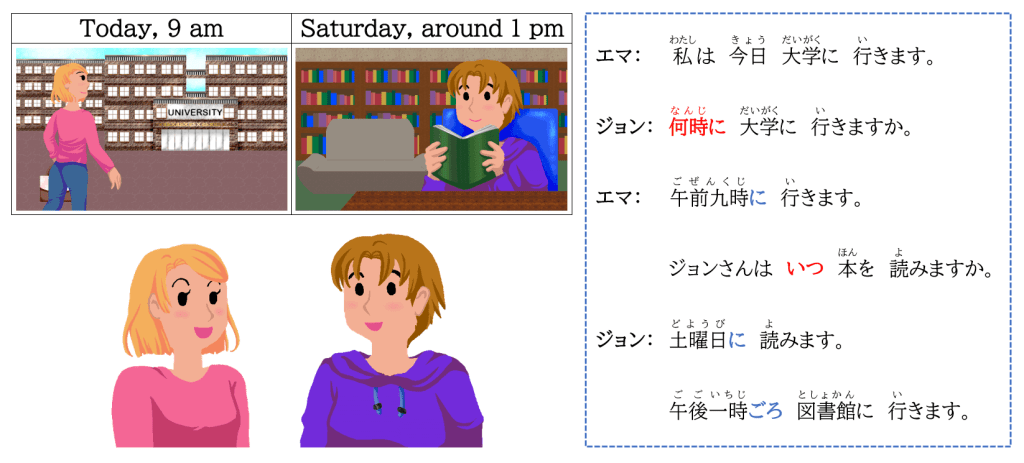
The particle used with time is に.
The point is that some words use the particle に and some do not.
Look again at the example above.
今日(きょう) is a word that expresses time, but it does not have the particle に.
However, the particle に is added to 午前(ごぜん)九時(くじ) and 土曜日(どようび).
The same applies to interrogatives.
何時(なんじ) becomes 何時(なんじ)に, but いつ doesn’t become いつに.
Learn the rules for identifying words with and without the particle に, and learn to say them correctly.
The sentence patterns in the examples are the blue ones: (subject / topic) は (time) に (place) に 行(い)きます and the question answer, (time) に verbます.
You can also change ‘(place) に’ part to ‘(place) で’ or add an object word.
I will introduce the details together with an explanation of the word order.
ごろ is very easy to use.
It is often used and convenient, so learn to use it!
Questions use the time interrogatives 何時(なんじ) and いつ.
The basic sentence pattern is (subject / topic) は 何時(なんじ)に/いつ verbますか.
The place word or object is inserted between the interrogative and the verb.
Pay attention to the rules for words with and without the particle に, and how to use 何時(なんじ)に and いつ, and practise a lot!
If you have a textbook, read the explanations of particles in the textbook.
| Second edition | Page 91: 3 Particles に (2) time |
| Third edition | Page 89: 3 Particles に (2) time |
Verb sentence pattern 4: (subject / topic) は (time) に verbます/ません
In the previous lesson, we studied the use of the particle に to indicate destination.
This time we will study the particle に, which indicates time.
The table below shows sentence patterns and examples using time.
| (subject / topic) は (time) に verbます/ません |
| Example: 私(わたし)は 午前(ごぜん)七時(しちじ)に 起(お)きます。 私(わたし)は 午後(ごご)八時(はちじ)に 寝(ね)ません。 |
| (subject / topic) は (time) verbます/ません |
| Example: 私(わたし)は 今日(きょう) 勉強(べんきょう)します。 私(わたし)は 週末(しゅうまつ) 勉強(べんきょう)しません。 |
| (subject / topic) は (time) に (object) を verbます/ません |
| Example: 私(わたし)は 午前(ごぜん)七時(しちじ)半(はん)に 朝(あさ)ご飯(はん)を 食(た)べます。 私(わたし)は 午後(ごご)十時(じゅうじ)に コーヒーを 飲(の)みません。 |
| (subject / topic) は (time) (object) を verbます/ません |
| Example: 私(わたし)は 明日(あした) 映画(えいが)を 見(み)ます。 私(わたし)は 朝(あさ) 新聞(しんぶん)を 読(よ)みません。 |
| (subject / topic) は (time) に (place) に/へ 行(い)きます/来(き)ます/帰(かえ)ります |
| Example: 私(わたし)は 午語(ごご)五時(ごじ)に うちに 帰(かえ)ります。 私(わたし)は 日曜日(にちようび)に 銀行(ぎんこう)へ 行(い)きません。 |
| (subject / topic) は (time) (place) に/へ 行(い)きます/来(き)ます/帰(かえ)ります |
| Example: 友達(ともだち)は 毎日(まいにち) うちに 来(き)ます。 私(わたし)は 今晩(こんばん) 友達(ともだち)の家(いえ)へ 行(い)きません。 |
Sentence patterns using (place) で are longer, so they will be explained together with the word order later on.
Look at the green time words in the examples, everyone.
All of these time words do not have the particle に.
Before you start practising sentence patterns, first learn the rules for words that require the particle に and words that do not require the particle に!
Time reference
In the example above, what time word is used with the particle に?
Specific time or days are used with the particle に, such as 午前(ごぜん)七時(しちじ) or 日曜日(にちようび).
In contrast, words without the particle に do not indicate a specific day, such as 今日(きょう) or 明日(あした), or they indicate repeated days rather than a single day, such as 毎日(まいにち) or 毎晩(まいばん).
The exceptions are 週末(しゅうまつ) and 朝(あさ).
These two words usually do not have the particle に, but they can.
Let’s divide the time words studied up to Lesson 3 into groups that use the particle に and those that do not.
Practice
Divide the words in the squares into groups ‘withに’, ‘without に’ and ‘with/without に’.
- 今(いま)
- 朝(あさ)
- 明日(あした)
- 今日(きょう)
- 今晩(こんばん)
- 週末(しゅうまつ)
- 土曜日(どようび)
- 日曜日(にちようび)
- 毎日(まいにち)
- 毎晩(まいばん)
| with に | without に | with/without に |
| specific time (午前(ごぜん)/午後(ごご)~時(じ)に) | ||
| day (~日(にち)に) | ||
| month (~月(がつ)に) | ||
| year (~年(ねん)に) | ||
You will learn how to say day, month, year and other calendar words in more detail in Lesson 4.
Check out the answers in the PDF below!
The answer PDF also contains words for other time periods using the Kanji characters 今 and 毎.
None of the words use the particle に.
These are words we will study later, so it’s okay if you don’t remember them yet!
If you have a textbook, also check the explanations in the textbook!
| Second edition | Pages 91 and 92: 4 Time Reference |
| Third edition | Page 90: 4 Time References |
Sentence pattern practice
Now let’s practise sentence patterns with time.
We will use the three sentence patterns below.
| Sentence pattern | (subject / topic) は (time) に/(time) verbます/ません |
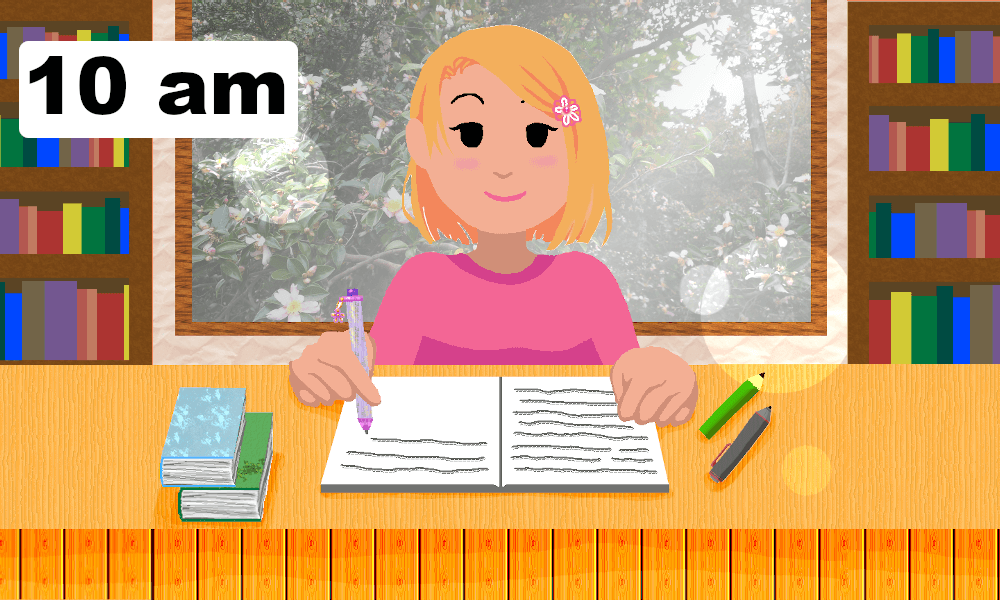 | エマさんは 午前(ごぜん)十時(じゅうじ)に 勉強(べんきょう)します。 |
| Sentence pattern | (subject / topic) は (time) に/(time) (object) を verbます/ません |
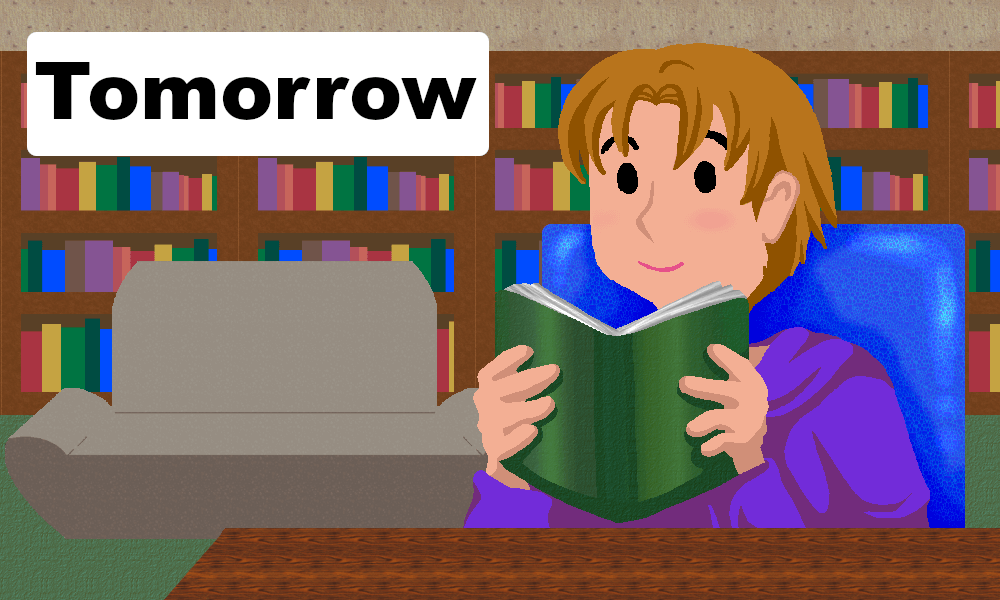 | ジョンさんは 明日(あした) 本(ほん)を 読(よ)みます。 |
| Sentence pattern | (subject / topic) は (time) に/(time) (place) に/へ 行(い)きます/来(き)ます/帰(かえ)ります |
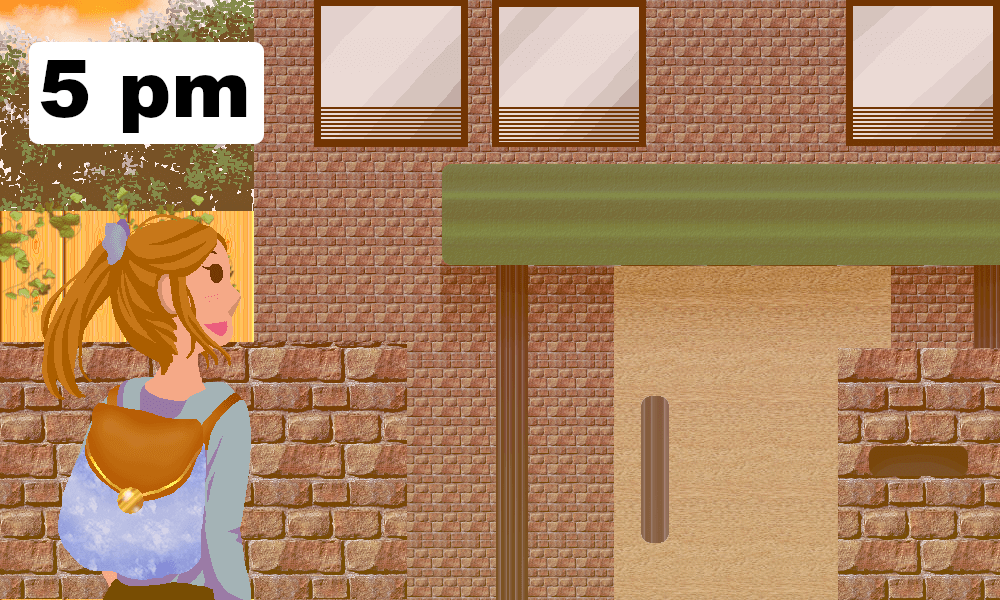 | サラさんは 午後(ごご)五時(ごじ)に うちに 帰(かえ)ります。 |
Watch out for the particle に and practise!
Practice
1. Below you will find Emma’s schedule. Let’s say it in Japanese.
Example: 7 am get up
エマさんは 午前(ごぜん)七時(しちじ)に 起(お)きます。
Emma’s schedule
| Example: 7 am | get up |
| 7.30 am | eat breakfast |
| 8 am | go to school |
| 12 pm | eat lunch |
| 1 pm | play tennis |
| 3.30 pm | drink coffee |
| 6 pm | return home |
| 7 pm | eat dinner |
| 8 pm | watch TV |
| 10 pm | read a book |
| 11 pm | go to sleep |
| tomorrow | go to the post office |
| Saturday | go on a date |
| Sunday | go to friend’s house |
2. Make a daily schedule for yourself as shown in the table above.
For practice 1, pay attention to ‘tomorrow’, ‘Saturday’ and ‘Sunday’.
Some words need the particle に and some don’t!
Check out the answers in the PDF below!
If you have a third edition textbook, do the exercises in the textbook!
| Third edition | Page 97: IV 何時に起きますか A |
Sentence pattern of questions
The sentence pattern for questions uses the question words 何時(なんじ)に or いつ.
何時(なんじ)に is used when asking about a specific time.
When answering, use (time) に verbます.

ジョンさんは 何時(なんじ)に 寝(ね)ますか。

午前(ごぜん)一時(いちじ)に 寝(ね)ます。
いつ is used when the time or day is not clear.
The particle に may or may not be added, depending on the time word in the answer.
ジョンさんは いつ 本(ほん)を 読(よ)みますか。
毎日(まいにち) 読(よ)みます。
エマさんは いつ 映画(えいが)を 見(み)ますか。
土曜日(どようび)に 見(み)ます。
Words without the particle に can be combined with a specific time.
You can also put words such as 今日(きょう) and 週末(しゅうまつ) without the particle に in front of the question words 何時(なんじ)に and いつ.
However, when combining words with the particle に with words from other time periods, の should be inserted between the words.
ジョンさんは 今日(きょう) 何時(なんじ)に 寝(ね)ますか。
午後(ごご)十一時(じゅういちじ)に 寝(ね)ます。
エマさんは 週末(しゅうまつ) いつ 勉強(べんきょう)しますか。
土曜日(どようび)の朝(あさ)に 勉強(べんきょう)します。
Now let’s practise asking questions using 何時(なんじ)に and いつ!
Practice
1. Look at the table below and answer the questions.
John’s schedule
| 7 am | get up |
| 7.30 am | eat breakfast |
| 8 am | go to work |
| 12 pm | eat lunch |
| 5 pm | return home |
| 6.30 pm | eat dinner |
| 8 pm | watch TV |
| 12 am | go to sleep |
- ジョンさんは 何時(なんじ)に 起(お)きますか。
- ジョンさんは 何時(なんじ)に 晩(ばん)ご飯(はん)を 食(た)べますか。
- ジョンさんは 何時(なんじ)に テレビを 見(み)ますか。
- ジョンさんは 何時(なんじ)に 寝(ね)ますか。
- ジョンさんは 何時(なんじ)に 仕事(しごと)に 行(い)きますか。
- ジョンさんは 何時(なんじ)に うちに 帰(かえ)りますか。
- ジョンさんは 何時(なんじ)に 朝(あさ)ご飯(はん)を 食(た)べますか。
- ジョンさんは 何時(なんじ)に 昼(ひる)ご飯(はん)を 食(た)べますか。
2. Look at the chart below to practise asking and answering questions.
Example: エマ / today / go to university
Q. エマさんは いつ 大学(だいがく)に 行(い)きますか。
A. 今日(きょう) 行(い)きます。
| Time/day | エマ | ジョン |
| today | go to university | go to the bank |
| 4 pm | go home | go to the café |
| tonight | watch a Japanese movie | study Japanese |
| tomorrow | go to the post office | go to a Japanese school |
| 11.30 am | eat lunch | listen to music |
| weekend | play tennis | read a book |
| every day | drink coffee | speak English |
3. Answer the questions.
- 何時(なんじ)に 起(お)きますか。
- 何時(なんじ)に 寝(ね)ますか。
- いつ 日本語(にほんご)を 勉強(べんきょう)しますか。
- いつ 映画(えいが)を 見(み)ますか。
When you’re done, check your answers in the PDF below!
If you have a textbook, do the exercises in it!
| Second edition | Page 98: II 何時に起きますか A |
| Third edition | Page 97: IV 何時に起きますか B |
ごろ
The word ごろ is used to indicate the approximate time.
You all practised how to say time in Lesson 1.
However, I think it was a little difficult to learn the rules for saying the minutes.
If you’re not quite sure whether to use ふん or ぷん, try ごろ!
Example: 1.23 am
→ 午前(ごぜん)一時(いちじ)ニ十分(にじゅっぷん)ごろ
→ 午前(ごぜん)一時(いちじ)二十五分(にじゅうごふん)ごろ
For example, 午前(ごぜん)一時(いちじ)二十三分(にじゅうさんぷん) is the correct answer.
However, it is hard to remember all the rules of the ふん/ぷん, so in my lessons I only taught three patterns of ごふん/じゅっぷん/はん, which end with the numbers 5, 0 and 30.
But if you use the ふん or ぷん rule that you remember and ごろ, you can express approximate time.
Not many people, when asked the time, will give an exact time, such as 今(いま)午前(ごぜん)十時(じゅうじ)二十一分(にじゅういっぷん)です.
It’s fine if you say, 今(いま)午前(ごぜん)十時(じゅうじ)ニ十分(にじゅっぷん)ごろです.
You can also answer the time-based questions that we are practising a lot this time by giving approximate times.
Not many people say, 午前(ごぜん)七時(しちじ)に起(お)きます and really get up at exactly 7 a.m., do they?
The word ごろ is very simple, as it is only added after the time.
Below are a few examples.
私(わたし)は 午前(ごぜん)七時半(しちじはん)ごろ 起(お)きます。
ジョンさんは 何時(なんじ)ごろ 起(お)きますか。
七時(しちじ)ごろ 起(お)きます。
The word ごろ can also be added after 何時(なんじ).
You do not need to add the particle に after ‘ごろ’.
There’s no practice in the textbooks, so let’s have a bit of practice here!
Practice
1. Use ごろ to tell the next time.
Example: 3.22 pm
午後(ごご)三時(さんじ)ニ十分(にじゅっぷん)ごろ
A. 5.09 am
B. 11.31 pm
C. 4.57 pm
D. 9.18 am
E. 6.46 pm
2. Use ごろ to answer the questions.
- 何時(なんじ)ごろ 寝(ね)ますか。
- 何時(なんじ)ごろ 日本語(にほんご)を 勉強(べんきょう)しますか。
See the PDF below for answers!
There is pair work in the textbook.
Practise the questions and answers by yourself or with someone else!
| Second edition | Page 98: II B |
| Third edition | Page 97: IV C |
Word order
Now you can say verb sentences with an object, place and time!
But when you want to say the object, place and time all in one sentence, in what order should you say them?
In Japanese, particles indicate word categories.
Therefore, as long as you use the correct particles, it is fine even if the word order is slightly different.
But of course there is a basic word order.
Please see the table below.
| Sentence pattern | (subject / topic) は (time) に (place) で (object) を verbます/ません |
| Example | 私(わたし)は 午前(ごぜん)九時(くじ)に うちで コーヒーを 飲(の)みます。 私(わたし)は 今日(きょう) 学校(がっこう)で 昼(ひる)ご飯(はん)を 食(た)べません。 |
| Sentence pattern | (subject / topic) は (time) に (place) に/へ 行(い)きます/来(き)ます/帰(かえ)ります |
| Example | 私(わたし)は 明日(あした) 日本(にほん)へ 帰(かえ)ります。 私(わたし)は 日曜日(にちようび)に 銀行(ぎんこう)に 行(い)きません。 |
The table above shows that both sentence patterns are arranged in the following order:
Subject / Topic → Time → Place → Object → Verb
This is the basic word order in Japanese.
The questions and answers are summarised below.
| 質問)しつもん) | 答(こた)え | |
| verb? | (subject / topic) は (time) に (place) で (object) を verbますか | はい、verbます いいえ、verbません |
| Example | エマさんは 今日(きょう) 学校(がっこう)で 本(ほん)を 読(よ)みますか。 | はい、読(よ)みます。 |
| time? | (subject / topic) は 何時(なんじ)に/いつ (place) で (object) を verbますか | (time) に verbます |
| Example | エマさんは いつ 学校(がっこう)で 本(ほん)を 読(よ)みますか。 | 今日(きょう) 読(よ)みます。 |
| place? | (subject / topic) は (time) に どこで (object) を verbますか | (place) で verbます |
| Example | エマさんは 今日(きょう) どこで 本(ほん)を 読(よ)みますか。 | 学校(がっこう)で 読(よ)みます。 |
| where to? | (subject / topic) は (time) に どこに/へ 行(い)きますか/来(き)ますか/帰(かえ)りますか | (place) に/へ 行(い)きます/来(き)ます/帰(かえ)ります |
| Example | エマさんは 今日(きょう) どこに 行(い)きますか。 | 学校(がっこう)に 行(い)きます。 |
| object? | (subject / topic) は (time) に (place) で 何(なに) を verbますか | (noun) を verbます |
| Example | エマさんは 今日(きょう) 学校(がっこう)で 何(なに)を 読(よ)みますか。 | 本(ほん)を 読(よ)みます。 |
| all? | (subject / topic) は 何時(なんじ)に/いつ どこで 何(なに)を しますか | (time) に (place) で (object) を verbます |
| Example | エマさんは いつ どこで 何(なに)を しますか。 | 今日(きょう) 学校(がっこう)で 本(ほん)を 読(よ)みます。 |
In Lesson 3, you will also practise sentences with frequency adverbs such as 時々(ときどき)(sometimes) and 全然(ぜんぜん)(not at all).
The word order of these adverbs will be explained later.
If you have a textbook, please also read the explanations in the textbook!
| Second edition | Pages 92 and 93: 6 Word Order |
| Third edition | Page 91: 7 Word Order |
Now let’s practise a long sentence with time, place and object all in one!
Practice
1. Make long sentences.
Example: エマ
エマさんは 今日(きょう) 学校(がっこう)で 日本語(にほんご)を 話(はな)します。
| people | time | place | object | verb |
| Example: エマ | today | school | Japanese | speak |
| (1) ジョン | 11.30 am | home | a hamburger | eat |
| (2) サラ | every day | café | coffee | drink |
| (3) たろう | tomorrow | America | N/A | go |
| (4) ユミ | Saturday | friend’s house | a Korean movie | watch |
| (5) アダム | tonight | home | sake | drink |
| (6) シン | morning | high school | Japanese | study |
| (7) ジャック | every night | home | British music | listen |
| (8) ゆきこ | weekend | school | tennis | do |
| (9) テオ | 4 pm | library | sports magazine | read |
| (10) カレン | today | university | English | speak |
2. Answer the questions.
- 午前(ごぜん)八時(はちじ)に カフェで 朝(あさ)ご飯(はん)を 食(た)べますか。
- 毎晩(まいばん) うちで 何(なに)を しますか。
- 明日(あした) どこへ 行(い)きますか。
- どこで 音楽(おんがく)を 聞(き)きますか。
- 何時(なんじ)に うちで 晩(ばん)ご飯(はん)を 食(た)べますか。
Read the questions carefully.
Pay attention to the 何(なに), どこ and 何時(なんじ) when answering the question.
If you do it slowly, you can do it!
When you’re done, check out the answers in the PDF below!
There are lots of exercises in the textbooks!
Please note that the illustrations for the exercises are on different pages.
| Second edition | Page 98: C |
| Third edition | Page 98: D |
Use all the time, place and object words to make long sentences.
The exercises in the third edition use the illustrations for I on page 94 and III A on page 96.
Use all the time, place and object words to make long sentences.
Summary quiz
We had lots of practice this time! Good job, everyone!
At the end of the lesson, take a summary quiz!
Quiz 1: Translate the following English sentences into Japanese.
- Emma studies history at university every day.
- John reads a book at the library on Saturdays.
- Sarah returns to Australia tomorrow.
- Yoshio drinks sake at home every night.
- Hanako will have dinner at a friend’s house today.
Quiz 2: Answer the following questions.
- 午前(ごぜん)八時(はちじ)に 何(なに)を しますか。
- 週末(しゅうまつ) どこに 行(い)きますか。
- 何時(なんじ)ごろ うちに 帰(かえ)りますか。
- 毎日(まいにち) どこで 昼(ひる)ご飯(はん)を 食(た)べますか。
- いつ うちで 日本語(にほんご)を 勉強(べんきょう)しますか。
That’s all for the quiz!
The questions are long and a bit difficult to answer.
First of all, let’s look at the question words, such as 何(なに), どこ and いつ.
If you can understand the question words, it will be easier to understand the meaning of the question.
Thank you to everyone who took the quiz! Answers will be announced in the next lesson.
If you have any questions, please leave a message using the contact form!
Homework
Workbook homework is on the following pages.
| Second edition | Pages 30 and 33 (Listening) |
| Third edition | Pages 35 and 39 (Listening) |
If you don’t have a workbook, do the homework below.
Download the Word or PDF version whichever you prefer!
Even if you have workbook homework to do, give it a go!
Check the answers in the workbook by looking at the answer book.
Answers to original homework assignments will be presented in the next lesson.
If you have any thoughts about the lessons or homework, please tell me!
In the next lesson, we will study expressions that invite someone to do something together.
The grammar is always very enjoyable when practised in class.
It’s easy and convenient, so I hope you learn it and use it!
Finally, additional practice is introduced.
This time, too, let’s use the sentence patterns we have studied to describe our day in Japanese.
This time, the sentences will be very long.
Example: 午前(ごぜん)七時(しちじ)に 起(お)きます。 → 午前(ごぜん)七時半(しちじはん)に うちで 朝(あさ)ご飯(はん)を 食(た)べます。 → 午前(ごぜん)八時(はちじ)に 学校(がっこう)に 行(い)きます。 → 午前(ごぜん)九時(くじ)に 学校(がっこう)で 日本語(にほんご)を 勉強(べんきょう)します。 → 午後(ごご)十二時(じゅうにじ)に カフェで 昼(ひる)ご飯(はん)を 食(た)べます → ……
You can make a lot of long sentences just by using the verb sentence patterns you’ve learnt so far!
Japanese isn’t hard once you learn the rules!
If you can use all the sentence patterns of verbs you have studied so far in Lesson 3, you will be able to talk about many things in Japanese with Japanese people more than you think!
You should try asking Japanese people questions that you have practised in your textbooks or questions that you have thought of yourself.
It’s more fun when you can talk, so please try to practise talking a lot!
Thank you for reading!
See you in the next lesson!
If you are interested in Japanese particles, read our blog!

For more lessons from Lesson 3, click here!

Click here to go to the Hiragana and Katakana, Kanji practice pages!


And be sure to check out the resources and practices on our Bookshelf page!

日本語(にほんご)のレッスン
みなさん、こんにちは!
前回(ぜんかい)のレッスンでは、場所(ばしょ)を使(つか)った動詞(どうし)の文型(ぶんけい)を練習(れんしゅう)しました。
これで、みなさんは「主語(しゅご) + 場所(ばしょ) + 目的語(もくてきご) + 動詞(どうし)」の文(ぶん)が言(い)えるようになりました!
今回(こんかい)は、時間(じかん)を使(つか)った動詞(どうし)の文型(ぶんけい)を勉強(べんきょう)します。
時間(じかん)と場所(ばしょ)と目的語(もくてきご)を全部(ぜんぶ)使(つか)った長(なが)い文型(ぶんけい)も少(すこ)し練習(れんしゅう)しますよ。
単語(たんご)の順番(じゅんばん)と助詞(じょし)に気(き)を付(つ)ければ、長(なが)い文(ぶん)でも難(むずか)しくないです。一緒(いっしょ)にがんばりましょう!
みなさんは、漢字(かんじ)を練習(れんしゅう)していますか。
ひらがなとカタカナだけでも日本語(にほんご)は書(か)けます。
でも、漢字(かんじ)を知(し)っているともっと便利(べんり)です。
日本人(にほんじん)でも難(むずか)しい漢字(かんじ)が書(か)けない人(ひと)は多(おお)いので、漢字(かんじ)が書(か)けなくてもいいです。でも、漢字(かんじ)が読(よ)めた方(ほう)がいいです。
日本語能力試験(にほんごのうりょくしけん) / JLPTに挑戦(ちょうせん)するつもりの人(ひと)は、ぜひ漢字(かんじ)の練習(れんしゅう)をしてください。
JLPT の N5 に挑戦(ちょうせん)するためには、『げんき1』の教科書(きょうかしょ)で勉強(べんきょう)する漢字(かんじ)は全部(ぜんぶ)覚(おぼ)えておいた方(ほう)がいいです。
たくさんあるので、少(すこ)しずつ勉強(べんきょう)して覚(おぼ)えましょう!
よかったら、漢字練習(かんじれんしゅう)のページを見(み)てみてください!
レッスンを始(はじ)める前(まえ)に、まず前回(ぜんかい)の宿題(しゅくだい)の答(こた)えを発表(はっぴょう)します。
WordとPDFを作(つく)ったので、答(こた)えを見(み)たい人(ひと)はダウンロードしてください!
レッスン29の宿題(しゅくだい)の答(こた)え
次(つぎ)に、前回(ぜんかい)のまとめのクイズの答(こた)えを発表(はっぴょう)します。
クイズの答(こた)えを見(み)なくてもいい人(ひと)は、スキップしてください。
前回(ぜんかい)のクイズも翻訳(ほんやく)と質問(しつもん)でした。
質問(しつもん)を聞(き)く時(とき)は、質問(しつもん)の単語(たんご)に注意(ちゅうい)しましょう。
「何(なに)」を使(つか)った質問(しつもん) → 目的語(もくてきご)を答(こた)えます。
「どこ」を使(つか)った質問(しつもん) → 場所(ばしょ)を答(こた)えます。
疑問詞(ぎもんし)がない質問(しつもん)は、「はい」か「いいえ」で答(こた)えます。
どんな質問(しつもん)も正(ただ)しく答(こた)えられるようにしましょう!
クイズ1:次(つぎ)の英語(えいご)の文(ぶん)を日本語(にほんご)に翻訳(ほんやく)してください。
- Emma reads an English book in the library.
エマさんは 図書館(としょかん)で 英語(えいご)の本(ほん)を 読(よ)みます。 - John goes to a Japanese language school.
ジョンさんは 日本語(にほんご)の学校(がっこう)に 行(い)きます。 - Sarah doesn’t eat ice cream at home.
サラさんは うちで アイスクリームを 食(た)べません。 - Yoshio comes to the university.
よしおさんは 大学(だいがく)に 来(き)ます。 - Hanako doesn’t drink green tea in a café.
はなこさんは カフェで お茶(ちゃ)を 飲(の)みません。
二番(にばん)の ‘Japanese language school’ は「日本語学校(にほんごがっこう)」でもいいです。
助詞(じょし)の「に」を「へ」に変(か)えてもいいです。
でも、助詞(じょし)の「を」は使(つか)えないので、「日本語(にほんご)の学校(がっこう)を行(い)きます」じゃないですよ。
三番(さんばん)は、否定文(ひていぶん)なので「verb ません」になります。
「うち」を「家(いえ)」に変(か)えてもいいです。
四番(よんばん)も、助詞(じょし)の「に」と「へ」のどちらを使(つか)ってもいいです。
五番(ごばん)の ‘café’ は「喫茶店(きっさてん)」でもいいです。
クイズ2:質問(しつもん)に答(こた)えましょう。
- うちで 何(なに)を しますか。
(noun) を verbます。
例(れい):映画(えいが)を 見(み)ます。 - どこで 映画(えいが)を 見(み)ますか。
(place) で verbます。
例(れい):友達(ともだち)のうちで 見(み)ます。 - 銀行(ぎんこう)に 行(い)きますか。
はい、行(い)きます。/いいえ、行(い)きません。 - 学校(がっこう)で 昼(ひる)ご飯(はん)を 食(た)べますか。
はい、食(た)べます。/いいえ、食(た)べません。 - カフェで 何(なに)を 飲(の)みますか。
(noun) を 飲(の)みます。
例(れい):コーヒーを 飲(の)みます。
答(こた)えの例(れい)は教科書(きょうかしょ)の単語(たんご)だけを使(つか)いましたが、ぜひ自分(じぶん)が使(つか)いたい単語(たんご)を使(つか)ってみてくださいね。
自分(じぶん)で調(しら)べるのは楽(たの)しいし、いい勉強(べんきょう)になりますよ!
それでは、動詞(どうし)の文型(ぶんけい)三回目(さんかいめ)のレッスンです!
今回(こんかい)は、前回(ぜんかい)勉強(べんきょう)した助詞(じょし)の「に」を使(つか)って、時間(じかん)を使(つか)った動詞(どうし)の文型(ぶんけい)を勉強(べんきょう)します。
時間(じかん)を使(つか)った文型(ぶんけい)では、単語(たんご)によって助詞(じょし)の「に」が要(い)らない時(とき)があります。
簡単(かんたん)に覚(おぼ)えられるルールを教(おし)えるので、心配(しんぱい)しなくて大丈夫(だいじょうぶ)ですよ!
時間(じかん)を使(つか)った文型(ぶんけい)の練習(れんしゅう)の後(あと)は、「目的語(もくてきご)」「場所(ばしょ)」「時間(じかん)」を全部(ぜんぶ)使(つか)った文型(ぶんけい)と語順(ごじゅん)について説明(せつめい)します。
長(なが)い文(ぶん)になるのでちょっと大変(たいへん)ですが、順番(じゅんばん)と助詞(じょし)だけ気(き)を付(つ)ければ間違(まちが)えません。
ゆっくりでいいので、長(なが)い文(ぶん)で話(はな)す練習(れんしゅう)もしてみましょう!
はじめに、今回(こんかい)のレッスンで使(つか)う時間(じかん)の単語(たんご)を覚(おぼ)えましょう!
教科書(きょうかしょ)の単語(たんご)のページは、下(した)のページです。
| 第二版(だいにはん) | 86ページと87ページ |
| 第三版(だいさんぱん) | 84ページと85ページ |
このレッスンで使(つか)う時間(じかん)の単語(たんご)だけ下(した)の表(ひょう)に書(か)きます。
単語(たんご)
| 日本語(にほんご) | 英語(えいご) |
| 明日(あした) | tomorrow |
| 今日(きょう) | today |
| 朝(あさ) | morning |
| 今晩(こんばん) | tonight |
| 毎日(まいにち) | every day |
| 毎晩(まいばん) | every night |
| 週末(しゅうまつ) | weekend |
| 土曜日(どようび) | Saturday |
| 日曜日(にちようび) | Sunday |
| いつ | When |
| ごろ | at about |
アクセントは人(ひと)や地方(ちほう)によって少(すこ)し違(ちが)います。
今回(こんかい)は、新(あたら)しい単語(たんご)がたくさんありますね。
練習(れんしゅう)でたくさん使(つか)って覚(おぼ)えましょう。
みなさん、第一課(だいいっか)で練習(れんしゅう)した時間(じかん)の言(い)い方(かた)を覚(おぼ)えていますか。
ずっと動詞(どうし)の練習(れんしゅう)をしていて忘(わす)れる人(ひと)が多(おお)いので、レッスンの前(まえ)に少(すこ)し復習(ふくしゅう)します。
動詞(どうし)のます形(けい)の変化(へんか)と、前回(ぜんかい)までに勉強(べんきょう)した文法(ぶんぽう)も少(すこ)し復習(ふくしゅう)しましょう!
復習(ふくしゅう)
1.時間(じかん)を日本語(にほんご)で言(い)ってください。
| A | 5.00 a.m. | G | 2.55 p.m. |
| B | 9.45 p.m. | H | 10.40 a.m. |
| C | 12.00 p.m. | I | 8.10 p.m. |
| D | 6.15 a.m. | J | 7.50 p.m. |
| E | 1.20 p.m. | K | 11.25 a.m. |
| F | 3.30 a.m. | L | 4.35 a.m. |
2.動詞(どうし)の辞書形(じしょけい)とます形(けい)を書(か)きましょう。
| English | dictionary form | masu form (affirmative) | masu form (negative) |
| to drink | |||
| to read | |||
| to get up | |||
| to listen to hear | |||
| to come | |||
| to study | |||
| to do | |||
| to see to look at to watch | |||
| to go | |||
| to speak to talk | |||
| to sleep to go to sleep | |||
| to eat | |||
| to go back to return |
3.質問(しつもん)に答(こた)えてください。
- 図書館(としょかん)で 何(なに)を しますか。
- どこで 日本語(にほんご)を 勉強(べんきょう)しますか。
- うちで 昼(ひる)ご飯(はん)を 食(た)べますか。
- どこへ 行(い)きますか。
- いま うちに 帰(かえ)りますか。
わからないところがあったら、教科書(きょうかしょ)や前(まえ)のレッスンで文法(ぶんぽう)をもう一度(いちど)チェックしましょう。
繰(く)り返(かえ)したくさん練習(れんしゅう)するのが大切(たいせつ)ですよ!
答(こた)えは下(した)のPDFでチェックできます!
それでは、今回(こんかい)のレッスンで勉強(べんきょう)する文型(ぶんけい)の例(れい)を見(み)てみましょう!
今回(こんかい)のレッスン
時間(じかん)と一緒(いっしょ)に使(つか)う助詞(じょし)は、「に」です。
ポイントは、助詞(じょし)の「に」を使(つか)う単語(たんご)と使(つか)わない単語(たんご)があることです。
上(うえ)の例(れい)をもう一度(いちど)見(み)てください。
「今日(きょう)」は時間(じかん)を表(あらわ)す単語(たんご)ですが、助詞(じょし)の「に」が付(つ)いていません。
でも、「午前(ごぜん)九時(くじ)」や「土曜日(どようび)」には助詞(じょし)の「に」が付(つ)いています。
疑問詞(ぎもんし)でも同(おな)じです。
「何時(なんじ)」は「何時(なんじ)に」ですが、「いつ」は「いつに」と言(い)いません。
助詞(じょし)の「に」が付(つ)く単語(たんご)と付(つ)かない単語(たんご)の見分(みわ)け方(かた)のルールを覚(おぼ)えて、正(ただ)しく言(い)えるようになりましょう。
例(れい)の中(なか)の文型(ぶんけい)は青(あお)で示(しめ)した「(subject / topic) は (time) に (place) に 行(い)きます」と質問(しつもん)の答(こた)えの「(time) に verbます」です。
「(place) に」を「(place) で」に変(か)えたり、目的語(もくてきご)を入(い)れたりもできます。
詳(くわ)しいことは、語順(ごじゅん)の説明(せつめい)と一緒(いっしょ)に紹介(しょうかい)するつもりです。
「ごろ」の使(つか)い方(かた)はとても簡単(かんたん)です。
よく使(つか)うし便利(べんり)なので、覚(おぼ)えて使(つか)ってみましょう!
質問(しつもん)は、時間(じかん)についての疑問詞(ぎもんし)の「何時(なんじ)」と「いつ」を使(つか)います。
基本(きほん)の文型(ぶんけい)は「(subject / topic) は 何時(なんじ)に/いつ verbますか」です。
「何時(なんじ)に/いつ」と動詞(どうし)の間(あいだ)に場所(ばしょ)の単語(たんご)や目的語(もくてきご)が入(はい)ります。
助詞(じょし)の「に」を使(つか)う単語(たんご)と使(つか)わない単語(たんご)のルールと、「何時(なんじ)に」と「いつ」の使(つか)い分(わ)けに注意(ちゅうい)しながら、たくさん練習(れんしゅう)しましょう!
教科書(きょうかしょ)がある人(ひと)は、教科書(きょうかしょ)にある助詞(じょし)の説明(せつめい)を読(よ)んでみましょう。
| 第二版(だいにはん) | 91ページ: 3 Particles に (2) time |
| 第三版(だいさんぱん) | 89ページ: 3 Particles に (2) time |
動詞(どうし)の文型(ぶんけい)4:(subject / topic) は (time) に verbます/ません
前回(ぜんかい)のレッスンでは、ゴールの場所(ばしょ)を示(しめ)す助詞(じょし)の「に」の使(つか)い方(かた)を勉強(べんきょう)しました。
今回(こんかい)は、時間(じかん)を示(しめ)す助詞(じょし)の「に」を勉強(べんきょう)します。
時間(じかん)を使(つか)った文型(ぶんけい)と例(れい)を下(した)の表(ひょう)にまとめますね。
| (subject / topic) は (time) に verbます/ません |
| 例(れい): 私(わたし)は 午前(ごぜん)七時(しちじ)に 起(お)きます。 私(わたし)は 午後(ごご)八時(はちじ)に 寝(ね)ません。 |
| (subject / topic) は (time) verbます/ません |
| 例(れい): 私(わたし)は 今日(きょう) 勉強(べんきょう)します。 私(わたし)は 週末(しゅうまつ) 勉強(べんきょう)しません。 |
| (subject / topic) は (time) に (object) を verbます/ません |
| 例(れい): 私(わたし)は 午前(ごぜん)七時(しちじ)半(はん)に 朝(あさ)ご飯(はん)を 食(た)べます。 私(わたし)は 午後(ごご)十時(じゅうじ)に コーヒーを 飲(の)みません。 |
| (subject / topic) は (time) (object) を verbます/ません |
| 例(れい): 私(わたし)は 明日(あした) 映画(えいが)を 見(み)ます。 私(わたし)は 朝(あさ) 新聞(しんぶん)を 読(よ)みません。 |
| (subject / topic) は (time) に (place) に/へ 行(い)きます/来(き)ます/帰(かえ)ります |
| 例(れい): 私(わたし)は 午語(ごご)五時(ごじ)に うちに 帰(かえ)ります。 私(わたし)は 日曜日(にちようび)に 銀行(ぎんこう)へ 行(い)きません。 |
| (subject / topic) は (time) (place) に/へ 行(い)きます/来(き)ます/帰(かえ)ります |
| 例(れい): 友達(ともだち)は 毎日(まいにち) うちに 来(き)ます。 私(わたし)は 今晩(こんばん) 友達(ともだち)の家(いえ)へ 行(い)きません。 |
「(place) で」を使(つか)った文型(ぶんけい)は長(なが)くなるので、後(あと)で語順(ごじゅん)と一緒(いっしょ)に説明(せつめい)します。
みなさん、例(れい)の中(なか)にある緑色(みどりいろ)の時間(じかん)の単語(たんご)を見(み)てください。これらの時間(じかん)の単語(たんご)は、全部(ぜんぶ)助詞(じょし)の「に」が付(つ)いていません。
文型(ぶんけい)の練習(れんしゅう)を始(はじ)める前(まえ)に、まず助詞(じょし)の「に」が要(い)る時間(じかん)の単語(たんご)と助詞(じょし)の「に」が要(い)らない単語(たんご)のルールを覚(おぼ)えましょう!
助詞(じょし)の「に」と使(つか)う時間(じかん)の単語(たんご)のルール
上(うえ)の例(れい)で、助詞(じょし)の「に」と一緒(いっしょ)に使(つか)っている時間(じかん)の単語(たんご)は、どんな単語(たんご)でしょう。
「午前(ごぜん)七時(しちじ)」や「日曜日(にちようび)」のように、特定(とくてい)の時間(じかん)や日(ひ)が助詞(じょし)の「に」と使(つか)われていますね。
助詞(じょし)の「に」を使(つか)わない単語(たんご)は、「今日(きょう)」や「明日(あした)」のように特定(とくてい)の日(ひ)じゃなかったり、「毎日(まいにち)」や「毎晩(まいばん)」のように一日(いちにち)だけじゃなかったりします。
でも、「週末(しゅうまつ)」と「朝(あさ)」は特別(とくべつ)です。
「週末(しゅうまつ)」と「朝(あさ)」は、たいてい助詞(じょし)の「に」を付(つ)けませんが、付(つ)けてもいいです。
第三課(だいさんか)までに勉強(べんきょう)した時間(じかん)の単語(たんご)を、助詞(じょし)の「に」と使(つか)うものと使(つか)わないものでわけてみましょう。
練習(れんしゅう)
四角(しかく)の中(なか)の単語(たんご)を 「with に」「without に」「with/without に」のグループに分(わ)けましょう。
- 今(いま)
- 朝(あさ)
- 明日(あした)
- 今日(きょう)
- 今晩(こんばん)
- 週末(しゅうまつ)
- 土曜日(どようび)
- 日曜日(にちようび)
- 毎日(まいにち)
- 毎晩(まいばん)
| with に | without に | with/without に |
| specific time (午前(ごぜん)/午後(ごご)~時(じ)に) | ||
| day (~日(にち)に) | ||
| month (~月(がつ)に) | ||
| year (~年(ねん)に) | ||
日(ひ)、 月(つき)、 年(とし)などのカレンダーの言(い)い方(かた)は、第四課(だいよんか)で詳(くわ)しく勉強(べんきょう)します。
下(した)のPDFで答(こた)えをチェックしましょう!
答(こた)えのPDFには、漢字(かんじ)の「今」と「毎」を使(つか)った他(ほか)の時間(じかん)の単語(たんご)も書(か)きました。
全部(ぜんぶ)助詞(じょし)の「に」を使(つか)いません。
後(あと)で勉強(べんきょう)する単語(たんご)なので、まだ覚(おぼ)えなくても大丈夫(だいじょうぶ)ですよ!
教科書(きょうかしょ)がある人(ひと)は、教科書(きょうかしょ)の説明(せつめい)もチェックしましょう!
| 第二版(だいにはん) | 91ページと92ページ: 4 Time Reference |
| 第三版(だいさんぱん) | 90ページ: 4 Time References |
文型(ぶんけい)の練習(れんしゅう)
それでは、時間(じかん)の文型(ぶんけい)を練習(れんしゅう)しましょう。
下(した)の三(みっ)つの文型(ぶんけい)を使(つか)います。
| 文型(ぶんけい) | (subject / topic) は (time) に/(time) verbます/ません |
| エマさんは 午前(ごぜん)十時(じゅうじ)に 勉強(べんきょう)します。 |
| 文型(ぶんけい) | (subject / topic) は (time) に/(time) (object) を verbます/ません |
| ジョンさんは 明日(あした) 本(ほん)を 読(よ)みます。 |
| 文型(ぶんけい) | (subject / topic) は (time) に/(time) (place) に/へ 行(い)きます/来(き)ます/帰(かえ)ります |
| サラさんは 午後(ごご)五時(ごじ)に うちに 帰(かえ)ります。 |
助詞(じょし)の「に」に気(き)を付(つ)けて、練習(れんしゅう)してみましょう!
練習(れんしゅう)
1.下(した)にエマさんのスケジュールがあります。日本語(にほんご)で言(い)ってみましょう。
例(れい):7 am get up
エマさんは 午前(ごぜん)七時(しちじ)に 起(お)きます。
Emma’s schedule
| Example: 7 am | get up |
| 7.30 am | eat breakfast |
| 8 am | go to school |
| 12 pm | eat lunch |
| 1 pm | play tennis |
| 3.30 pm | drink coffee |
| 6 pm | return home |
| 7 pm | eat dinner |
| 8 pm | watch TV |
| 10 pm | read a book |
| 11 pm | go to sleep |
| tomorrow | go to the post office |
| Saturday | go on a date |
| Sunday | go to friend’s house |
2.上(うえ)の表(ひょう)のように、自分(じぶん)の一日(いちにち)のスケジュールを言(い)ってみましょう。
1の練習(れんしゅう)は、 ‘tomorrow’ ‘Saturday’ ‘Sunday’ に注意(ちゅうい)です。
助詞(じょし)の「に」が要(い)る単語(たんご)と要(い)らない単語(たんご)がありますよ!
それでは、下(した)のPDFで答(こた)えをチェックしてみましょう!
第三版(だいさんぱん)の教科書(きょうかしょ)がある人(ひと)は、教科書(きょうかしょ)にある練習(れんしゅう)をしましょう!
| 第三版(だいさんぱん) | 97ページ: IV 何時に起きますか A |
質問(しつもん)の文型(ぶんけい)
質問(しつもん)の文型(ぶんけい)は、「何時(なんじ)に」か「いつ」を使(つか)います。
「何時(なんじ)に」は特定(とくてい)の時間(じかん)を聞(き)く時(とき)に使(つか)います。
答(こた)える時(とき)は、「(time) に verbます」で答(こた)えます。
ジョンさんは 何時(なんじ)に 寝(ね)ますか。
午前(ごぜん)一時(いちじ)に 寝(ね)ます。
「いつ」は、時間(じかん)や日(ひ)がよくわからない時(とき)に使(つか)います。
答(こた)えの時間(じかん)の単語(たんご)によって、助詞(じょし)の「に」が付(つ)いたり、付(つ)かなかったりします。
ジョンさんは いつ 本(ほん)を 読(よ)みますか。
毎日(まいにち) 読(よ)みます。
エマさんは いつ 映画(えいが)を 見(み)ますか。
土曜日(どようび)に 見(み)ます。
助詞(じょし)の「に」が付(つ)かない単語(たんご)と、特定(とくてい)の時間(じかん)を組(く)み合(あ)わせて言(い)うこともできます。
疑問詞(ぎもんし)の「何時(なんじ)」や「いつ」の前(まえ)にも、助詞(じょし)の「に」が付(つ)かない「今日(きょう)」や「週末(しゅうまつ)」のような単語(たんご)を入(い)れることができます。
でも、助詞(じょし)の「に」が付(つ)く単語(たんご)と他(ほか)の時間(じかん)の単語(たんご)を組(く)み合(あ)わせる時(とき)は、単語(たんご)と単語(たんご)の間(あいだ)に「の」を入(い)れます。
ジョンさんは 今日(きょう) 何時(なんじ)に 寝(ね)ますか。
午後(ごご)十一時(じゅういちじ)に 寝(ね)ます。
エマさんは 週末(しゅうまつ) いつ 勉強(べんきょう)しますか。
土曜日(どようび)の朝(あさ)に 勉強(べんきょう)します。
それでは、「何時(なんじ)」と「いつ」を使(つか)った質問(しつもん)を練習(れんしゅう)しましょう!
練習(れんしゅう)
1.下(した)の表(ひょう)を見て、質問(しつもん)に答(こた)えてください。
John’s schedule
| 7 am | get up |
| 7.30 am | eat breakfast |
| 8 am | go to work |
| 12 pm | eat lunch |
| 5 pm | return home |
| 6.30 pm | eat dinner |
| 8 pm | watch TV |
| 12 am | go to sleep |
- ジョンさんは 何時(なんじ)に 起(お)きますか。
- ジョンさんは 何時(なんじ)に 晩(ばん)ご飯(はん)を 食(た)べますか。
- ジョンさんは 何時(なんじ)に テレビを 見(み)ますか。
- ジョンさんは 何時(なんじ)に 寝(ね)ますか。
- ジョンさんは 何時(なんじ)に 仕事(しごと)に 行(い)きますか。
- ジョンさんは 何時(なんじ)に うちに 帰(かえ)りますか。
- ジョンさんは 何時(なんじ)に 朝(あさ)ご飯(はん)を 食(た)べますか。
- ジョンさんは 何時(なんじ)に 昼(ひる)ご飯(はん)を 食(た)べますか。
2.下(した)の表(ひょう)を見(み)て、質問(しつもん)と答(こた)えを練習(れんしゅう)しましょう。
例(れい): エマ / today / go to university
Q. エマさんは いつ 大学(だいがく)に 行(い)きますか。
A. 今日(きょう) 行(い)きます。
| Time/day | エマ | ジョン |
| today | go to university | go to the bank |
| 4 pm | go home | go to the café |
| tonight | watch a Japanese movie | study Japanese |
| tomorrow | go to the post office | go to a Japanese school |
| 11.30 am | eat lunch | listen to music |
| weekend | play tennis | read a book |
| every day | drink coffee | speak English |
3.質問(しつもん)に答(こた)えてください。
- 何時(なんじ)に 起(お)きますか。
- 何時(なんじ)に 寝(ね)ますか。
- いつ 日本語(にほんご)を 勉強(べんきょう)しますか。
- いつ 映画(えいが)を 見(み)ますか。
できたら、下(した)のPDFで答(こた)えをチェックしてみましょう!
教科書(きょうかしょ)がある人(ひと)は、教科書(きょうかしょ)にある練習(れんしゅう)をしましょう!
| 第二版(だいにはん) | 98ページ: II 何時に起きますか A |
| 第三版(だいさんぱん) | 97ページ: IV 何時に起きますか B |
ごろ
「ごろ」はだいたいの時間(じかん)を言(い)う時(とき)に使(つか)います。
みなさんは、一課(だいいっか)で時間(じかん)の言(い)い方(かた)を練習(れんしゅう)しましたね。
でも、分(ふん)のルールがちょっと難(むずか)しかったと思(おも)います。
「ふん」か「ぷん」かよくわからない時(とき)は、「ごろ」を使(つか)ってみましょう!
例(れい):1.23 am
→ 午前(ごぜん)一時(いちじ)ニ十分(にじゅっぷん)ごろ
→ 午前(ごぜん)一時(いちじ)二十五分(にじゅうごふん)ごろ
例(れい)は「午前(ごぜん)一時(いちじ)二十三分(にじゅうさんぷん)」が正解(せいかい)です。
でも、「ふん/ぷん」のルールを全部(ぜんぶ)覚(おぼ)えるのは大変(たいへん)なので、私(わたし)のレッスンでは5,0,30の数字(すうじ)で終(お)わる「ごふん/じゅっぷん/はん」の三(さん)パターンしか教(おし)えませんでした。
でも、自分(じぶん)が覚(おぼ)えている「ふん」か「ぷん」のルールと「ごろ」を使(つか)えば、だいたいの時間(じかん)は表現(ひょうげん)できます。
時間(じかん)を聞(き)かれた時(とき)に「今(いま)午前(ごぜん)十時(じゅうじ)二十一分(にじゅういっぷん)です」と答(こた)える人(ひと)は、あまりいません。「今(いま)午前(ごぜん)十時(じゅうじ)ニ十分(にじゅっぷん)ごろです」と答(こた)えればいいです。
今回(こんかい)たくさん練習(れんしゅう)している時間(じかん)を使(つか)った質問(しつもん)でも、だいたいの時間(じかん)を答(こた)えて大丈夫(だいじょうぶ)です。
「午前(ごぜん)七時(しちじ)に起(お)きます」と言(い)って、本当(ほんとう)に午前(ごぜん)七時(しちじ)ちょうどに起(お)きる人(ひと)は、あまりいないと思(おも)います。
「ごろ」は時間(じかん)の後(あと)に付(つ)けるだけなので、とても簡単(かんたん)です。
下(した)に少(すこ)し例(れい)を書(か)きますね。
私(わたし)は 午前(ごぜん)七時半(しちじはん)ごろ 起(お)きます。
ジョンさんは 何時(なんじ)ごろ 起(お)きますか。
七時(しちじ)ごろ 起(お)きます。
「ごろ」は「何時(なんじ)」の後(あと)にも付(つ)けられます。
「ごろ」の後(あと)は、助詞(じょし)の「に」を付(つ)けなくていいです。
教科書(きょうかしょ)に練習(れんしゅう)がないので、ここで少(すこ)しだけ練習(れんしゅう)しましょう!
練習(れんしゅう)
1.「ごろ」を使(つか)って次(つぎ)の時間(じかん)を言(い)ってみましょう。
例(れい): 3.22 pm
午後(ごご)三時(さんじ)ニ十分(にじゅっぷん)ごろ
A. 5.09 am
B. 11.31 pm
C. 4.57 pm
D. 9.18 am
E. 6.46 pm
2.「ごろ」を使(つか)って質問(しつもん)に答(こた)えてください。
- 何時(なんじ)ごろ 寝(ね)ますか。
- 何時(なんじ)ごろ 日本語(にほんご)を 勉強(べんきょう)しますか。
答(こた)えは下(した)のPDFを見(み)てください!
教科書(きょうかしょ)にペアワークがあります。
質問(しつもん)と答(こた)えを自分(じぶん)で練習(れんしゅう)したり、誰(だれ)かと一緒(いっしょ)に練習(れんしゅう)したりしてください!
| 第二版(だいにはん) | 98ページ: II B |
| 第三版(だいさんぱん) | 97ページ: IV C |
語順(ごじゅん)
これで、みなさんは目的語(もくてきご)、場所(ばしょ)、時間(じかん)を使(つか)った動詞(どうし)の文型(ぶんけい)を言(い)えるようになりました!
でも、目的語(もくてきご)と場所(ばしょ)と時間(じかん)全部(ぜんぶ)を一(ひと)つの文(ぶん)で言(い)いたい時(とき)、どの順番(じゅんばん)で言(い)えばいいでしょうか。
日本語(にほんご)は助詞(じょし)が単語(たんご)のカテゴリーを示(しめ)してくれます。
なので、正(ただ)しい助詞(じょし)を使(つか)っていれば、語順(ごじゅん)が少(すこ)し違(ちが)っても大丈夫(だいじょうぶ)です。
でも、もちろん基本的(きほんてき)な語順(ごじゅん)はあります。
下(した)の表(ひょう)を見(み)てください。
| 文型(ぶんけい) | (subject / topic) は (time) に (place) で (object) を verbます/ません |
| 例(れい) | 私(わたし)は 午前(ごぜん)九時(くじ)に うちで コーヒーを 飲(の)みます。 私(わたし)は 今日(きょう) 学校(がっこう)で 昼(ひる)ご飯(はん)を 食(た)べません。 |
| 文型(ぶんけい) | (subject / topic) は (time) に (place) に/へ 行(い)きます/来(き)ます/帰(かえ)ります |
| 例(れい) | 私(わたし)は 明日(あした) 日本(にほん)へ 帰(かえ)ります。 私(わたし)は 日曜日(にちようび)に 銀行(ぎんこう)に 行(い)きません。 |
上(うえ)の表(ひょう)を見(み)ると、どちらの文型(ぶんけい)も
主語(しゅご)/トピック → 時間(じかん) → 場所(ばしょ) → 目的語(もくてきご) → 動詞(どうし)
の順番(じゅんばん)で並(なら)んでいますね。これが、日本語(にほんご)の基本的(きほんてき)な語順(ごじゅん)です。
質問(しつもん)と答(こた)えを下(した)にまとめます。
| 質問)しつもん) | 答(こた)え | |
| verb? | (subject / topic) は (time) に (place) で (object) を verbますか | はい、verbます いいえ、verbません |
| Example | エマさんは 今日(きょう) 学校(がっこう)で 本(ほん)を 読(よ)みますか。 | はい、読(よ)みます。 |
| time? | (subject / topic) は 何時(なんじ)に/いつ (place) で (object) を verbますか | (time) に verbます |
| Example | エマさんは いつ 学校(がっこう)で 本(ほん)を 読(よ)みますか。 | 今日(きょう) 読(よ)みます。 |
| place? | (subject / topic) は (time) に どこで (object) を verbますか | (place) で verbます |
| Example | エマさんは 今日(きょう) どこで 本(ほん)を 読(よ)みますか。 | 学校(がっこう)で 読(よ)みます。 |
| where to? | (subject / topic) は (time) に どこに/へ 行(い)きますか/来(き)ますか/帰(かえ)りますか | (place) に/へ 行(い)きます/来(き)ます/帰(かえ)ります |
| Example | エマさんは 今日(きょう) どこに 行(い)きますか。 | 学校(がっこう)に 行(い)きます。 |
| object? | (subject / topic) は (time) に (place) で 何(なに) を verbますか | (noun) を verbます |
| Example | エマさんは 今日(きょう) 学校(がっこう)で 何(なに)を 読(よ)みますか。 | 本(ほん)を 読(よ)みます。 |
| all? | (subject / topic) は 何時(なんじ)に/いつ どこで 何(なに)を しますか | (time) に (place) で (object) を verbます |
| Example | エマさんは いつ どこで 何(なに)を しますか。 | 今日(きょう) 学校(がっこう)で 本(ほん)を 読(よ)みます。 |
第三課(だいさんか)では「時々(ときどき)」や「全然(ぜんぜん)」のような副詞(ふくし)を使(つか)った文(ぶん)も練習(れんしゅう)します。
これらの副詞(ふくし)の語順(ごじゅん)については、あとで説明(せつめい)しますね。
教科書(きょうかしょ)がある人(ひと)は、教科書(きょうかしょ)の説明(せつめい)も読(よ)んでみてください!
| 第二版(だいにはん) | 92ページと93ページ: 6 Word Order |
| 第三版(だいさんぱん) | 91ページ: 7 Word Order |
それでは、時間(じかん)と場所(ばしょ)と目的語(もくてきご)が全部(ぜんぶ)入(はい)った長(なが)い文(ぶん)を練習(れんしゅう)してみましょう!
練習(れんしゅう)
1.長(なが)い文(ぶん)を作(つく)りましょう。
例(れい): エマ
エマさんは 今日(きょう) 学校(がっこう)で 日本語(にほんご)を 話(はな)します。
| people | time | place | object | verb |
| Example: エマ | today | school | Japanese | speak |
| (1) ジョン | 11.30 am | home | a hamburger | eat |
| (2) サラ | every day | café | coffee | drink |
| (3) たろう | tomorrow | America | N/A | go |
| (4) ユミ | Saturday | friend’s house | a Korean movie | watch |
| (5) アダム | tonight | home | sake | drink |
| (6) シン | morning | high school | Japanese | study |
| (7) ジャック | every night | home | British music | listen |
| (8) ゆきこ | weekend | school | tennis | do |
| (9) テオ | 4 pm | library | sports magazine | read |
| (10) カレン | today | university | English | speak |
2.質問(しつもん)に答(こた)えてください。
- 午前(ごぜん)八時(はちじ)に カフェで 朝(あさ)ご飯(はん)を 食(た)べますか。
- 毎晩(まいばん) うちで 何(なに)を しますか。
- 明日(あした) どこへ 行(い)きますか。
- どこで 音楽(おんがく)を 聞(き)きますか。
- 何時(なんじ)に うちで 晩(ばん)ご飯(はん)を 食(た)べますか。
質問(しつもん)をよく読(よ)みましょう。
「何(なに)」「どこ」「何時(なんじ)」に注意(ちゅうい)して答(こた)えましょう。
ゆっくりやれば、できますよ!
終(お)わったら、下(した)のPDFで答(こた)えをチェックしてみてください!
教科書(きょうかしょ)にも練習(れんしゅう)がたくさんありますよ!
イラストのページが違(ちが)うので気(き)を付(つ)けてくださいね。
| 第二版(だいにはん) | 98ページ: C |
| 第三版(だいさんぱん) | 98ページ: D |
時間(じかん)と場所(ばしょ)と目的語(もくてきご)を全部(ぜんぶ)使(つか)って、長(なが)い文(ぶん)を作(つく)ってください。
第三版(だいさんぱん)の練習(れんしゅう)は、94ページの I のイラストと96ページの III A のイラストを使(つか)います。
時間(じかん)と場所(ばしょ)と目的語(もくてきご)を全部(ぜんぶ)使(つか)って、長(なが)い文(ぶん)を作(つく)ってください。
まとめのクイズ
今回(こんかい)もたくさん練習(れんしゅう)しました!おつかれさまでした!
レッスンの最後(さいご)に、まとめのクイズに挑戦(ちょうせん)しましょう!
クイズ1:次(つぎ)の英語(えいご)の文(ぶん)を日本語(にほんご)に翻訳(ほんやく)してください。
- Emma studies history at university every day.
- John reads a book at the library on Saturdays.
- Sarah returns to Australia tomorrow.
- Yoshio drinks sake at home every night.
- Hanako will have dinner at a friend’s house today.
クイズ2:質問(しつもん)に答(こた)えましょう。
- 午前(ごぜん)八時(はちじ)に 何(なに)を しますか。
- 週末(しゅうまつ) どこに 行(い)きますか。
- 何時(なんじ)ごろ うちに 帰(かえ)りますか。
- 毎日(まいにち) どこで 昼(ひる)ご飯(はん)を 食(た)べますか。
- いつ うちで 日本語(にほんご)を 勉強(べんきょう)しますか。
クイズは以上(いじょう)です!
質問(しつもん)が長(なが)くてちょっと難(むずか)しいですね。
まずは「何(なに)」「どこ」「いつ」などの疑問詞(ぎもんし)を見(み)つけましょう。
疑問詞(ぎもんし)がわかると、質問(しつもん)の答(こた)えがわかると思(おも)います。
クイズに挑戦(ちょうせん)してくれたみなさん、ありがとうございます!答(こた)えは次(つぎ)のレッスンで発表(はっぴょう)します。
何(なに)か質問(しつもん)があったら、お問(と)い合(あ)わせフォームからメッセージをお願(ねが)いします!
宿題(しゅくだい)
ワークブックの宿題(しゅくだい)は、下(した)のページです。
| 第二版(だいにはん) | 30ページと33ページ (Listening) |
| 第三版(だいさんぱん) | 35ページと39ページ (Listening) |
ワークブックがない人(ひと)は、下(した)の宿題(しゅくだい)をしてください。
WordとPDFのうち、好(す)きな方(ほう)をダウンロードしてください!
ワークブックの宿題(しゅくだい)がある人(ひと)も挑戦(ちょうせん)しましょう!
ワークブックの答(こた)えは、答(こた)えの本(ほん)を見(み)てチェックしてください。
オリジナルの宿題(しゅくだい)の答(こた)えは、次(つぎ)のレッスンで発表(はっぴょう)します。
レッスンや宿題(しゅくだい)についての感想(かんそう)があったら、教(おし)えてくださいね!
次(つぎ)のレッスンでは、誰(だれ)かを誘(さそ)う表現(ひょうげん)を勉強(べんきょう)します。
クラスで練習(れんしゅう)すると、いつもとても楽(たの)しい文法(ぶんぽう)です。
簡単(かんたん)で便利(べんり)なので、ぜひ覚(おぼ)えて使(つか)って欲(ほ)しいです!
最後(さいご)に、もう一(ひと)つ練習(れんしゅう)があります。
今回(こんかい)も、勉強(べんきょう)した文型(ぶんけい)を使(つか)って自分(じぶん)の一日(いちにち)を日本語(にほんご)で言(い)ってみましょう。
今回(こんかい)は文(ぶん)がとても長(なが)くなりますね。
例(れい):午前(ごぜん)七時(しちじ)に 起(お)きます。 → 午前(ごぜん)七時半(しちじはん)に うちで 朝(あさ)ご飯(はん)を 食(た)べます。 → 午前(ごぜん)八時(はちじ)に 学校(がっこう)に 行(い)きます。 → 午前(ごぜん)九時(くじ)に 学校(がっこう)で 日本語(にほんご)を 勉強(べんきょう)します。 → 午後(ごご)十二時(じゅうにじ)に カフェで 昼(ひる)ご飯(はん)を 食(た)べます → ……
これまでに勉強(べんきょう)した動詞(どうし)の文型(ぶんけい)だけで、たくさん長(なが)い文(ぶん)が作(つく)れますね!
日本語(にほんご)はルールを覚(おぼ)えれば難(むずか)しくないんですよ!
第三課(だいさんか)でこれまでに勉強(べんきょう)した動詞(どうし)の文型(ぶんけい)が全部(ぜんぶ)わかると、日本人(にほんじん)と日本語(にほんご)でいろいろ話(はな)せますよ!
教科書(きょうかしょ)で練習(れんしゅう)した質問(しつもん)や、自分(じぶん)で考(かんが)えた質問(しつもん)を聞(き)いてみるといいです。
話(はな)せるともっと楽(たの)しいので、ぜひたくさん話(はな)す練習(れんしゅう)をしてみてください!
最後(さいご)までお読(よ)みくださり、ありがとうございます!
次(つぎ)のレッスンで 、お会(あ)いしましょう!
日本語(にほんご)の助詞(じょし)について興味(きょうみ)がある人(ひと)は、ブログを読(よ)んでみてください!
第三課(だいさんか)の他(ほか)のレッスンはこちらからどうぞ!
ひらがな・カタカナ・漢字(かんじ)の練習(れんしゅう)はこちらです!