

The blog posts are available in English and Japanese. Read whichever you prefer!
ブログの記事は英語と日本語でご覧になれます。お好きな方をお読みください!
English article

Hello, everyone!
We have changed the date of the blog to every Saturday, as there is not enough time for preparation if the update day is Friday. I’ll keep trying my best to present you all with useful information, so please stay tuned!
Well, the theme this time is sushi! Do you like sushi?
Sushi is very popular in Australia, where I currently live. There is always at least one sushi restaurant in every shopping mall. There is probably not a town in Australia that doesn’t have even one sushi restaurant.
Before becoming a Japanese teacher, I worked for two years making sushi rolls at a sushi restaurant in a famous Australian shopping mall.
The restaurant is so popular that even now, almost three years after it opened, people still queue up to get in, so it was very busy at lunch and dinner time.
Drawing on my experience working in a very popular sushi restaurant, in this article I want to introduce you to Australian sushi culture and how to make a good makizushi!
First, a review of sushi basics!
The sushi in the photo at the beginning of this article is a sushi roll (makizushi). In Japan, it is sold everywhere including convenience stores. Sushi rolls are also popular in Australia, and you can see people eating them with their hands while still in a paper bag. It is one of the finger foods.
As Japanese people of course know, there are many types of sushi other than makizushi. I have made a simple table with illustrations below, so please have a look.
The letters in [] are the Rooma-ji (pronunciation of Japanese words expressed in the English alphabet). Below the Japanese is the English notation. (This may differ slightly from shop to shop.)

Although the type of sushi is the same in Japan and Australia, uramaki (uramaki means ‘rolls inside out’. In normal sushi rolls, the seaweed is on the outside, but in the uramaki, the seaweed is on the inside) are popular in Australia for their glamorous appearance. The restaurant where I worked served uramaki in the shop’s conveyor belt lane and on take-away.
For vegetarians and vegans, sushi and inari sushi with kakiage (vegetable tempura) were selling well. Inari sushi and kakiage were sometimes questioned about their ingredients, as if they were not yet well known.
What surprised me when customers requested it was the temakizushi without vinegared rice and the mini rolls without ingredients. I won’t comment on whether it is good or bad as it is up to the customer, but without sushi rice, the seaweed doesn’t stick to each other, so I couldn’t roll it well. (As an aside, when I worked at a ramen shop, I was once asked to take the noodles out of the ramen. There are all kinds of people out there.)
Mini rolls usually have only one type of filling, but I have been asked to make two types. I don’t recommend using two types of filling, as the filling is too much and the seaweed will crack.
Sushi in Australia
As you will notice from the photos in the article, Australian sushi has far fewer raw ingredients. Instead, fried foods, tuna salad and crab-flavoured fish cake salad are often used. Also, almost all sushi rolls use avocado as an ingredient. In the photo you can see a sushi roll with only avocado inside. It looks a bit shocking, but it is delicious.
The reason for the lack of raw fish is probably because people are not culturally accustomed to eating raw fish.
In terms of raw fish items, the restaurant where I worked provided salmon, tuna, kingfish, squid, octopus, scallops and blood clams/ark shells. Other items included prawns and sea eel, but these were heat-treated. Salmon is by far the most popular.
Incidentally, apparently octopus is not to everyone’s liking. I know an Australian who ate takoyaki without knowing anything about it and then regretted it when she found out it was octopus. This is another difference in food culture.
I mentioned earlier that avocado is often used in Australian sushi, but of course some people don’t like it. Requests for avocado-free and cucumber-free sushi were common. I have the feeling that a lot of people don’t like vegetables. Vegetables and fruit are cheap in Australia, but personally I think they taste better in Japan.
Then, one of the reasons sushi and Japanese food is so popular in Australia is because many foods are gluten-free.
When I was working in restaurants I was often asked if the food was gluten-free. I never really paid attention to it when I was in Japan, but I wonder if more and more people in Japan are paying attention to it these days.
Here’s a bit of advice for those who think sushi is healthy. Sushi rice contains a fair amount of sugar, so keep that in mind.
Direct from a former sushi roll maker! How to make a good makizushi
Now, as a former sushi roll maker, I’d like to show you how I proudly recommend making makizushi!
I have about two years’ experience, but I was told I was the best in the shop. It would be a shame to leave that skill behind, so I hope to pass it on to you and make it useful.
How to prepare the bamboo mat (makisu)

The bamboo mat used to make sushi rolls is called ‘makisu’.
When making sushi rolls, cover the entire mat with plastic wrap before use to prevent the sushi rice and ingredients from getting on the mat and soiling it. This makes it easier to clean up after use.
The instructions for preparing the makisu are shown in the image above. The seaweed is placed on the outer flat side of the bamboo. If both sides are rounded, like the one I bought, either side is fine. Place the seaweed on the side with the edges of the wrap stacked on top of each other.
How to make makizushi
Here I show you how to make makizushi like the ones pictured in the article.
In the image, the way the ingredients are placed on the left and right is slightly different in order to show both ways of making the ingredients pop out and the way of making them not pop out. The one with the filling popping out is less difficult. (If you think the filling is supposed to stay out, but it does, say you made it that way on purpose.)


When serving on a plate, show the cross-section of the sushi roll rather than both ends; when cutting into two equal portions, add more ingredients in the centre to make it look better when cut.
If you are making sushi rolls that are to be cut into smaller pieces, such as eight equal portions, fill the gaps between the two ends of the roll with sushi rice before cutting, to make it easier to cut.
If you want to put mayonnaise or other sauces inside the sushi roll, you can spread the sauce on top of the sushi rice and place the ingredients on top of it. (Not so common in Japan, but sauce is often used inside sushi rolls in Australia.)
Just in case you’re interested, I’ve also prepared a Word and PDF of the above image for you to download and use if you like!
How was it? I’m sure there are many ways to make sushi rolls introduced, but in my experience this method has been the least error-prone. If you have any suggestions or feedback, please let me know!
The method introduced here is the most basic way of making sushi rolls.
There are many other ways to make sushi that could be used at a sushi party, such as how to make mini rolls that form a flower shape or how to make heart-shaped sushi rolls! I will introduce those in the next article. Please look forward to them!
Thank you for reading!
See you soon!
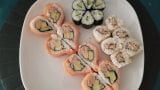
Click here to find out how to make the flower-shaped mini rolls and the heart-shaped rolls!
Why not read other articles about Japanese culture? Check them out, if you like!



Read more articles about Australia here!


And there are even free original Japanese lessons!

日本語の記事
みなさん、こんにちは!
更新日が金曜日だと準備時間が足りないので、ブログの更新日を毎週土曜日に変更しました。これからもがんばってみなさんの役に立つ情報を紹介していきたいと思うので、引き続きよろしくお願いします!
さて、今回のテーマは寿司です!みなさんは、寿司が好きですか。
現在私が住んでいるオーストラリアでは、寿司は大人気です。どのショッピングモールに行っても必ず一つ以上は寿司屋さんがあります。一つも寿司屋さんがない町は無いのではないかと思うほど何処にでもお店があります。
日本語教師になる前、私は二年ほどオーストラリアの有名なショッピングセンター内にある寿司屋さんで巻き寿司作りを担当していました。オープンから約三年経った今でも行列ができるほど人気のお店なので、ランチやディナータイムはすごく忙しかったです。
大人気のお寿司屋さんで働いていたその経験を生かして、この記事ではオーストラリアの寿司文化や、上手な巻きずしの作り方について紹介したいと思います!
まずは寿司の基礎知識のおさらいから!
この記事の冒頭に載せた写真の寿司は、巻き寿司ですね。日本だとコンビニでも売られています。オーストラリアでも巻き寿司は人気で、紙袋などにいれたまま手でもって食べている人を見かけます。いわゆるフィンガーフードの一つですね。
日本人のみなさんはもちろんご存知だと思いますが、寿司には巻き寿司以外にも色々種類があります。イラスト付きで簡単にまとめた表を作ってみたので、見てみてください。[]内はローマ字の読み仮名です。日本語の下にあるのが英語表記です。(お店によって若干違うかもしれません)
お寿司の種類は日本とオーストラリアで共通ですが、オーストラリアでは見た目が華やかな裏巻きが人気です。私が働いていたお店では、店内の回転ずしレーンとテイクアウトで裏巻きを提供していました。
ベジタリアンやビーガンの人には、かき揚げを使った寿司やいなり寿司などが売れていましたね。いなり寿司やかき揚げはまだあまり知られていないのか、原材料について質問されることも時々ありました。
お客さんからリクエストされて驚いたのは、手巻きずしの酢飯抜きと、細巻きの具なしですかね。本人の自由なので良し悪しは語りませんが、酢飯抜きだとのりがくっつかないので上手く巻けなかったです。(余談ですが、ラーメン屋さんで働いていた時はラーメンの麺抜きを頼まれたことがあります。色んな人がいますね)
細巻きは普通具が一種類だけですが、二種類にしてくれと頼まれたこともあります。具を二種類にすると中身が多すぎてのりが割れてしまうので、お勧めは出来ません。
オーストラリアの寿司事情
記事の写真をご覧になると気が付くと思いますが、オーストラリアのお寿司は生ものの具が圧倒的に少ないです。代わりに揚げ物やツナサラダ、カニ風味かまぼこのサラダなどをよく使います。あと、ほとんど何にでもアボカドを入れます。写真にはアボカドだけの巻き寿司が載っていますね。ちょっと衝撃的な見た目ですが、おいしいです。
生ものが少ない理由は、恐らく文化的に生の魚を食べ慣れていないからだと思います。生魚のネタだと、私が働いていたお店ではサーモン、マグロ、ハマチ、イカ、タコ、ホタテ、赤貝を提供していました。他にはエビ、アナゴなどもありましたが、こちらは加熱処理済みです。圧倒的に人気なのはサーモンだと思います。
ちなみに、どうやらタコは好き嫌いがわかれるみたいです。何も知らずにたこ焼きを食べた後で、タコだと知って後悔したオーストラリア人を知っています。これも食文化の違いですね。
先程オーストラリアの寿司にはよくアボカドが使われていると言いましたが、もちろん嫌いな人もいます。アボカド抜きときゅうり抜きのリクエストはよくありました。私の周囲の人だけかも知れませんが、野菜嫌いの人が多いような気がします。オーストラリアは野菜も果物も安いですが、個人的には日本の方がおいしいと思います。
それから、オーストラリアで寿司や日本食が人気な理由の一つには、グルテンフリーの食べ物が多いからと言うのもあるようです。レストランで働いていた時によくグルテンフリーかどうか質問を受けました。私は日本にいた時に気にしたことは無かったのですが、最近は日本でも気にする人が増えてきているのでしょうか。
ここで、寿司はヘルシーだと思っている方にちょっと忠告です。酢飯には結構な量の砂糖が含まれているので、その点は念頭においておくといいですよ。
元巻きずし担当直伝!上手な巻きずしの作り方
それでは、元巻き寿司担当の私が自信をもってお勧めする巻きずしの作り方を紹介したいと思います!経験は2年ほどですが、お店で一番上手だと太鼓判を押してもらいました。その技術を持て余すのは惜しいので、みなさんに伝授して役立てていただければと思います。
巻きすの準備の仕方

巻き寿司を作る時に使う竹の道具を「巻きす」と言います。
巻き寿司を作る時は、酢飯や具がついて巻きすが汚れないように、ラップで全体を覆ってから使います。そうすると使い終わって片付ける時も楽です。
巻きすの準備の仕方は上の画像の通りです。のりを乗せるのは竹の外側の平らな面です。私が買ったもののように両面が丸くなっている場合は、どちらでもいいです。ラップの端を重ねた方にのりを置きましょう。
巻き寿司の作り方
ここでは、記事の写真のような巻き寿司の作り方を紹介します。
画像では具を外に飛び出させる作り方と、外に出さない作り方を両方お見せするために左右で具の置き方が少し違います。具が外に出る方が難易度は低いです。(具を外に出さないつもりが出てしまった時は、あえてそのように作ったと言いましょう)


お皿に盛りつける際には、巻き寿司の両端ではなく断面を見せましょう。2等分に切る時は、切った時の見栄えがいいように中央の具を多めにします。8等分など細かくカットして食べる前提で作る場合は、切る前に巻き寿司の両端の隙間を酢飯で埋めると切りやすくなります。
マヨネーズなどのソースを巻き寿司の中に入れたい場合は、酢飯の上にソースを塗って、その上に具を置くといいですよ。(日本ではあまりないですが、オーストラリアでは巻き寿司の中にソースをよく使います)
一応上記の画像のWordとPDFも用意したので、よかったらダウンロードしてご利用ください!
いかがでしたか?巻き寿司の作り方はいろいろ紹介されていると思いますが、私の経験ではこの方法が一番失敗がなかったです。ご意見やご感想があればぜひお知らせください!
今回ご紹介したのは、最も基本的な巻き寿司の作り方です。
このほかにも、お花の形になる細巻きの作り方やハート型の裏巻きの作り方など、寿司パーティーで使えそうな寿司の作り方が色々あります!それらは次回紹介したいと思います。お楽しみに!
最後までお読みくださり、ありがとうございます!
それでは、また!
花形の細巻きとハートの裏巻きの作り方はこちらから!
日本の文化についての他の記事も読んでみませんか。よければチェックしてみてください!
オーストラリアに関する他の記事はこちらからお読みになれます!
無料のオリジナル日本語レッスンもありますよ!